
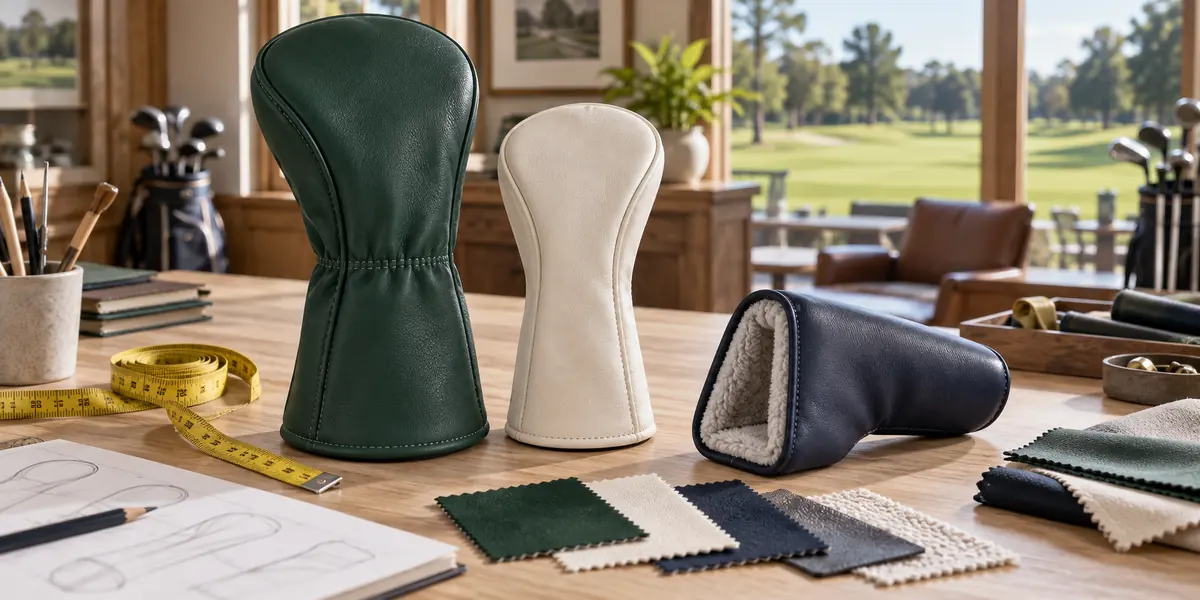
Source custom golf headcovers by approving the club fit, construction and artwork together. A quote becomes useful when it identifies exactly which cover, which decoration and which quantity it includes. Start with the club profiles your customers use, then compare samples and the complete delivered order.
For a pro shop, define the range and reorder needs. For a tournament, identify the player gift, event date and distribution plan. This guide takes you from that brief to sample approval, quotation comparison and delivery. Browse the PASSEN custom golf headcover range alongside the checklist.
Choose the club profile before the logo
| Profile | Information to supply | What the sample must demonstrate |
|---|---|---|
| Driver | Club model, head dimensions and opening needs | Easy removal and a secure fit without forcing the cover |
| Fairway wood or hybrid | Separate club types and identification numbers | Correct fit and clear identification for each cover |
| Blade putter | Head length, depth and shaft position | Closure clearance around the intended head and shaft |
| Mallet putter | Head outline, depth and shaft entry | Matching semicircle or square profile where offered |
| Iron set | Required club numbers and set contents | One correctly identified cover for every listed component |
A nominal driver volume is a starting point, not a complete fit specification. Likewise, two putters described as mallets can have different shapes and shaft positions. Supply photographs with dimensions and test the chosen sample on the actual club. External cover dimensions alone cannot establish usable internal space.
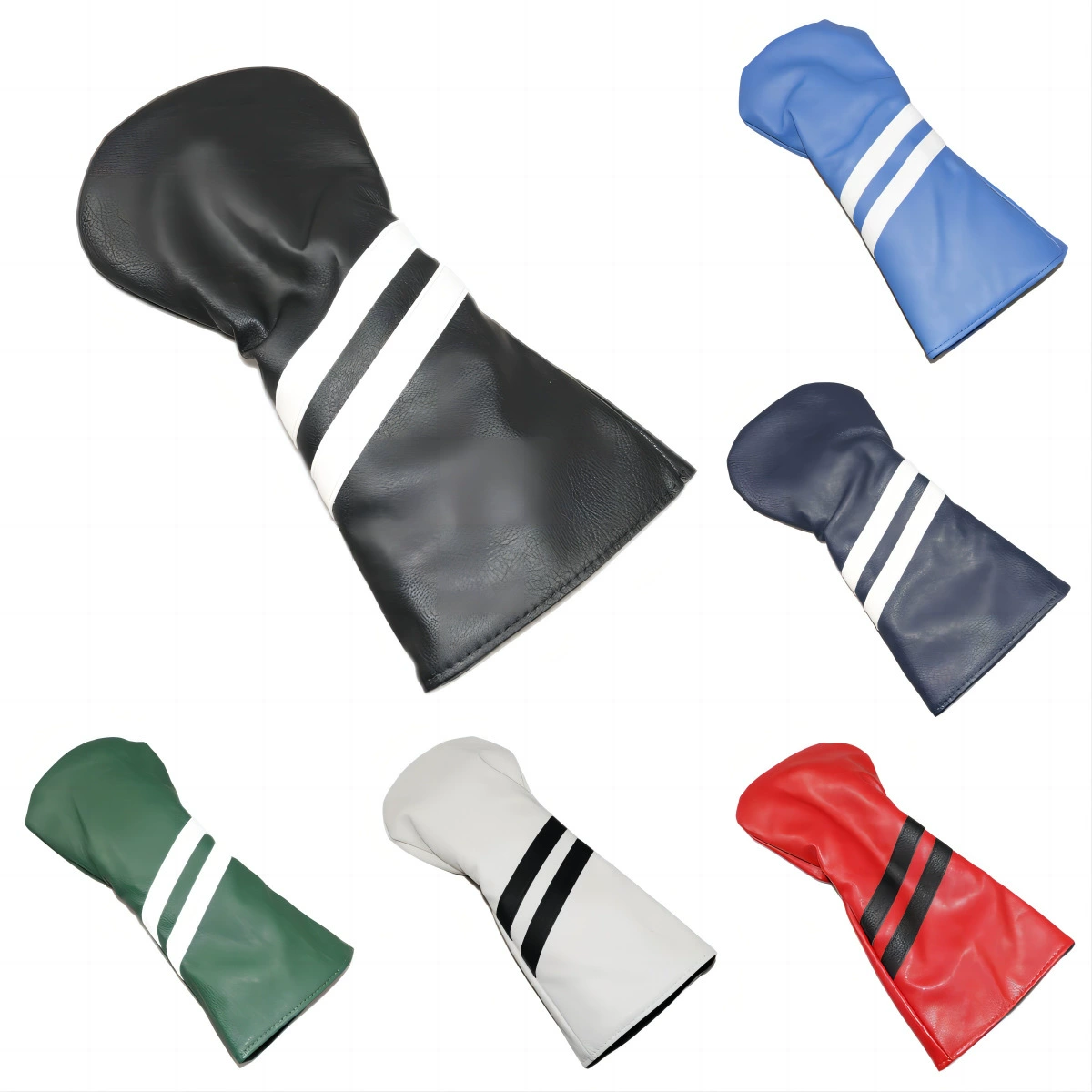
Two-stripe wood headcover
PU exterior and plush lining. Identify the intended wood profile and approve the opening fit.
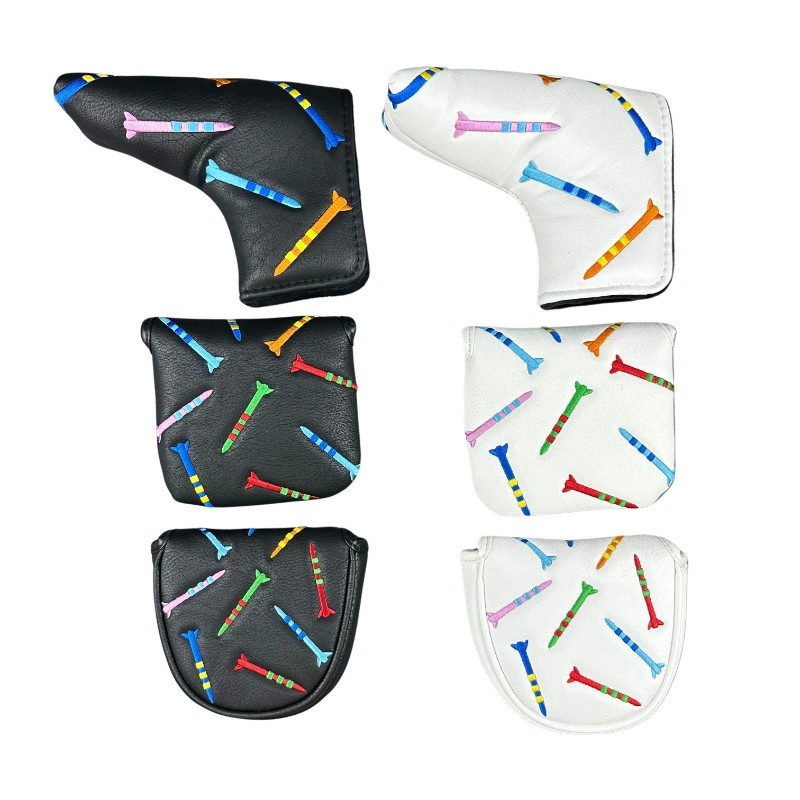
Rocket magnetic putter headcover
Compare the offered blade, semicircle mallet and square mallet profiles; specify each separately.
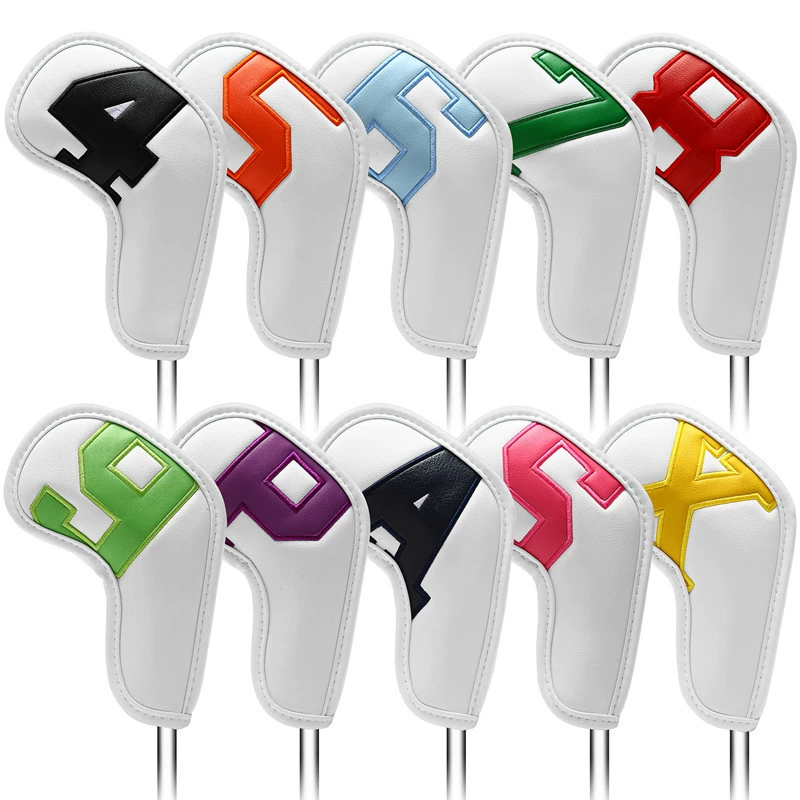
Numbered iron headcover set
List the club numbers and quantity of each cover in one complete set before comparing set prices.
Compare exterior, lining and construction
| Material route | Reason to consider it | Sample review |
|---|---|---|
| PU exterior | A smooth surface for coordinated colors and decoration | Surface feel, flexing, seam finish and artwork execution |
| Genuine leather | A leather texture and appearance for a selected program | Leather specification, thickness, finish and care needs |
| Neoprene | A flexible, close-fitting construction | Actual stretch, seam comfort and compatible decoration |
| Knit | A textured sock-style appearance | Yarn composition, recovery, opening retention and label or pattern detail |
These are material routes to discuss, not a statement that every listed SKU is available in every material. Compare the finished construction: exterior, padding, lining, seams and closure act together. Ask for the material specification and any relevant test information rather than assigning a fixed lifespan from the material name alone. See the headcover material comparison for a deeper review.
Three approvals that belong in every sample review
Complete configuration
Match every supplied cover to the club profile and the component list.
Artwork at actual size
Approve placement, lettering, thread or print colors and seam clearance.
Finished sample
Review fit, lining, closure and finish together before bulk production.
Choose decoration for the panel and artwork
Flat embroidery, raised embroidery, printing, woven labels and patches create different results. Fine lettering may need simplification; a large graphic may span several panels. Review the design on the chosen material at its finished size and include the back or side placement if those areas are branded.
Supply editable vector artwork where possible, plus a visual reference, color requirements and the intended logo dimensions. A mockup shows placement; a physical sample shows how the chosen process sits on the material. Embroidery also needs a production stitch file, so identify who prepares it and include its setup charge, if any, in the quotation. Use the headcover embroidery guide when stitch construction is the main decision.
Make quantity and price comparisons consistent
Standard PASSEN orders start at 200 per SKU. Logo, color or packaging customization starts at 500 per SKU. Sets are counted as sets; different SKUs do not combine to meet the minimum.
For example, 250 driver covers plus 250 putter covers do not meet a 500-per-SKU customization minimum. A numbered iron set is quoted per complete set, with its contents specified. Keep model, colorway and packaging versions separate in the order schedule.
| Quote line | What to record |
|---|---|
| Product | SKU, profile, material and quantity per SKU |
| Decoration | Method, positions, size, colors and setup charges |
| Presentation | Bag or box, insert, barcode and assembly |
| Quality approval | Sample reference, agreed checks and acceptance process |
| Delivery | Destination, shipping basis, carton dimensions and arrival requirement |
The existing volume references below apply to a standard PU driver-cover program with 3D embroidery. Confirm the specification and quotation scope before using a figure as your purchase cost; the set and single-cover columns use different units.
| Custom quantity | Per headcover reference | Driver + fairway + hybrid set | Production reference |
|---|---|---|---|
| 500 sets | $4-$6 | $12-$18 | 25-35 days |
| 2,000+ sets | $3-$5 | $9-$15 | 20-30 days |
A lower product price can be offset by larger cartons, additional logo locations or a more elaborate box. Compare the same delivery basis, currency and component count. Freight, import costs and receiving costs should be accounted for separately where they are not included in the quote.
Free samples and production planning
PASSEN offers free samples. Send the selected model, intended club profile and artwork requirements so the sample arrangement can be matched to your project. Approve the final sample reference in writing and keep photographs of the dimensions, decoration and pack contents.
The headcover sourcing schedule allows 7-14 days for sampling and 25-35 days for standard production from artwork approval for the applicable custom program. The existing overseas planning reference is 8-12 weeks overall, including consolidation and ocean shipping; a rush route can be 4-5 weeks using 20-day production and 7-day air freight. Identify the route and order conditions in the quotation. A production interval is not the same as a guaranteed arrival date.
Work backward from the day goods must be ready for sale or packed for the event. Put artwork approval, sample approval, production completion, inspection, dispatch and arrival on separate lines. If the date changes, review the affected stage before approving a new schedule.
Inspect the approved sample and the received order
- Fit each intended club, then remove and replace the cover to assess handling and retention.
- Check that the closure clears the shaft and that the lining and seams do not create an unwanted contact point.
- Compare artwork placement, spelling, numbers and colors with the approved proof.
- Check stitching ends, edges, surface appearance and the operation of the selected closure.
- Verify each set’s component list, individual labels, pack count and carton identification.
- Keep the approved sample and record any agreed changes for the production and reorder reference.
Agree the inspection and defect-reporting process before shipment, including what photographs or samples are needed if a discrepancy is found. Do not infer a universal warranty from another supplier’s policy. For repeat orders, refer to the approved specification and identify any material, artwork or packaging revision explicitly.
Plan packaging around the way the covers will be used
For retail, consider a visible product name, club profile and barcode. For an event, check how the gift will be handed to each player and whether the packaging should carry the event date. A gift box should be tested with the finished cover inside; squeezing it into a smaller box can affect presentation.
Request packed weight and carton dimensions for the actual configuration. Product reference weight is not shipping weight. When combining covers with towels or other accessories, specify whether packing and assembly are included. The accessory packaging guide provides a packing brief, and the tournament gift budget guide helps plan a complete player pack.
Frequently asked questions
What is the MOQ for custom golf headcovers?
Standard PASSEN orders start at 200 per SKU. Logo, color or packaging customization starts at 500 per SKU. Sets are counted as sets; different SKUs do not combine to meet the minimum.
Can one cover fit every driver or putter?
No universal fit should be assumed. Supply the club model, dimensions and shaft position where relevant, then approve the chosen cover on the intended club.
Can driver and putter quantities be combined to reach the MOQ?
Different SKUs do not combine. List each profile and its quantity separately, and identify the contents of any quoted set.
Are samples available?
PASSEN offers free samples. Include the model and sample requirements in your request, and approve the applicable production reference before the bulk order.
How long should I allow?
For the applicable headcover program, allow 7-14 days for sampling and 25-35 days for standard production. Shipping and approval stages are separate; confirm the complete route against your required arrival date.
What should I send for a quotation?
Send the model or club profiles, quantity per SKU, artwork, material and color preferences, packaging, destination and required arrival date.
Request a project quotation
Send the selected products, quantity per SKU, logo artwork, packaging, delivery destination and required arrival date.