MOQ Explained: What Custom Golf Accessories Really Cost at Every Order Size
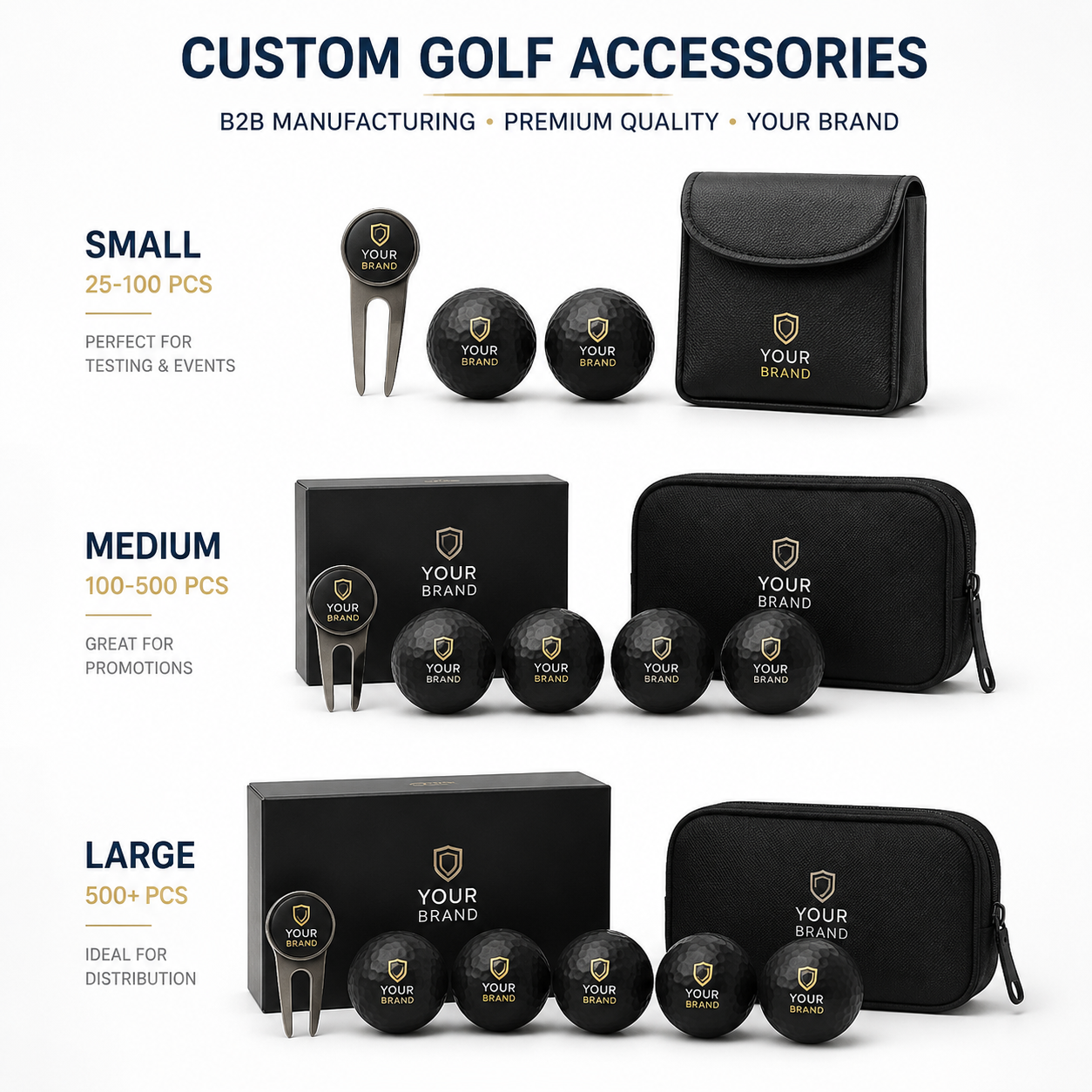
Ask a golf accessory manufacturer for a quote and the first number you hear is MOQ. Minimum Order Quantity. For most B2B buyers it sounds like a wall. 100 pieces. 200 pieces. 500. Before you have even discussed materials or colors or lead times, you are told how many you must buy.
MOQ is not a wall. It is a pricing signal. Once you understand what drives it and how to work with it, you stop overpaying for small runs and stop over-ordering inventory you do not need. This guide breaks down exactly what MOQ means in golf accessories, what drives per-unit cost at every quantity tier, and how to negotiate like a buyer who knows the factory floor.
Key Takeaways
- MOQ exists because of setup costs, not material costs. The factory needs to cover mold fees, machine configuration, and embroidery digitizing before the first piece comes off the line. Once setup is covered, every extra unit is pure margin.
- The 3 biggest cost drivers are setup, labor, and materials — in that order. At 50 units, setup can be 30-40% of your total cost. At 500 units, it drops to 5-8%. At 2,000 units, setup is a rounding error.
- Most MOQs are negotiable by 20-30% if you accept a per-unit price bump of 10-15%. The factory gets paid either way. They prefer larger orders but rarely turn down a smaller order with better margin.
- Mixed-product orders are the most underused negotiation tool. If your supplier's MOQ is 200 pieces for headcovers and 200 for towels, ordering 100 of each in one PO can often get you below the stated minimum because the total order value stays the same.
- The sweet spot for unit economics is 500-1,000 pieces across most golf accessory categories. Above 2,000 pieces, per-unit costs barely drop but inventory risk spikes sharply.
What MOQ Actually Means — And What It Does Not
MOQ is the smallest number of units a factory will produce for a given order. What it actually represents is the factory's break-even point on setup costs. Before a single golf towel is sewn or a single ball marker is stamped, the factory has already spent money.
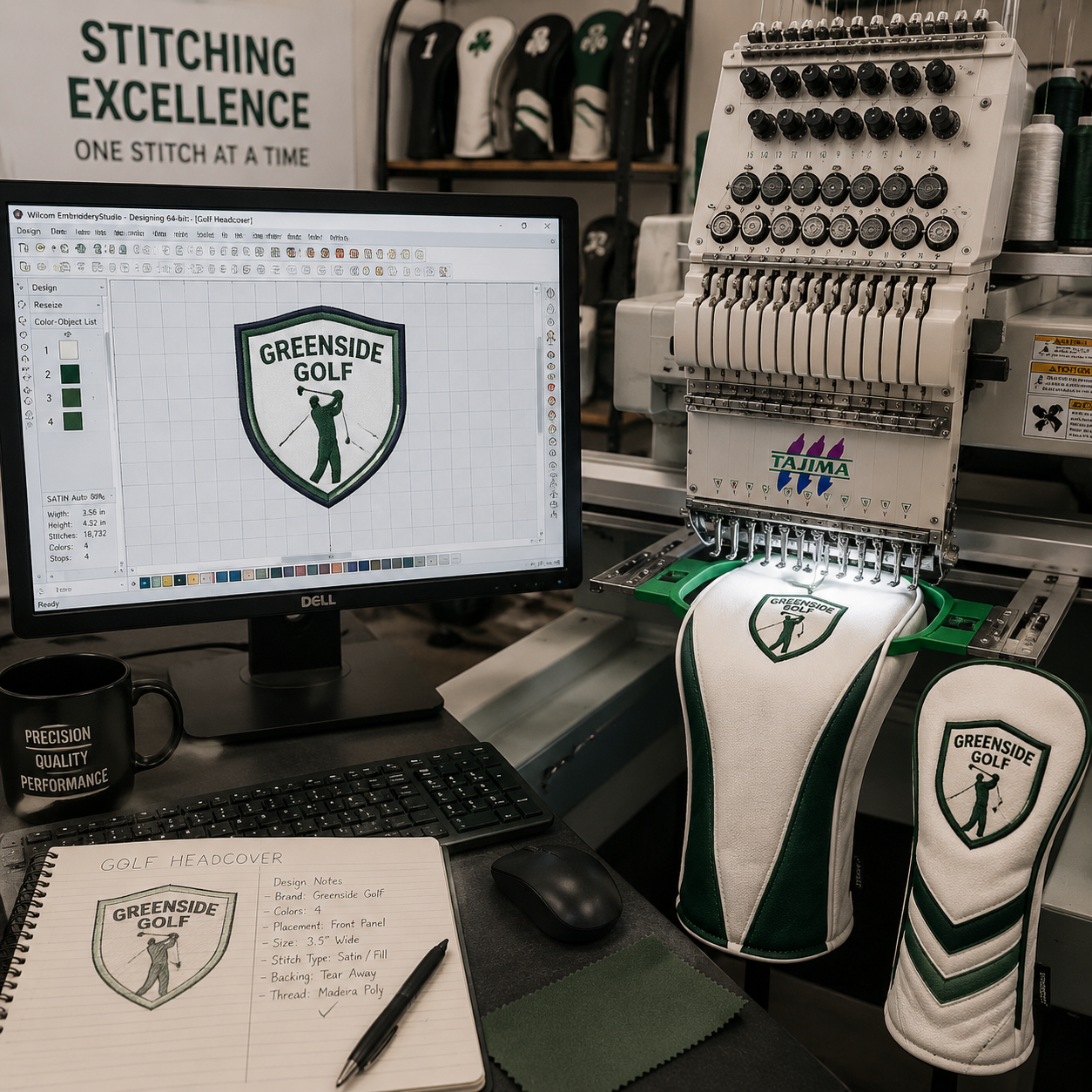
A die-cast mold for a custom ball marker costs $200-$800 to machine. An embroidery machine needs 20-30 minutes of digitizing and test runs before production starts. A screen printing setup requires screens to be coated, exposed, washed, and registered. These costs are fixed. Whether you order 50 pieces or 5,000, the mold costs the same. The digitizing costs the same. The setup costs the same.
MOQ is the factory telling you how many units they need to sell you before the per-unit price drops to a point where the math works for both sides.
What MOQ does not mean: the factory cannot produce fewer units. Almost every factory can and will produce below their stated MOQ. They just charge more per unit to make the total order value worth their time. A $1,500 order is a $1,500 order whether it is 50 pieces at $30 each or 200 pieces at $7.50 each.
Setup, Labor, and Materials: The 3 Cost Drivers
Understanding MOQ starts with understanding where your money goes. Every golf accessory order has three cost components. Their proportions shift dramatically as order size changes.
1. Setup Costs (Biggest Impact on Small Orders)
Setup costs are one-time expenses the factory incurs before production begins. They are the same whether you order 50 units or 5,000. Here is what they look like across common customization methods:
| Customization Method | Setup Cost | Setup Breakdown |
|---|---|---|
| Embroidery (3D/Flat) | $30-$80 | Digitizing fee: $20-$50. Test stitch run: $10-$30. |
| Die Casting (Ball Markers) | $200-$800 | Mold machining: $150-$600. Test shot run: $50-$200. |
| Screen Printing | $40-$100 | Screen making per color: $15-$30. Registration setup: $25-$70. |
| Laser Engraving | $10-$40 | File prep + machine programming. No physical mold. |
| Woven Labels | $30-$80 | Loom setup + test run. One-time per design. |
At 50 units with a $500 mold, setup costs $10 per piece. At 500 units, it costs $1 per piece. At 5,000 units, it costs $0.10. Same mold. Same setup. Ten times the order.
B2B Buyer Tip: Setup costs are often bundled into the per-unit price on quotes. Ask for the setup fee to be quoted separately as a line item. This tells you exactly what you are paying to open the factory door and lets you compare quotes more accurately. A supplier who refuses to break out setup costs is either inexperienced or hiding a margin pad.
2. Labor Costs (Falls Fastest with Volume)
Labor is the cost that drops fastest as order size increases. A worker setting up an embroidery machine spends time threading, loading the design, and running test stitches. On a 50-piece order, that setup labor might be 10-15 minutes. On a 5,000-piece order, it is the same 10-15 minutes. The productive labor — actually running the machine — happens whether you order 50 or 5,000 pieces. The non-productive setup labor gets diluted.
For manual work like hand-stitching leather headcovers or assembling gift boxes, labor costs stay relatively flat because each unit requires human time. This is why premium products with high hand-finishing content have smaller MOQ-driven price drops. The per-unit labor cost barely changes with volume.
3. Material Costs (Relatively Flat)
Material costs drop 10-20% at very high volumes (5,000+ units) because the factory can buy raw materials in bulk and negotiate better rates with their suppliers. For most B2B buyers ordering 100-1,000 units, material costs are nearly flat. A square meter of PU leather costs the factory roughly the same whether they are cutting 100 headcovers or 1,000.
The one exception is packaging. Custom-printed gift boxes, branded poly bags, and custom tins often have their own MOQ with the packaging supplier. A custom-printed box might have a 1,000-piece minimum regardless of how many headcovers you order. This is why many smaller orders use stock packaging with a sticker label instead of fully custom printed boxes.
Real Pricing by MOQ: What Your Order Actually Costs
Here is how per-unit pricing shifts across the four most common MOQ breakpoints for a standard custom golf accessory. Use this as a reference, not a price list. Every factory, material, and design will vary.
| Product | 50 units | 100 units | 500 units | 2,000 units |
|---|---|---|---|---|
| PU Leather Headcover (3D Embroidery) | $9-$12 | $7-$9 | $5-$7 | $4-$5 |
| Custom Golf Towel (Microfiber) | $4-$6 | $3-$5 | $2.50-$3.50 | $2-$2.50 |
| Zinc Alloy Ball Marker (Soft Enamel) | $2-$3 | $1.50-$2 | $1-$1.50 | $0.80-$1.20 |
| Tournament Gift Set (3-Piece) | $15-$22 | $12-$16 | $8-$12 | $6-$9 |
| Rubber Golf Tees (Printed Logo) | $0.15-$0.25 | $0.10-$0.15 | $0.06-$0.10 | $0.04-$0.06 |
The biggest price drop nearly always happens between 100 and 500 units. That is where setup costs cross the threshold from being a significant percentage of unit cost to a manageable one. Going from 500 to 2,000 units saves you another 15-25% per unit. Going from 2,000 to 5,000 saves maybe 5-10% more but multiplies your inventory risk by 2.5x. For most B2B buyers, 500-1,000 units is the economic sweet spot.
Mixed-Product Orders: The MOQ Hack Most Buyers Miss
The single most underused negotiation tactic in custom golf accessories is the mixed-product order. If a factory's stated MOQ is 200 pieces for headcovers and 200 for towels, they are usually willing to accept 100 headcovers plus 100 towels because the total order value stays similar.
Here is how it works. A factory's real minimum is not a piece count. It is a dollar threshold. For a manufacturer doing custom golf accessories, that threshold is typically $800-$2,000 in total order value for domestic factories and $500-$1,500 for overseas. Below that amount, the administrative overhead (invoicing, shipping documents, communication) eats too much of the margin.
If you want 80 headcovers and 60 towels and 40 ball markers, add up the total invoice. If it clears $1,200-$1,500, most factories will say yes regardless of the per-product MOQ. Frame the conversation around total order value, not per-SKU piece count.
Three things to ask when negotiating a mixed order:
- "What is the minimum total order value you can accept?" This gets the factory thinking in dollars, not pieces.
- "If I combine three products at 80 units each, can we count that as one order?" Frame the convenience — one invoice, one shipment, one set of customs documents.
- "What is the setup fee per additional product if I stay under the per-SKU MOQ?" Sometimes paying an extra $50-$100 per additional SKU is cheaper than hitting a 200-piece MOQ on a product you do not need 200 of.
Setup Fees: When to Pay Them and When to Push Back
Not every setup fee is legitimate. Some are baked into the per-unit cost and some are added as a separate line item to make the per-unit price look lower on the quote. Being able to tell the difference saves money.
Legitimate setup fees you should expect to pay:
- Mold/die costs for die-cast or injection-molded products (one-time, you own the mold)
- Embroidery digitizing (one-time, you own the file)
- Screen creation for screen printing (per-color, reusable for reorders)
- Custom packaging die lines for printed boxes (one-time)
Fees you should question or negotiate:
- "Sample fee" above $100 for a standard product sample (factory samples are a cost of doing business)
- "Design fee" for converting your vector file to their machine format (this is digitizing, see above)
- "Handling fee" or "service fee" on top of shipping (shipping should include handling)
- "Small order surcharge" as a flat fee rather than a per-unit price increase (flat fees hurt small orders disproportionately)
How to Negotiate a Lower MOQ Without Hurting the Relationship
Factories are businesses. They want orders. Here are five ways to get a lower MOQ that work because they make business sense for both sides:
- Offer to pay the setup fee upfront and separately. A factory that has already been paid for the mold is more flexible on the production run size. You derisk their upfront cost and they reward you with a lower piece-count minimum.
- Commit to a reorder schedule. "I will start with 100 pieces now and commit to 400 more within 12 months." If the factory trusts the follow-through, they will often waive the standard MOQ for the first run.
- Accept a longer lead time. Factories prefer large orders partly because they fill production slots efficiently. If your smaller order can be squeezed into a gap between two large runs, the factory earns margin they would have otherwise lost to idle time. Ask: "Can you slot this into an open production window?"
- Use stock blanks with custom decoration. The MOQ on the manufacturing side (molding, cutting, sewing) is often higher than the MOQ on the decoration side (embroidery, printing, engraving). If the factory already has a stock blank headcover or towel body, adding your logo is a decoration-only job with a much lower minimum.
- Pay a deposit larger than the standard 30%. A 50% deposit signals commitment and covers the factory's raw material costs. On a small order, this can be the difference between a factory saying yes or walking away.
FAQ
Why is the MOQ different for every product type?
Because the setup cost structure is different. A ball marker requires a $200-$800 mold. A golf towel requires maybe $40 in screen setup. The factory needs more units to break even when the setup cost is higher. Products with complex tooling (die-cast markers, injection-molded tees, custom metal divot tools) carry higher MOQs than products with simple decoration (screen-printed towels, embroidered patches).
Can I get a lower MOQ for my first order?
Yes. Most factories are willing to accept 50-70% of their stated MOQ on a first order, especially if you position it as a trial run with the potential for larger reorders. Be direct: "I would like to start with a trial order of 80 pieces before committing to a quarterly program." The factory hears "future business" and adjusts.
What if I only need 30 pieces for a small tournament?
Below 50 pieces, you are in small-batch territory. Your best options: (1) Find a domestic decorator who works with stock blanks — they can embroider or print on pre-made headcovers or towels with no manufacturing MOQ. (2) Ask your supplier if they have leftover stock from a previous run in a similar color — you can buy 30 pieces from someone else's 500-piece order. (3) Accept that per-unit pricing will be 2-3x the standard rate and budget accordingly. A $15 headcover at 30 pieces is still cheaper than ordering 200 pieces you cannot sell.
Do MOQs apply to reorders?
Usually yes, but reorders are cheaper and faster because the setup is already done. The mold exists. The embroidery file is digitized. The screens are on the shelf. A reorder of 100 pieces might carry the same MOQ requirement as the first order, but the per-unit price should be lower because the setup cost line item is zero. If a factory tries to charge you the same per-unit price on a reorder as on the initial order, push back. The setup costs are already covered.
MOQ Cheat Sheet: 5 Things to Remember
- MOQ is a pricing signal, not a rule. It tells you where the factory's breakeven point sits. Most MOQs are flexible by 20-30% with a per-unit price adjustment of 10-15%.
- Ask for setup costs as a separate line item. This is the single most powerful question in any custom manufacturing conversation. It tells you exactly what you are paying to open production and makes comparison shopping possible.
- The 100-to-500 unit range is where the best deals happen. Below 100 units, setup costs dominate. Above 500 units, per-unit prices approach their floor but inventory risk climbs.
- Combine products to reach the factory's dollar minimum. If MOQ is 200 pieces and you need 60 headcovers plus 80 towels, ask if a combined order value of $XXX clears their threshold.
- Reorder, do not over-order. Buying 500 units to get a $2 per-unit discount on a product you will only sell 200 of is a net loss. Run the math on total cost, not per-unit cost.
MOQ is one of the first things every new buyer worries about and one of the last things experienced buyers lose sleep over. Once you understand the three cost drivers and know which questions to ask, it stops being a mystery and starts being a tool. Use it to get the right quantity at the right price. Not the minimum quantity at a price that leaves you with a warehouse of unsold inventory.