

Standard golf tee length is not one universal size. Retail ranges commonly combine shorter tees for irons and fairway woods with longer tees that give modern drivers enough insertion depth and adjustable ball height. The useful choice depends on clubhead depth, turf firmness and how much of the tee remains above the ground.
This guide separates total tee length from playing height and shows how buyers can build a practical custom pack. For swing setup rather than product selection, read how high to tee up a driver.
Common standard golf tee length options
| Nominal length | Approximate metric length | Typical assortment role | Buyer checks |
|---|---|---|---|
| 2 1/8 in | 54 mm | Lower tee heights, irons, hybrids and some fairway woods | Insertion depth, head support and pack identification |
| 2 3/4 in | 70 mm | Versatile general-purpose format across mixed player needs | Usable height range, straightness and print area |
| 3 1/4 in | 83 mm | Longer driver setup and larger clubhead clearance | Stability in firm ground, shaft strength and color coding |
| 4 in maximum | 101.6 mm | Upper Rules limit, not a default retail recommendation | Rules compliance, actual finished length and intended use |
These are range-planning references rather than a promise that one length fits every golfer. The USGA equipment rule for tees sets a maximum length and other design restrictions, but it does not require every golfer to use the same size.
Total length is different from tee height
Total length is measured from the tip to the top of the cup. Tee height is the portion that remains above the turf after insertion. A 3 1/4 inch tee can be set low, while a 2 1/8 inch tee may not leave enough shaft in the ground for a tall driver setup.
Clubhead depth
Deeper driver faces usually need more available height. Smaller woods and irons normally use a lower ball position.
Turf condition
Firm ground may require more insertion force and a stronger tip. Soft ground may need additional insertion depth for stability.
Player consistency
Color bands or stepped references can help golfers repeat a chosen height, provided the decoration is approved and remains clear.
A buyer planning retail packs should therefore decide whether the product solves one use case or provides a mixed selection. A tournament pack may favor a simple general-purpose length, while a pro-shop assortment can separate driver and short-tee options.
Build a golf tee length range for the intended customer
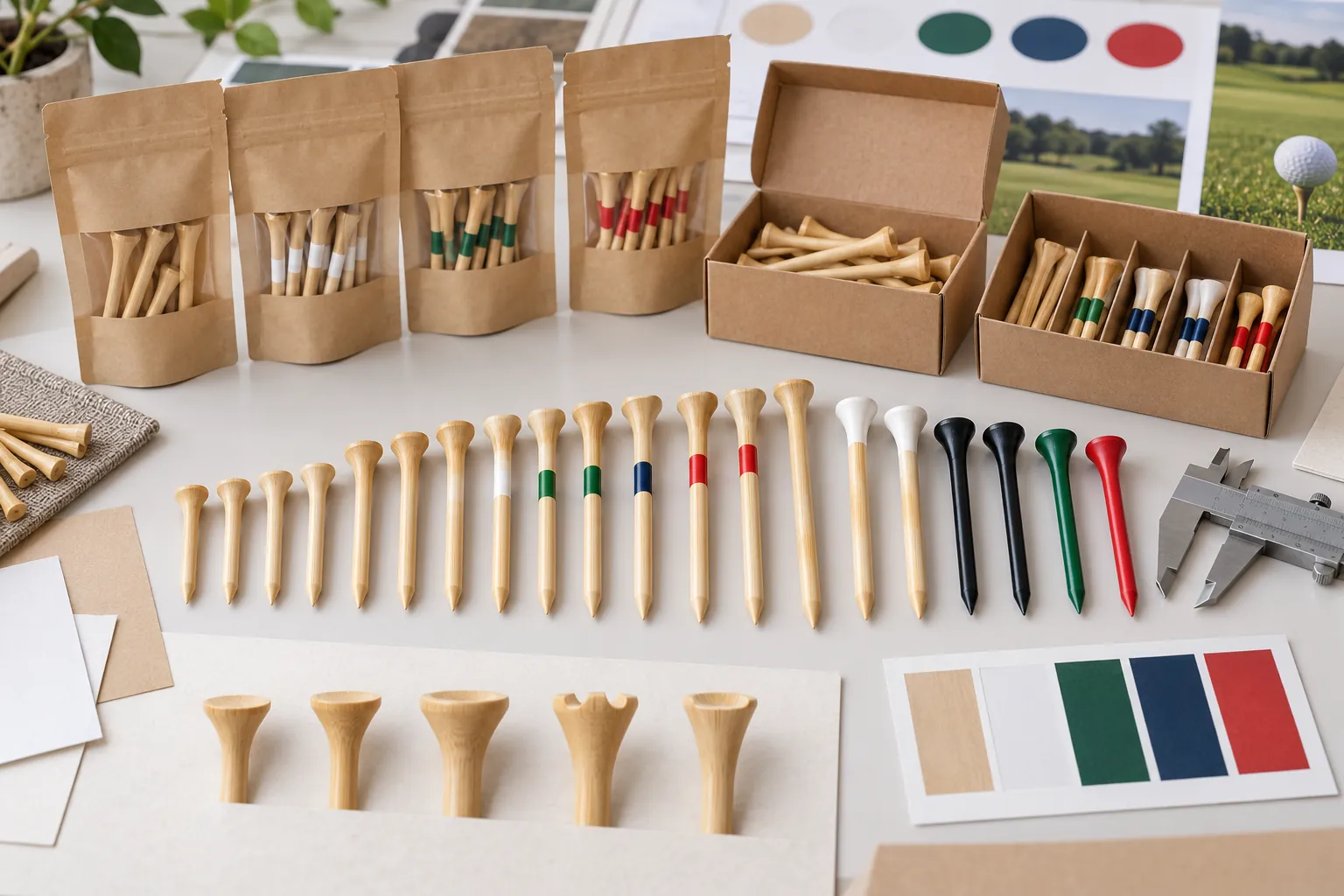
Start with the use case, then select lengths and pack counts. Do not begin by filling a box with every available format. Too many sizes can confuse the customer, complicate artwork and split inventory across unnecessary SKUs.
Single-length pack
Useful when the audience and club use are clear. Keep the printed length, quantity and material easy to verify on the package.
Driver and short mix
Combine a longer main tee with a smaller number of short tees. Separate the lengths visually through color, bands or compartments.
Event kit
Pair a practical tee count with markers or another accessory only after checking the complete assembled fit and packing list.
For branded bamboo formats, the custom bamboo golf tee pack guide covers counts, color bands and pack approval. Material comparisons are available in the bamboo, plastic and wooden tee guide.
Length affects printing and color bands
A longer shaft creates more decoration space, but usable artwork still depends on the printable area, taper and insertion zone. Keep logos and text away from the point and from areas likely to be hidden in the turf. Request a print-position drawing with dimensions before approving artwork.
Color bands can separate lengths or indicate a preferred insertion reference. Define band width, position, color reference and tolerance. Confirm the appearance on the actual material because bamboo grain, wood color and molded plastic can change how the same ink or coating looks.
Head shape, shaft and point still matter
Two tees with the same length can perform differently. Cup diameter and depth affect ball support, while shaft diameter and taper affect stiffness and insertion. The point geometry matters in firm ground, and the transition below the cup can become a stress area.
Inspect straightness, surface finish, splinters or flash, cup consistency and point shape. For a mixed pack, compare each length separately. A single approved long tee does not validate the shorter SKU if its tooling, taper or material differs.
Packaging a mixed tee assortment
State the quantity of each length per pack and per master carton. If the pack includes different colors or materials, list each combination as a line item. Use an insert, printed panel or clear window only when it helps the buyer understand the contents.
The package must also prevent tees from moving into the wrong compartment or damaging printed surfaces. Compare pouches, boxes, tubes and gift formats in the golf tee packaging guide.
How to approve standard golf tee length samples
Measure finished length
Check multiple pieces from each proposed SKU from tip to cup. Record the agreed tolerance and measuring method.
Review the full geometry
Inspect cup, shaft, taper and point rather than confirming length alone. Check straightness on a flat reference.
Test realistic insertion
Use representative turf conditions and confirm that each tee can reach its intended height while remaining stable.
Approve the decorated pack
Check print position, color bands, quantity by length, package labeling and carton pack-out together.
Keep a retained approved sample for every length and color. The packaging artwork should use the same nominal dimensions and units as the purchase specification.
Prepare a custom golf tee length brief
List every length, material, head and point shape, shaft diameter direction, colors, logo method, print position and quantity per pack. Define whether bands indicate size, preferred height or decoration only. Add the package format and required label or barcode information.
Include quantity per SKU, destination and required date. Buyers planning a broader range can review the custom golf tees page for material, branding and quotation requirements.
Frequently asked questions
What is the standard golf tee length?
There is no single universal length. Common retail options include 2 1/8, 2 3/4 and 3 1/4 inches, selected according to club use and preferred tee height.
What golf tee length is commonly used for a driver?
Longer tees such as 2 3/4 or 3 1/4 inches provide useful adjustment for modern drivers, but the correct playing height depends on the clubhead and golfer.
Are short golf tees only for irons?
No. Short tees can also suit hybrids and fairway woods when a low, stable setup is preferred.
What is the maximum tee length under the Rules of Golf?
The USGA Equipment Rules state that a tee must not be longer than 4 inches, or 101.6 mm.
Should a custom tee pack include multiple lengths?
Use multiple lengths when the pack has a clear driver-and-short-tee purpose. Identify the contents and quantities so customers understand the assortment.
What should a custom golf tee inquiry include?
Include length, material, geometry, colors, logo, print position, count per pack, packaging, quantity per SKU and destination.
Plan a practical golf tee length assortment
Send the intended customer, required lengths, material, colors, logo, pack counts, packaging, quantity per SKU and destination. PASSEN can review the assortment and sample details before quotation.