
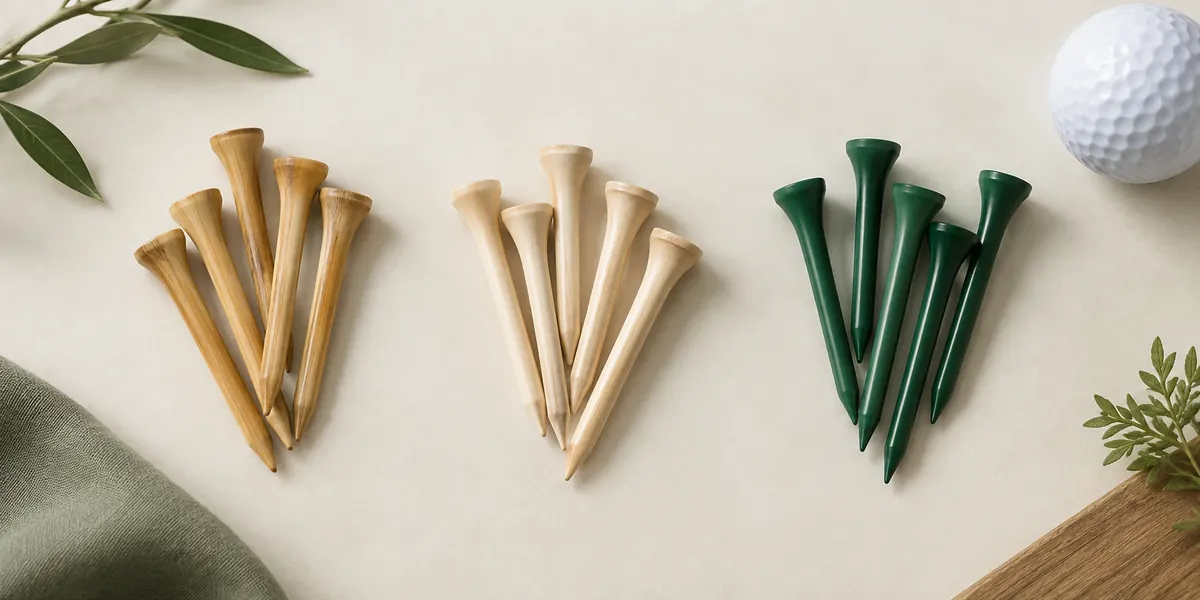
Compare golf tees by their complete design and intended use, not material alone. Bamboo, wood and plastic options can differ in length, head shape, shaft profile, finish and packing. Those differences matter when comparing ball support, handling, repeated use and logo presentation. There is no verified universal durability winner or distance improvement established in this guide.
Compare the three materials
| Material | What to compare | Avoid assuming |
|---|---|---|
| Bamboo | Finished shape, surface, breakage pattern and decoration | That bamboo is unbreakable or performs identically across suppliers |
| Wood | Wood specification, grain, finish and tee dimensions | That every wooden tee breaks on the first swing |
| Plastic | Polymer, profile, flexibility and repeated-use behavior | That all plastic tees share one durability or recycling outcome |
Bamboo and wood are not interchangeable material specifications even when catalog wording groups them together. Plastic is also a broad category: identify the actual formulation where it matters. Ask the quotation to name the selected material, rather than relying on an image or a loosely worded product title.
For a branded order, compare custom logo golf tees and confirm length, artwork, pack count and quantity per SKU before requesting a quotation.
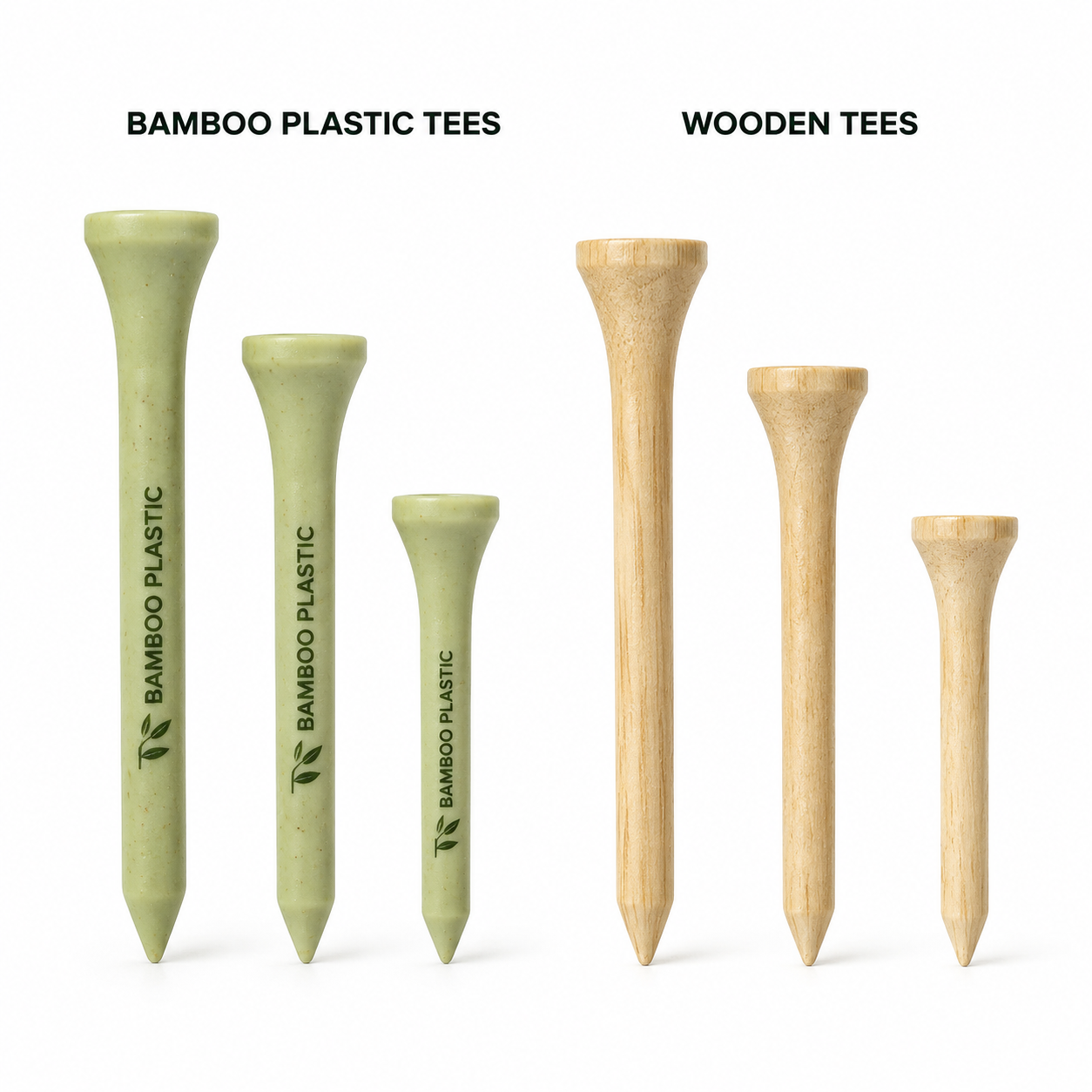
Wood vs plastic golf tees: compare the order, not only the material
Choose wood or bamboo when a natural-material presentation suits the program; compare plastic when the selected design's repeated-use behavior is important. There is no universal winner. Tee length, profile, finish, logo area, pack count and the course's requirements can change the decision.
| Buying question | Wood / bamboo | Plastic |
|---|---|---|
| What defines the material? | Name wood and bamboo separately; confirm finish and decoration. | Identify the selected polymer and molded construction where relevant. |
| What needs a sample? | Head shape, surface, logo clarity and breakage behavior. | Head shape, stiffness, deformation and repeated-use behavior. |
| How should cost be compared? | Use the same length, quantity, branding and pack basis. | Use the same basis; do not assume a guaranteed number of uses. |
| What belongs on the packaging? | Approved material and count; substantiate environmental wording. | Approved material and count; do not assume local recyclability. |
Do wooden or plastic tees add distance? Material alone does not establish a distance gain. Compare the intended height and profile with the actual club and playing surface; keep an unsupported performance promise out of the product brief.
Is bamboo the same as wood? No. Keep the material designation explicit, even if the supplier places both in a natural-material collection. Pride Golf Tee's material FAQ identifies hardwood for its own wooden tees; that description is not a specification for PASSEN bamboo or every wood product.
Planning tournament or retail packs? Specify pieces per pack, packs per carton, material, length, logo placement and each version's quantity. Compare a striped bamboo tee configuration or the 100-pack option before finalizing the packing brief.
Discuss your tee material and pack →Length, stripes and pack count are separate choices
Select the length
Overall tee length differs from the height of the ball above the playing surface. Insertion depth and setup also matter. Compare the selected tee with the intended club and surface.
Confirm the stripe function
Color bands can be decorative. Do not describe them as calibrated height guides unless their location and intended function have been confirmed.
Define the quantity
Tees per pack, packs per carton and individual tee count must agree. An assortment image does not define the contents of one pack.
Durability: compare actual samples, not slogans
Use comparable lengths and profiles, identify the test setup and record what constitutes failure. Count tees that break, deform or become unsuitable for the intended use. Also record lost tees if the comparison is intended to estimate replenishment demand. A tee that survives impact but is not recovered has a different practical cost from a retained tee.
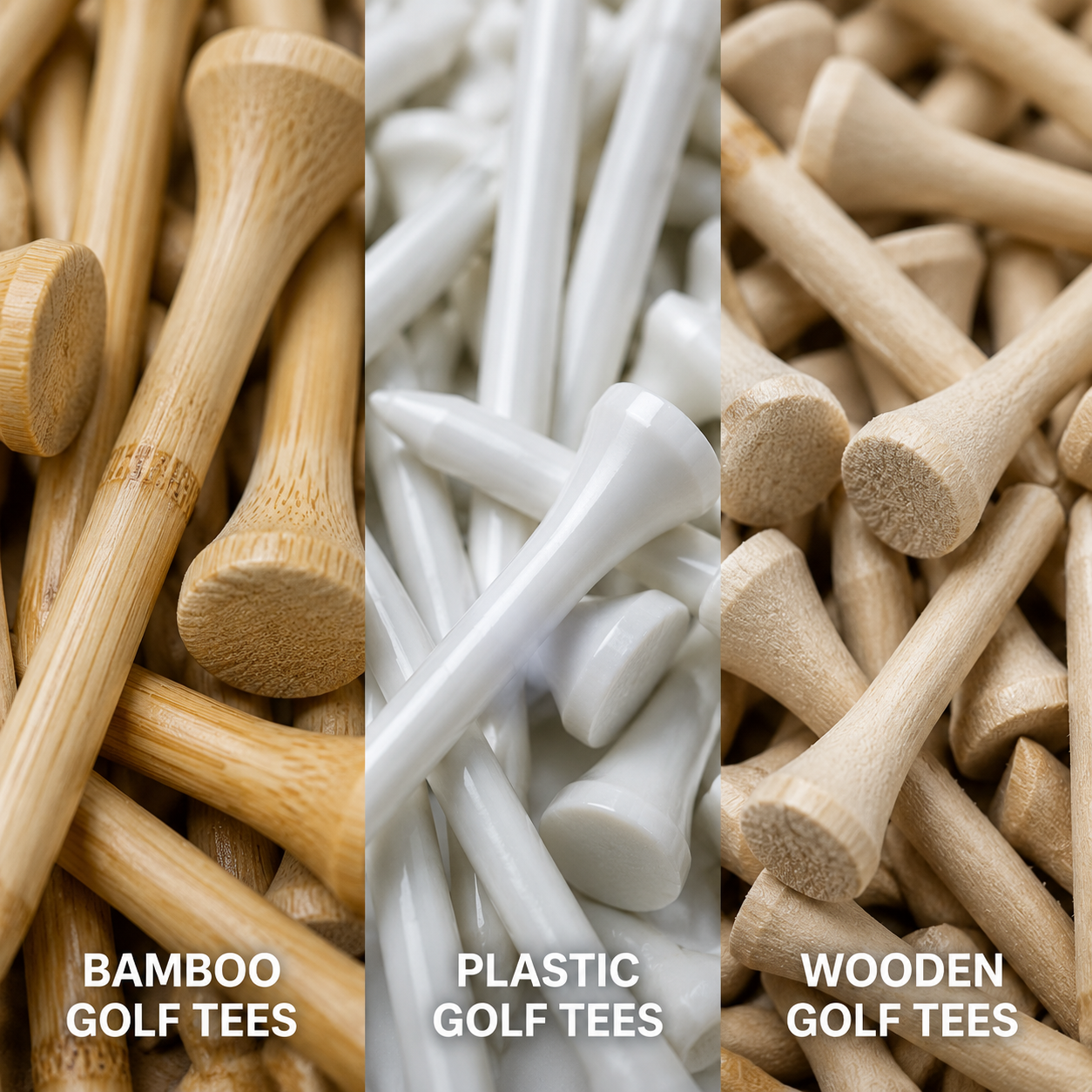
Avoid claiming that a material increases distance, reduces spin or lasts a fixed number of rounds without relevant evidence. A controlled product evaluation needs to separate material from geometry and player variation. Customer preference percentages also need an identifiable study and sample; they should not be invented from general market impressions.
Environmental questions to ask before labeling
Material origin, coating, printing, packaging and disposal conditions all matter. Do not promise a universal decomposition period from the word bamboo or wood. Likewise, a plastic item is not necessarily accepted by a local recycling program simply because its polymer can be recycled in principle.
Ask for evidence relevant to the exact environmental claim you intend to print. Keep natural-material descriptions distinct from certification claims. Encourage collection and suitable disposal of damaged tees rather than treating any material as permission to leave debris on the course.
Logo and finish review
A tee offers a small, curved decoration area. Identify whether the logo belongs on the head, shaft or packaging and check the artwork at actual size. Fine lines, small text, stripe overlap and surface texture can limit legibility. Review the selected decorated sample for appearance and the agreed handling conditions before approving pack artwork.
Compare real PASSEN configurations
| Product | Current listing distinction | Ordering point |
|---|---|---|
| 100-pack tees, KIB-5 | 70 mm or 83 mm; confirm the selected wood/bamboo designation | 500 individual tees = 5 packs per SKU, standard or custom |
| Striped bamboo tees, 88-9K | 70 mm or 83 mm with selected stripe appearance | 200 pieces per SKU standard; 500 custom; define pack size |
| Adjustable rubber tee, OKD | A different construction requiring actual working-height review | Do not equate packed dimensions with playing height |
The rubber option is shown as a separate use-case comparison, not as an interchangeable wood or bamboo tee. Current product pages identify the selected configuration; other materials and designs need a project-specific availability review.

Compare complete costs
Use the same individual count, pack count, artwork and delivery scope in every quotation. Separate product, setup, packaging and freight costs. A low piece price is not enough to establish lower cost per round without a documented use and recovery comparison. Avoid universal market-share or discount claims when making a stocking decision.
Frequently asked questions
Which material is best?
Select the actual design for your use and compare samples. This guide does not establish a universal winner.
Does bamboo always outlast wood or plastic?
No such universal result is confirmed. Geometry, material quality and use conditions affect any comparison.
Are 70 mm and 83 mm playing heights?
They are overall tee lengths. Ball height above the surface also depends on insertion and setup.
Are wooden and bamboo tees the same material?
No. Confirm the exact supplied material even if a catalog groups them under similar wording.
Can I mix lengths to reach MOQ?
Different standard SKUs do not combine to reach the minimum. State each configuration separately.
What does the 100-pack minimum mean?
For KIB-5, the confirmed minimum is 500 individual tees per SKU, equal to five packs of 100.
Industry range reference: Pride Golf Tee lists wood, bamboo, plastic and specialty options. The existence of multiple ranges supports comparing specific designs; it does not establish a universal material ranking.
Request a custom golf tee quote
Send the tee material, length, color or finish, logo placement, pack count, quantity per SKU and delivery destination. For a mixed order, list each tee version separately so the quote matches the intended assortment.