

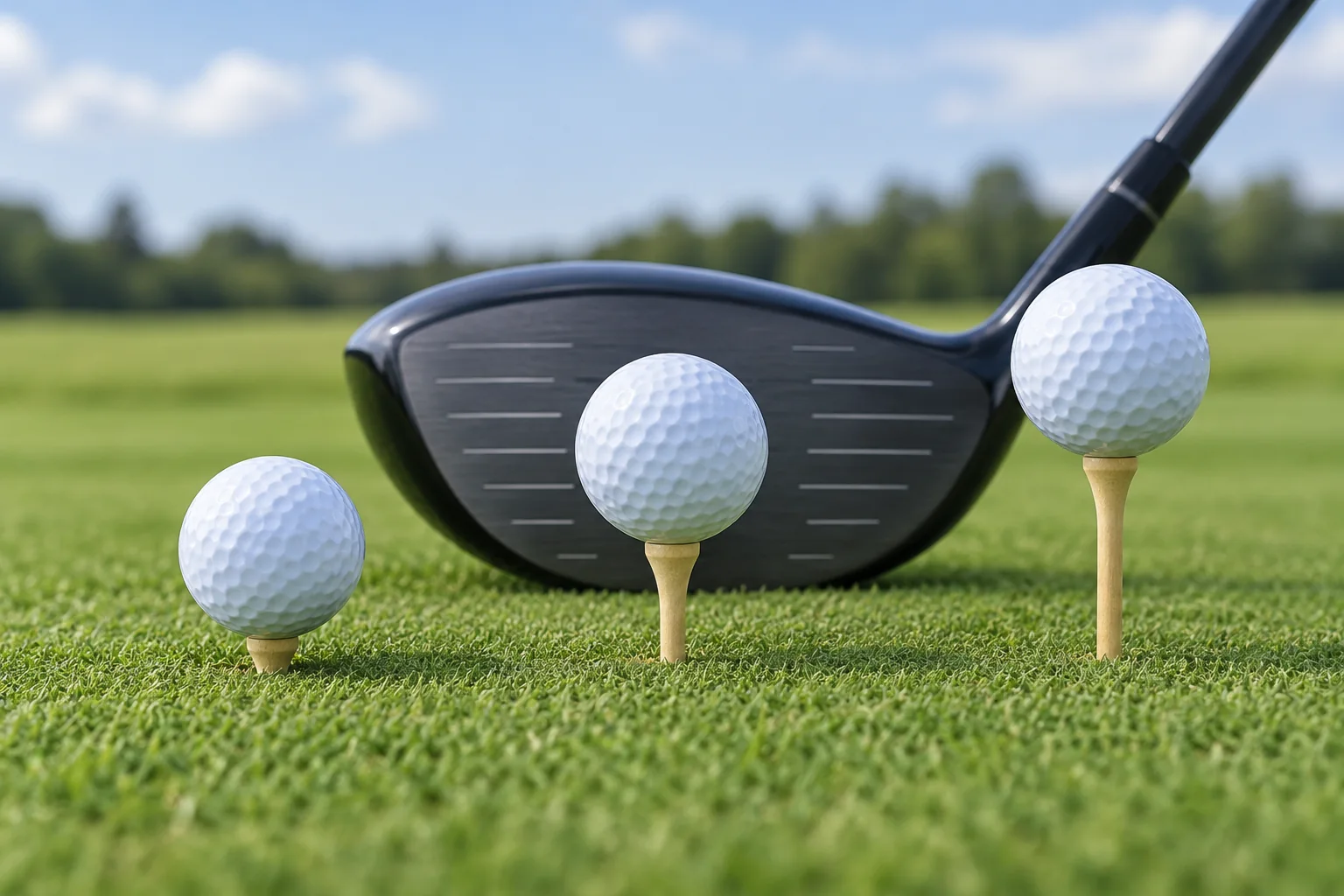
How high should you tee up a driver? A useful starting point is to set the ball so roughly half of it sits above the top edge of the driver face at address. From there, test small changes and watch strike location, launch, spin and shot shape. Driver design and swing delivery differ, so there is no single height that suits every golfer.
To decide how high to tee up driver shots, use the clubface as the first reference and confirm the result through repeated strikes.
This guide explains high, standard and low tee positions, how to test them and how clubs, events and golf brands can specify tee lengths and markings that help golfers reproduce the approved setup.
Start with the driver face, not a number alone
A tee marked “2¾ inches” or “3¼ inches” describes the complete tee, not the height of the ball above the turf. Part of the tee remains in the ground, and the insertion depth changes with turf firmness. Use the driver face and ball position as the practical reference at address.
Set a repeatable starting point
Begin with about half the ball above the driver crown. Keep ball position and stance consistent.
Check the strike
Use impact tape, foot spray approved for practice, or clear face marks to see where the ball contacts the clubface.
Change one variable
Raise or lower the tee in small steps while keeping the same driver and target.
Record the result
Compare strike height, launch, curvature, carry and consistency across several shots rather than one best drive.
Low, standard and high tee positions compared
| Position | Possible effect | What to watch |
|---|---|---|
| Lower | May encourage a lower strike and lower flight for some players | Excess spin, contact low on the face, reduced carry or turf contact |
| Starting point | About half the ball above the crown gives many golfers room to strike on the upswing | Center-to-high-face contact, predictable launch and balanced curvature |
| Higher | May support a higher strike and launch when matched with the swing | Contact too high on the face, sky marks, inconsistent path or a ball placed beyond a comfortable setup |
A higher tee does not automatically produce more distance, and a lower tee does not automatically produce more control. The result depends on angle of attack, face contact, delivered loft, club path and speed. Treat tee height as a test variable, not a guaranteed fix.
Why strike location changes launch and spin
Modern drivers do not produce identical launch conditions across the entire face. Contact below the preferred area can add spin and reduce launch, while higher-face contact can reduce spin and raise launch. Very high or off-center contact may sacrifice ball speed and control.
The goal is not simply to tee the ball as high as possible. The goal is a repeatable height that lets the golfer present the clubface consistently and find a useful strike pattern. A launch monitor can help, but face contact and ball flight already provide valuable evidence.
Strike
Note whether contact clusters low, central, high, toward the heel or toward the toe.
Flight
Compare launch window, peak height, curvature, carry and roll under similar conditions.
Confidence
A technically promising setting is not useful if the golfer cannot reproduce it comfortably.
Match tee height with ball position and angle of attack
Driver tee height works together with ball position. Many golfers play the ball forward in the stance to meet it later in the swing arc, but exact placement depends on the individual setup. Moving the ball while changing tee height makes it difficult to know which adjustment caused the result.
Use the same alignment, stance width and ball position while comparing heights. If a golfer changes swing delivery or driver loft later, repeat the test. A tee-height reference belongs to a particular player, driver and setup rather than every club in the bag.
Tee-height starting points for other clubs
| Club | General starting point | Purpose of the test |
|---|---|---|
| Driver | About half the ball above the crown | Support an upward or level strike with room above the turf |
| Fairway wood | Lower than driver, with the ball only modestly above the crown | Create a clean strike without encouraging contact too high on the face |
| Hybrid | Low tee, similar to a preferred fairway lie | Give a consistent lie while preserving the club's normal impact pattern |
| Iron or wedge | Very low, with the head of the tee just above the turf | Provide a clean lie without changing the intended iron strike |
These are starting points, not fitting prescriptions. Practice with the actual club and record the result. A golfer may prefer different settings for wind, shot shape or a particular teeing ground, but a standard reference improves consistency.
Run a simple range test
- Warm up before collecting results.
- Select one driver, one ball model and one target.
- Hit a small group from a lower repeatable height.
- Repeat at the normal starting point and a slightly higher height.
- Record face contact, launch window, curvature and useful distance.
- Remove obvious mishits only if the same rule is used for every group.
- Retest the preferred setting on another day before making it the standard.
Use lined or banded tees, a finger-depth reference or a separate setting tool to reproduce insertion depth. If bands are used, define where the measurement starts and how the band should sit relative to the turf. A decorative stripe that moves between batches is not a reliable height reference.
Choose tee length for the intended setup
A tee needs enough exposed length for the chosen ball height and enough insertion depth for stability. Soft or wet turf may require deeper insertion than firm ground. Oversized driver heads often lead buyers toward longer tees, while irons and hybrids can use shorter options.
For a retail, tournament or private-label pack, define the club use and pack mix before selecting lengths. A mixed pack can separate driver tees from shorter iron or par-three tees. Review the golf tee buying guide for material, length and sample checks, and compare available programs on the custom golf tees page.
Turn a useful height into a product specification
For clubs, events and golf brands, repeatability can be built into the tee without making a performance promise. A color band, printed line or molded feature can act as a visual reference, but it must be positioned and inspected consistently.
| Specification | What to define | Sample check |
|---|---|---|
| Overall length | Finished length, measurement method and tolerance | Measure multiple pieces from the sample lot |
| Cup | Diameter, depth and edge finish | Ball sits securely without an oversized contact area |
| Shaft and point | Diameter, taper, straightness and tip shape | Tee inserts into the intended turf and remains stable |
| Height reference | Band position, width, color and measurement datum | Compare the reference position across pieces and batches |
| Decoration | Artwork size, print area, color and orientation | Check registration, adhesion and legibility |
| Pack | Length mix, count, label, barcode and presentation | Verify count and SKU separation before carton approval |
For color bands and print placement, see the striped bamboo tee guide and golf tee logo printing guide. Send each length and artwork combination as a separate SKU in the quotation brief.
Frequently asked questions
Should half the golf ball sit above the driver?
That is a practical starting point for many golfers. Test small changes with the actual driver and assess strike location, flight and consistency.
Does a higher tee always increase distance?
No. A higher tee can change strike and launch, but distance also depends on speed, face contact, delivered loft, spin and club path.
Can tee height cause a sky mark?
A very high setup combined with contact under the ball can strike the top of the driver. Check height, ball position and strike pattern before repeating the shot.
How high should a fairway wood be teed?
Use a lower setup than a driver, often with only a modest portion of the ball above the crown, then test the strike with the actual club.
Can a printed line be used as a tee-height guide?
Yes, if the line position is defined from a clear measurement point and production samples are checked for consistent placement.
What is the MOQ for custom golf tees?
PASSEN's standard MOQ is 200 per SKU. Logo, color or packaging customization starts at 500 per SKU.
Plan a custom golf tee program
Send the tee material, lengths, cup and shaft requirements, band or logo placement, pack mix, quantity per SKU and destination. PASSEN can review the specification and sample checks before quotation.