
8 Must-Have Custom Accessories for Golf Club Pro Shops
A well-stocked pro shop is the difference between a player walking out empty-handed and walking out with $80 worth of branded merchandise they will use for years. But shelf space is limited. Rent is expensive. Every square foot of retail in a golf club needs to earn its keep.
This guide covers the 8 accessory categories that generate the highest turns and best margins in golf club pro shops. These are not fashion items. They are the staples that move off the shelf month after month, season after season, and they all have one thing in common: they take a logo beautifully.
Key Takeaways
- Headcovers, towels, and ball markers make up 60-70% of accessory revenue in a typical golf club pro shop. Start here. The returns are predictable.
- A custom logo adds 40-60% to the perceived value of an accessory. A $15 unbranded towel becomes a $25 branded trophy. The club logo does the selling.
- Members do not comparison shop club-branded items. They buy at the pro shop because the product carries the club crest and nowhere else sells it. This is monopoly economics on a small scale.
- The accessories that sell best are the ones players lose or wear out. Tees, balls, gloves, and ball markers are consumables. Stock them deep. Headcovers and bags are durable goods. Stock them wide but shallow.
- Every product in this list can be sourced with a custom logo at MOQs of 100-500. You do not need to order 5,000 of anything to get a fair price. Start small, test the market, reorder the winners.
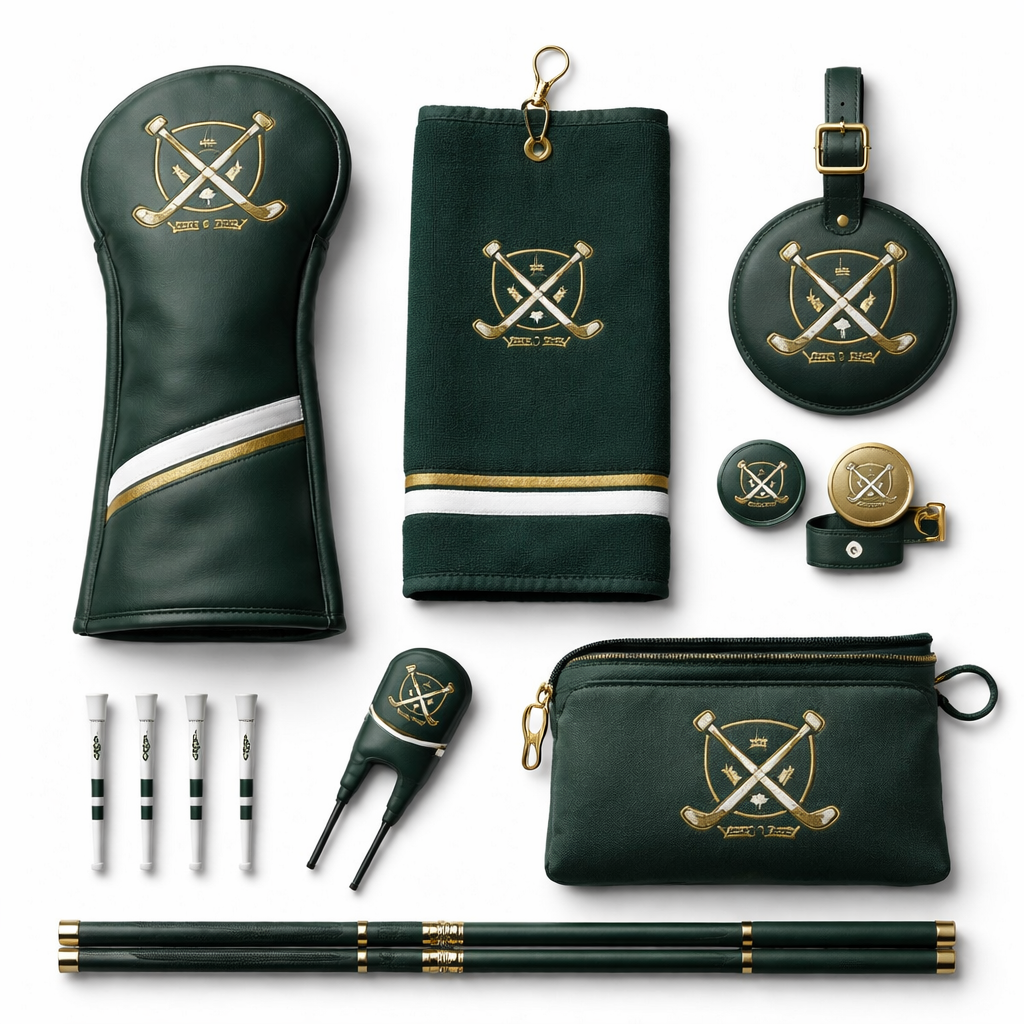
1. Custom Golf Headcovers
Why they sell: A headcover is the most visible accessory on a golf bag. Every round, every range session, every clubhouse visit — the headcover is seen. Players treat branded headcovers the way car owners treat branded keychains. It is a statement piece.
What to stock: Start with driver covers in 3-4 classic colors (black, navy, dark green, white). Add fairway wood and hybrid covers if driver covers sell through. The driver cover always outsells everything else combined by 3:1 or more.
Material guide: PU leather at the entry level ($8-12 wholesale), genuine leather for the premium tier ($18-25 wholesale). Neoprene for a sporty look at lower cost ($5-7 wholesale). Knitted headcovers have a retro-resort aesthetic that sells well at destination courses.
Pro tip: Order an extra 10% in your club's most common bag color. A navy headcover on a navy bag looks intentional. A navy headcover on a red bag looks like it was free. Color matters more than material.
2. Custom Golf Towels
Why they sell: Every golfer needs a towel. They get dirty, they get lost, they wear out. A club-branded towel is the highest-turn accessory in most pro shops because it is both practical and affordable. At $15-25 retail, it is an impulse buy even for a member who just came in for a sleeve of balls.
Material options: Microfiber dominates the market for good reason. It cleans clubs better, dries faster, and prints cleaner than cotton. Cotton waffle weave has a classic look that appeals to traditional clubs. Tri-fold towels with a carabiner clip are the most popular format because they hang easily on any bag.
Decoration: Screen printing is cost-effective for large logos and solid colors. Embroidery elevates the perceived value. Woven jacquard towels are the premium option — the design is woven into the fabric itself rather than printed on top. They are more expensive but feel substantially higher quality and last longer.
Restocking rhythm: Plan to reorder every 6-8 weeks during peak season (April-October). Keep a 3-month buffer in the stockroom before tournament season starts.
3. Ball Markers
Why they sell: The ultimate impulse accessory. A club-branded ball marker costs $5-12 at retail, fits in a pocket, and gets used on every green. Players collect them from courses they visit. They are the souvenir that actually gets used.
Formats that work: Hat clip markers with a magnetic backing are the most practical format — players keep them on their cap and never lose them. Traditional coin-style markers with a presentation case are better for gift sets and tournament favors. Divot tool and marker combos sell well as a packaged unit.
Material choices: Zinc alloy with soft enamel fill is the workhorse — durable, detailed, and affordable at $1-2 wholesale. Brass markers have a heavier, more premium feel. Stainless steel with laser etching offers the finest detail for complex logos.
Sizing: The 25mm (1-inch) diameter is standard. Oversized 35mm markers feel more premium and work better for complex logos. Undersized 20mm markers are lighter and preferred by players who walk and carry.
4. Golf Tees
Why they sell: The cheapest branded accessory you can stock and the one that gets the most impressions. A bag of 50 branded tees costs $3-5 wholesale and retails for $8-12. Every tee a player pushes into the ground is a free ad for your club.
Material trends: Bamboo tees are taking over. They are stronger than wood, more eco-friendly than plastic, and print beautifully with a logo. Plastic tees are durable but increasingly viewed as environmentally irresponsible. Wood tees are the traditional option but break most easily. Biodegradable plastic is emerging as a middle ground.
Packaging: The standard retail format is a resealable bag of 25-50 tees. For higher-end presentation, a wooden box of 100 tees with a branded lid sells for $15-20 and feels like a gift rather than a commodity. Mixed-length packs (2.75-inch and 3.25-inch) cover all player preferences in one SKU.
5. Divot Tools & Groove Cleaners
Why they sell: Every golfer is supposed to carry a divot tool. Most do not. A branded divot tool on the counter at $8-12 is an easy upsell and it serves a genuine utility purpose that members appreciate. Groove cleaners are less common but higher margin — players who care about spin will pay $12-15 for a quality tool.
What moves: The switchblade-style divot tool with a magnetic ball marker is the bestselling format. It feels satisfying to use and the ball marker integration reduces SKU count. Groove cleaners with a wire brush and nylon bristle combination are the most practical format.
Customization: Laser engraving on a metal divot tool produces a clean, permanent mark. For multi-color logos, soft enamel on a zinc alloy body offers the best detail. Both methods have one-time setup fees of $30-80.
6. Bag Tags & Luggage Tags
Why they sell: Golfers travel. A club-branded bag tag that doubles as a luggage tag is both practical and a status marker. At $10-15 retail, it is an easy add-on sale and the customer effectively becomes a walking billboard at every airport and resort they visit.
Materials: Silicone tags are durable, colorful, and inexpensive ($1-2 wholesale). PU leather tags feel premium and match headcovers aesthetically. Metal tags with printed leather inserts offer the highest perceived value.
Format: The most popular design is a two-sided tag with the club logo on the front and a contact information card slot on the back. Include a clear plastic privacy cover over the contact card slot — it is a small detail that shows quality.
7. Putting Training Aids
Why they sell: Putting aids are the gateway to the training category. A putting mirror or alignment stick set at $25-40 is an easy sell to a member who just complained about three-putting. The category has grown 30%+ annually as home practice setups become more common.
What to stock: Start with a putting mirror ($15-20 wholesale) and an alignment stick set ($8-12 wholesale). Add a putting mat ($50-80 wholesale) if you have the floor space for a demo unit. The demo unit does 80% of the selling — members need to try it before they buy it.
The demo effect: Set up a 10-foot putting mat near the counter with a mirror and alignment sticks. Members will use it while waiting for tee times. Every minute they spend on the mat increases the probability of a sale by an order of magnitude. This is the highest-ROI floor space investment in the shop.
8. Tournament & Event Gift Sets
Why they sell: Club tournaments need prizes. Corporate outings need giveaways. Member-guest events need welcome gifts. Pre-assembled gift kits solve the organizer's problem — one order, one delivery, one invoice instead of sourcing five items from five suppliers.
What to include: The core kit is a towel + ball marker + divot tool + tees. Add a headcover for premium tier. Add a sleeve of custom-printed golf balls for the highest tier. Package everything in a branded gift box or drawstring bag.
Pricing tiers: Budget kit ($8-12 wholesale, retails $15-20) for large-field events. Standard kit ($18-25 wholesale, retails $30-40) for member-guest and corporate outings. Premium kit ($35-50 wholesale, retails $60-80) for invitation-only events and major tournament prizes.
Inventory strategy: Do not pre-assemble every kit. Keep components in stock and assemble to order. This reduces carrying costs and lets you customize kits for specific events. A tournament organizer who can pick and choose components will pay a premium for the flexibility.
How to Build Your Pro Shop Inventory: The 80/20 Rule
Not every club needs all 8 categories. A 150-member semi-private club and a 600-member resort course have different customer bases and different inventory needs. Here is how to prioritize:
| Category | Turn Frequency | Margin | Priority |
|---|---|---|---|
| Custom Towels | Very High | 50-60% | Stock first |
| Golf Tees (Branded) | Very High | 50-65% | Stock first |
| Ball Markers | High | 55-70% | Stock early |
| Divot Tools | High | 50-65% | Stock early |
| Custom Headcovers | Medium | 40-55% | Stock second wave |
| Tournament Gift Sets | Medium | 30-45% | Stock by season |
| Bag Tags | Low-Medium | 55-70% | Add third |
| Putting Aids | Low | 30-40% | Demo-driven |
The 80/20 pattern is clear: towels, tees, ball markers, and divot tools generate 80% of accessory revenue with 20% of the SKU count. Start there. Let demand pull the rest into your inventory rather than pushing everything onto the shelf at once.
FAQ
What MOQ should I expect for custom pro shop accessories?
100-200 pieces per product is standard for most custom golf accessories. Towels and tees can go as low as 50 pieces. Headcovers typically require 100-200 pieces minimum. Ball markers with custom molds may require 200-500 pieces for the first order but reorders can be as low as 50-100.
How long does it take from order to delivery?
Standard lead time is 25-45 days for custom accessories produced in Asia. Express options (15-20 days) are available at a 20-30% premium. Sampling adds 7-10 days before production begins. Always budget 60 days from order to shelf for your first order - the sample approval step always takes longer than you expect.
Should I stock multiple colors of the same product?
For headcovers, yes - stock 3-4 colors. For towels, start with 2 colors (a neutral and your club color). For ball markers, 1 design with 2-3 finish options (gold, silver, black nickel). For tees, 1 color is enough. The rule of thumb: the higher the retail price, the more color variety matters. A $35 headcover customer wants color choice. A $5 ball marker customer does not care.
How do I price custom pro shop accessories?
A simple formula: wholesale cost x 2.2 to 2.5 for standard items, x 2.5 to 3.0 for premium items. A $10 headcover retails at $22-25. A $5 towel retails at $11-13. A $2 ball marker retails at $5-6. Tournament gift sets should be priced at wholesale x 1.8 to 2.0 because the volume per order is higher and the customer is more price-sensitive.
Can custom accessories help pro shops build repeat sales?
Yes. Logoed basics such as tees, towels, markers, divot tools, grips, and gift sets can be reordered seasonally and used to reinforce shop identity.