

To use a golf ball marker, place it right behind or right next to the ball before lifting the ball. When it is your turn, replace the ball on its original spot and remove the marker before making the stroke. The marker preserves the ball's exact position while it is lifted and cleaned on the putting green.
If you are learning how to use a golf ball marker, the essential sequence is mark, lift, replace and remove.
This guide covers the basic procedure, common mistakes, marker formats and the product details that matter when clubs, events and golf brands order custom ball markers.
How to mark, lift and replace the ball
Place the marker
Put a ball marker right behind or right next to the ball. Avoid leaving a visible gap that makes the original spot uncertain.
Lift the ball
Once the spot is marked, pick up the ball. A ball lifted from the putting green may be cleaned.
Replace the ball
Set the ball back on its original spot. Do not use the marker to gain a more favorable position or alignment.
Remove the marker
Take the marker away before making the stroke. Leaving it in place for the stroke can result in a penalty.
The official procedure is set out in R&A Rule 14 and the corresponding USGA Rules of Golf. Tournament committees and players should always follow the current rules and any applicable local rules.
Where should the marker be placed?
Most players place the marker immediately behind the ball because the sequence is easy to see and repeat. The rules also allow a marker right next to the ball, including in front or to the side, provided the spot is marked accurately. The key requirement is proximity and a clear reference for replacement.
Place the marker before touching or lifting the ball. If a player lifts a ball that must be replaced without first marking its spot, marks it incorrectly or makes a stroke with the marker left in place, Rule 14 can apply a one-stroke penalty.
What can be used as a ball marker?
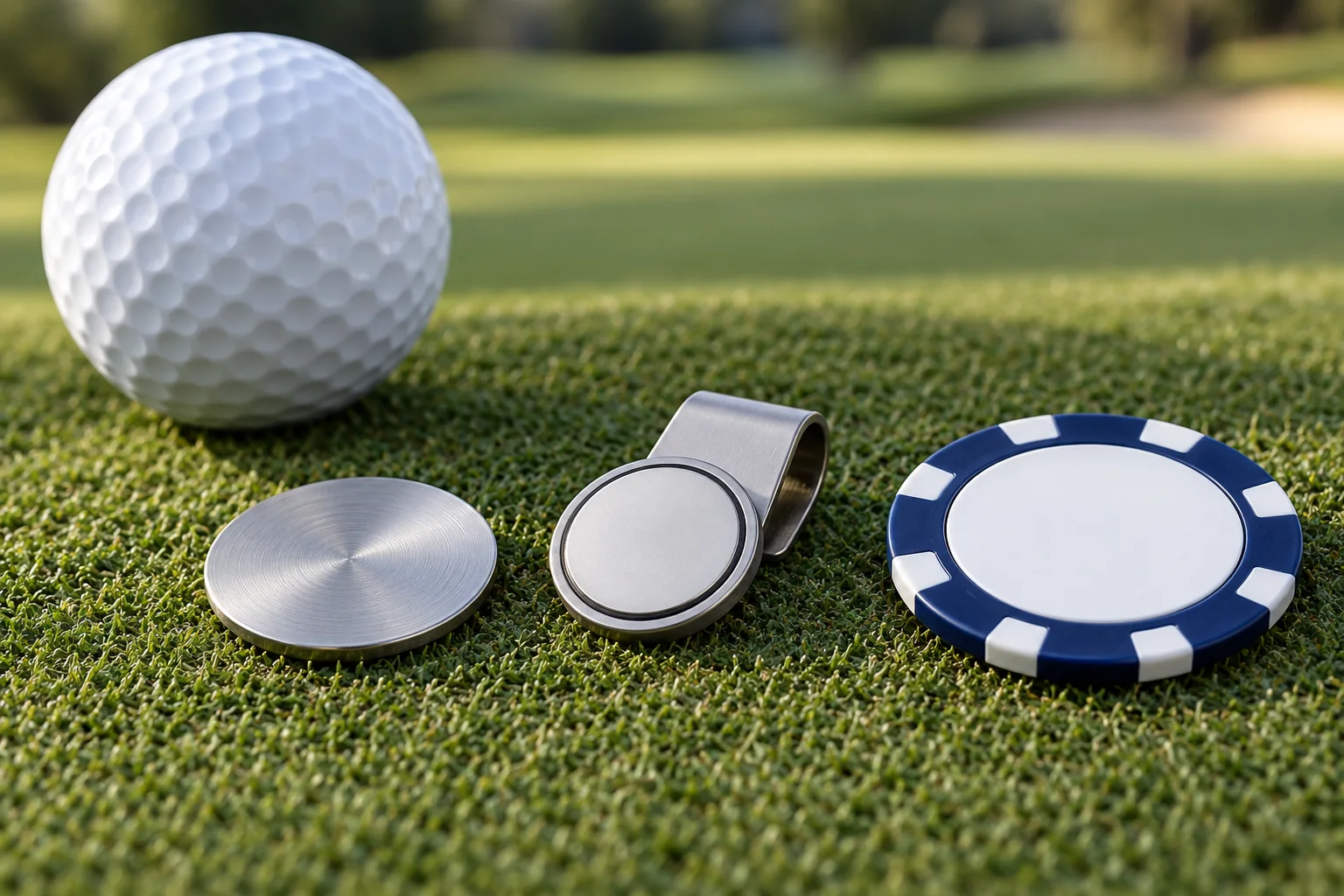
| Format | Advantages | Points to review |
|---|---|---|
| Thin metal coin | Low profile, durable and easy to carry | Edge finish, visibility, diameter and surface decoration |
| Magnetic hat-clip marker | Quick access and compact storage | Magnet retention, polarity, clip fit, plating and repeated removal |
| Poker-chip marker | Large decoration area and strong event visibility | Thickness, diameter, edge detail and possible interference near a playing line |
| Plastic marker | Lightweight with flexible color options | Molding quality, flatness, edge flash, color consistency and print adhesion |
| Divot-tool marker | Combines two accessories in one unit | Magnet retention, tool safety, marker removal and finish durability |
A ball marker is an artificial object made for marking the spot, or another small piece of equipment that qualifies under the rules. A coin is a familiar choice. The best product format depends on playing use, carrying method, decoration area and the customer program.
What if a marker interferes with another player's line?
A marker can be moved when it interferes with another player's stance, stroke or line of play. A common method is to align the marker with a fixed reference and move it one or more putter-head lengths to the side. After the other player has played, reverse the same measurement so the marker and ball return to the original spot.
Choose a fixed reference that will not move, and remember the direction and number of putter-head lengths. The marker is being moved temporarily; the ball's original spot does not change.
Common ball-marker mistakes
Lifting first
Mark the spot before lifting a ball that must be replaced. Do not rely on memory or a distant reference.
Leaving a gap
Place the marker immediately behind or next to the ball so replacement is accurate.
Forgetting the marker
Replace the ball and remove the marker before making the stroke.
Moving without returning
If a marker is shifted for interference, reverse the same measured move before replacing the ball.
Using an awkward format
A very thick marker may distract a nearby player or deflect a ball if placed in the line.
Confusing identification and position
Permanent marks on the golf ball help identification; a separate marker preserves its spot on the green.
Choose a marker for play, events or retail
A low-profile coin marker works well for normal play. A poker-chip format provides more branding area and can suit registration packs, gifts or sponsor programs. A magnetic hat-clip set keeps the removable marker accessible. A combined divot tool and marker is useful when the buyer wants a coordinated accessory rather than a single loose piece.
When choosing a format, test it in the actual carrying position. A hat clip should hold securely without damaging the intended cap material. A magnetic marker should release by hand but remain attached during normal movement. A poker chip should lie flat and maintain its edge and print after repeated handling.
Plan artwork around the usable decoration area
Do not scale a logo to the full outside diameter. Keep critical artwork inside the safe area after allowing for rims, bevels, raised borders, magnetic seats or molded edges. Small text and thin lines can close up in enamel, printing, engraving or relief.
| Decoration method | Useful for | Sample check |
|---|---|---|
| Soft or hard enamel | Colored metal designs with defined cells | Fill level, clean boundaries, color references and surface finish |
| Fine detail, gradients or multi-color graphics where the substrate allows | Registration, adhesion, abrasion and edge clearance | |
| Laser engraving | Durable line work and simple personalization on suitable metal | Contrast, depth, line width and alignment |
| Relief or die-struck detail | Raised or recessed metal graphics | Tooling depth, edge definition and plating coverage |
| Molded color | Plastic or rubber-style promotional formats | Color, flash, flatness, detail and material consistency |
Review the artwork on the physical sample at normal viewing distance. A design that looks clear on a large screen may be unreadable on a small marker. For more options, compare the golf ball marker buying guide and poker chip ball marker guide.
Test magnets, clips, finish and packing
For magnetic markers, define the magnet size, location and assembly method. Test retention in the intended hat clip or divot tool, repeated removal cycles and the effect of plating or coatings on fit. The ball marker magnet guide covers these checks in more detail.
Inspect marker diameter, thickness, flatness, edge condition, finish color, artwork position and surface defects across multiple units. For sets, verify that the marker fits every clip or tool in the lot. Packaging should prevent metal parts from rubbing together and should keep the correct marker, clip, tool and insert with the correct SKU.
Prepare a custom ball-marker brief
Send the marker format, diameter, thickness, base material, finish, decoration method, artwork, color references, magnet or clip requirement, packaging, quantity per SKU, destination and required arrival date. For a combined program, list each component separately and define whether it is quoted as one set or as individual items.
See the custom golf ball markers page for commercial options, or the ball marker and divot tool page when the program combines both accessories.
Frequently asked questions
Do I place the ball marker behind the ball?
Behind the ball is the usual method. The marker may also be placed right next to the ball, including in front or to the side, as long as the spot is marked accurately.
Can I use a coin as a golf ball marker?
A coin is commonly used. The rules define a ball marker as an artificial object such as a tee, coin, an object made as a ball marker or another small piece of equipment.
Can I clean the ball after marking it?
A ball lifted from the putting green may be cleaned. Different restrictions can apply when a ball is lifted elsewhere for another reason, so follow the current rule for that situation.
What happens if a marker is in another player's line?
It can be moved temporarily using a measured reference, then returned by reversing the same move before the ball is replaced.
Which custom ball marker format offers the largest logo area?
Poker-chip markers generally provide more visible area, while thin metal markers and magnetic hat-clip markers provide a lower profile. Confirm the usable artwork area on the physical sample.
What is the MOQ for custom golf ball markers?
PASSEN's standard MOQ is 200 per SKU. Logo, color or packaging customization starts at 500 per SKU.
Plan a custom golf ball marker
Send the marker format, size, material, finish, artwork, magnet or clip requirement, packaging, quantity per SKU and destination. PASSEN can review the construction and sample checks before quotation.