
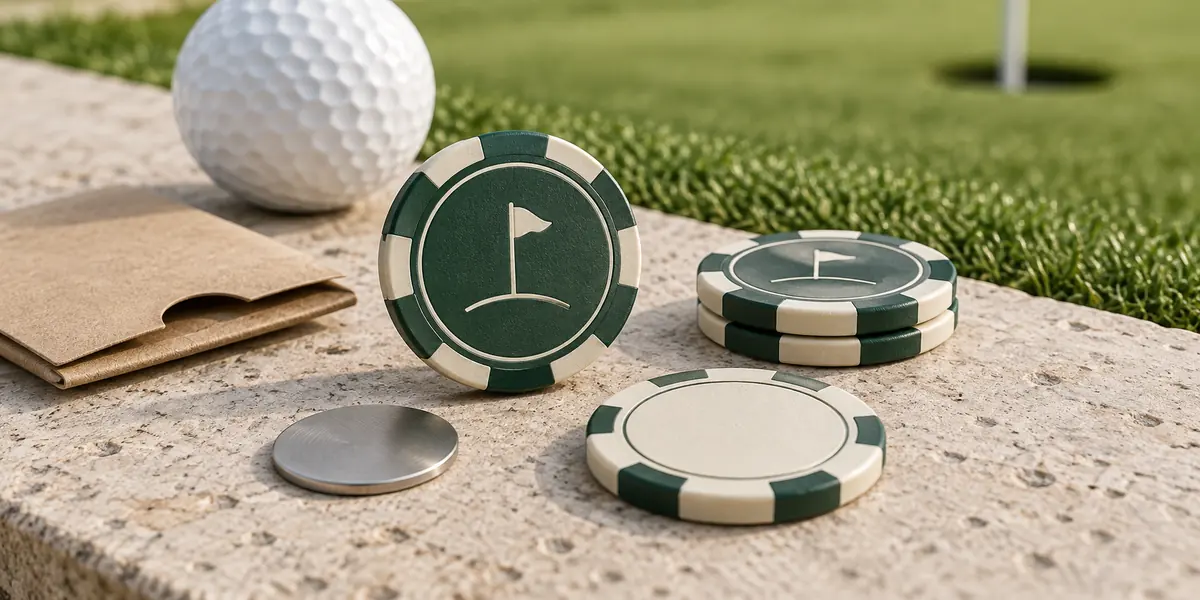
Golf poker chip ball markers offer a broad circular face for an event design, but diameter, thickness and artwork area need to be specified separately. Choose it for the way it will be carried, presented and used on the green, then approve the actual-size design. A casino-style appearance alone does not establish the material, weight or magnetic compatibility.
This guide focuses on the chip format. For other shapes and clip combinations, see the golf ball marker design guide. Poker-chip concepts shown here are illustrative; confirm availability and a sample specification for the requested construction before treating it as an approved PASSEN product.
Poker chip, flat marker or removable insert?
| Format | Reason to consider it | What to check |
|---|---|---|
| One-piece poker chip | A visible event graphic and a substantial item to handle | Thickness, edge finish and pocket comfort |
| Small flat marker | A compact format for marking a ball position | Visibility, handling and the usable design area |
| Chip with removable center | A larger presentation piece plus a smaller marker | Whether the insert is included, how it is retained and how easily it is removed |
| Marker with hat clip | A separate way to carry a marker on a visor | Marker-to-clip compatibility and visor fit |
A removable insert and a magnetic attachment are distinct features. Neither follows automatically from the word “chip.” If your brief needs both, request an assembled sample and identify which part marks the ball and which part is used for carrying or presentation.

Three design checks before a quote
Measure the finished chip
Record diameter and thickness separately, then check the intended pocket, sleeve or insert.
Review both faces
Supply separate front and back artwork and approve the design at its final printed size.
Inspect the approved finish
Compare edge quality, surface appearance and handling with the retained sample.
Choose diameter and thickness together
There is no single purchasing dimension that describes every golf poker chip. As a market reference, Fore Better Golf lists a 1.5-inch example; 1.5 inches converts to 38.1 mm. That is an example from another supplier, not a PASSEN specification or a universal standard. Ask for the actual dimensions of the model under review.
A wider face provides more room in principle, but a molded rim or printed edge pattern may leave a much smaller central design area. Thickness changes the feel in a pocket and the space needed in a fitted pack. Weight must be stated independently: two chips with the same outside dimensions can use different constructions.
Make a simple paper circle at the proposed diameter to review layout, then use a physical sample to judge thickness and handling. A paper proof cannot establish comfort, flatness or finish quality. For a removable center, record the center diameter and its usable artwork area separately from the outer chip.
What the construction description should tell you
| Specification | Ask for | Avoid assuming |
|---|---|---|
| Body | The actual material and any layered or insert construction | That every casino-style chip is ceramic or clay |
| Face decoration | The proposed printing, label or other decoration method | That every image can wrap across the entire face |
| Edge | Molded, printed or otherwise finished edge details | That face artwork automatically continues onto the edge |
| Retention | Details of any removable insert or compatible magnet | That a chip fits an existing hat clip |
| Surface finish | The selected appearance and sample evaluation method | A fixed scratch resistance or lifetime without evidence |
Describe the finished result rather than collecting incompatible finish terms. For example, a printed polymer face and an enamel-filled metal marker are different constructions with different artwork constraints. Ask the supplier to identify the proposed method instead of listing every possible process as though they apply to one chip.
Design the front and back as a pair
- Give each face one main message: a club emblem on the front and an event name or date on the reverse is one possible layout.
- Request the exact artwork template for the chosen construction, including the usable area, safe area and any required bleed.
- Keep small lettering away from borders and curved edges. Print a proof at actual size to check legibility.
- Identify front and back orientation. If the design must read a particular way when flipped, show that relationship explicitly.
- Approve color references, border registration and any variable names or numbers before signing off the final artwork revision.
Use the background, rim and center intentionally. A detailed sponsor logo can become unreadable when reduced, even if it looks sharp on a screen. If several sponsors are involved, a backing card may carry supporting information more clearly than squeezing every logo onto the marker. Obtain permission for the artwork you supply.

Do not choose a fixed bleed allowance from another supplier’s template. The required allowance depends on the process and finished chip. A digital proof establishes layout; a decorated physical sample establishes how the colors, surface texture and small details actually appear.
Using a chip as a ball marker
The USGA ball-marker FAQ addresses items that may be used to mark a ball position. Designs with alignment features also need consideration under the Equipment Rules on alignment devices. Do not describe a custom design as universally approved for competition without an applicable determination.
A larger chip can be easy to see, but another player may ask for a marker to be moved. Follow the Rules procedure for moving and replacing it. Keep the selection brief focused on a marker that is comfortable to handle and appropriate for its intended use; size alone does not make one format better for every golfer.
Check the sample and the packed order
Compare both faces with the signed artwork. Look for an off-center print, an uneven border, incorrect reverse orientation, damaged edges and a chip that does not sit as intended on a flat reference surface. Check a removable center repeatedly if one is part of the design. Record the agreed acceptance criteria rather than approving only the nicest sample photograph.
For surface durability, agree on a relevant handling or rub check and its conditions before production. Inspect the face and edge after packing and unpacking. A claim such as waterproof or scratch-proof needs evidence for the selected construction; it should not be added simply because the marker is intended for golf.
Choose a sleeve, backing card or fitted box around the confirmed dimensions. If the chip is combined with a repair tool, prevent the fork or metal parts from rubbing its face. State how many chips belong in each pack and whether different event designs must be kept separate. The accessory packaging guide explains the wider presentation and shipping brief.
Prepare a specification that can be reviewed
Send diameter, thickness, intended material, front and back artwork, edge treatment, required insert or attachment, quantity per design, packaging and destination. If you need a clip format instead, the current PASSEN hat clip listing uses a 25 mm removable marker; this separate product does not establish compatibility with a poker chip.
Standard PASSEN MOQ is 200 per SKU; logo, color or packaging customization starts at 500 per SKU. Different SKUs do not combine to meet the minimum. Confirm feasibility, sample terms, price and delivery timing for the proposed chip rather than transferring specifications from another marker or another supplier.
Frequently asked questions
What diameter should I choose for a poker chip marker?
Choose using the actual model dimensions, usable artwork area, carrying preference and packaging. A market example is not a universal standard.
Can the front and back have different artwork?
Include separate files in the brief and confirm the selected construction supports the required decoration on both faces.
Is every poker chip marker magnetic?
No. Ask for the material and attachment details, and test the actual combination if a magnetic holder is required.
Does a poker chip always have a removable center?
No. A one-piece chip and a chip with an insert are separate formats. Confirm the complete contents and retention method.
Is every custom design approved for tournament play?
Do not assume blanket approval. Review applicable ball-marker and alignment-device rules and consult the event committee where needed.
What must be included in a quotation request?
Provide dimensions, construction, both artwork faces, edge and finish, any insert, quantity per SKU, packaging, destination and required date.
Discuss your project
Send your selected format, quantity per SKU, artwork, packaging and delivery destination for review.