
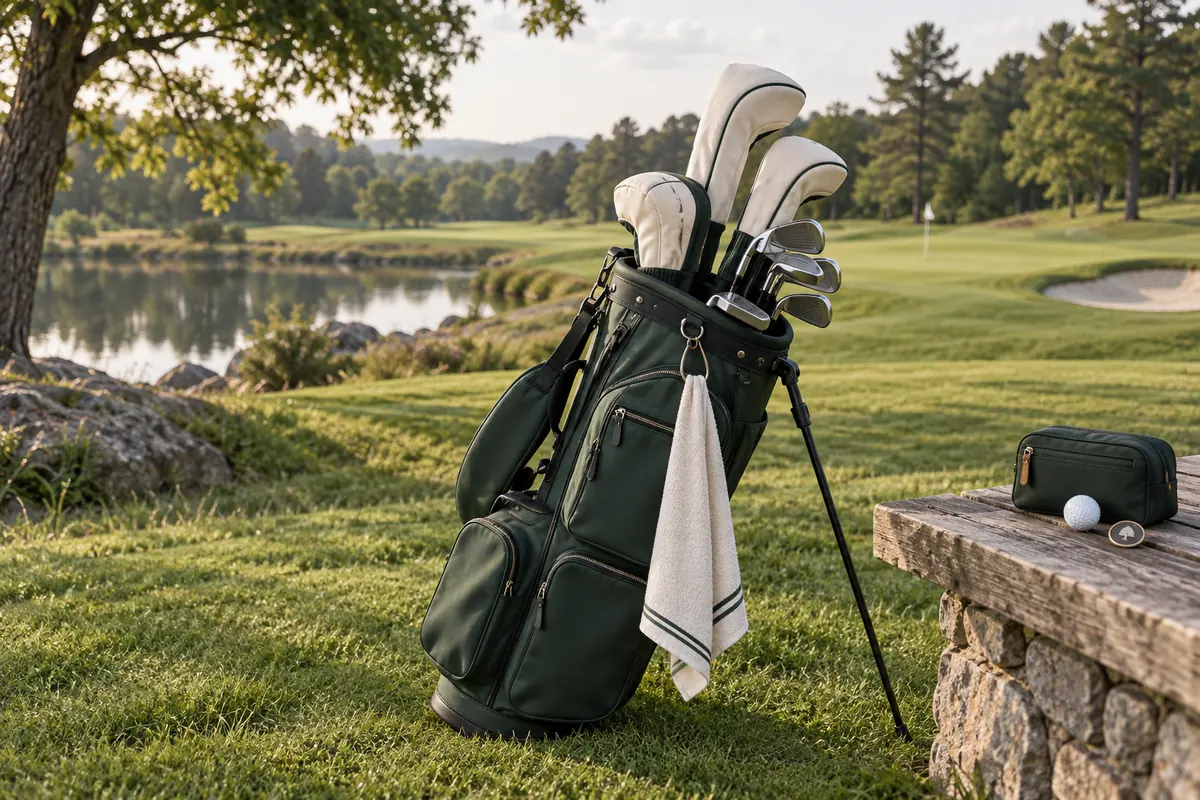
Here is how to organize a golf bag: start with its divider layout, playing position and the accessories you reach for most often. Give each club a repeatable position, keep frequently used items accessible, and check the arrangement with the bag standing or mounted the way you actually use it.
A tidy bag is not necessarily a full bag. Start by taking everything out, removing unused items and returning only the equipment you need. If you are still choosing the bag itself, use our golf bag selection guide first.
Identify the bag’s orientation before choosing a layout
Stand behind the bag in its normal playing position. Find the taller side of the opening, the support legs or cart-facing side, and any dedicated putter well. What one diagram calls “back” may face a different direction when the bag is strapped to a cart. Use the actual construction as your reference.
A practical starting point is to group clubs by length, keeping shorter clubs reachable rather than hidden under larger heads. Follow any dedicated club-well labels. Then lift each club in and out to check clearance between shafts, grips and headcovers. Divider shape and full-length separation matter as much as the number printed on the bag label.
Example 4-way, 5-way and 14-way layouts
4-way: broad groups
Use one compartment for woods, two for iron groups and one for wedges. Place the putter where its grip and head fit comfortably.
5-way: an extra group
Use the additional space to split longer clubs or isolate a putter where the actual opening allows. Keep the remaining groups in a consistent order.
14-way: individual positions
Assign a repeatable slot to each club you carry. Use the dedicated putter well if provided, and leave unused positions empty.
These are schematic divider patterns, not dimensioned drawings of a PASSEN model. The colored zones suggest grouping; they do not prescribe an exact club count or a universal top-to-bottom orientation. Compare with the practical arrangement principles in adidas’s golf bag organization guide.
Match the arrangement to how you carry or ride
| Use | Check after loading |
|---|---|
| Walking with a stand bag | Legs deploy freely; the load is comfortable; the towel stays off the ground |
| Riding with a cart bag | The strap does not cover essential pockets; club heads clear the supports |
| Using a push cart | The base and upper support hold the bag without obstructing access |
| Practice session | Only the needed clubs and accessories are loaded; loose items stay contained |
Do this check with normal pocket contents in place. A layout that works on an empty bag may become awkward once rainwear or a full accessory pouch changes its shape. Use the intended carry handles, straps and supports when checking access.
Give each pocket a job
| Pocket or location | Suggested contents | Practical check |
|---|---|---|
| Easy-reach small pocket | Tees, ball markers and repair tool | Separate sharp prongs and close loose containers |
| Ball pocket | The balls needed for the round | Avoid burying smaller accessories beneath them |
| Protected valuables pocket | Keys, phone or wallet as suitable | Keep away from damp towels and loose metal tools |
| Long apparel pocket | Rain layer or spare clothing | Avoid packing so tightly that the zipper strains |
| Approved drink holder | A securely closed bottle | Check the bag’s designated holder and pocket guidance |
Use a small pouch for tiny items if a large pocket makes them hard to find. Count what you typically use rather than carrying every spare you own. Keep damp items apart from valuables, and empty rubbish after the round. The aim is a routine you can repeat without searching through several pockets.
Place towels, tags and headcovers without interference
Attach the towel to the intended ring or loop and check its lowest point with the bag standing and being carried. Keep it clear of wheels, feet and leg mechanisms. Our towel attachment guide explains the different hardware arrangements.
Use a tag position where it remains readable without obstructing a pocket. Replace headcovers after use and make sure large covers do not trap shorter clubs below them. A small ball pouch or tee pouch should simplify access, not create another loose object swinging into the bag.
Run a two-minute access check
- Lift and return each club without pulling hard on its neighbors.
- Reach the ball marker, tees and repair tool with the bag in playing position.
- Open the main pockets with the cart strap or carry harness in place.
- Check that the towel, tag and straps clear the ground and moving parts.
- Return everything to its assigned place after the round.
For clubs, retailers and event packs
Organized accessory packs work best when the pieces have a clear purpose. A marker and repair tool can share a small compartment; larger soft goods need their own space. If you are specifying a bag or organizer, check the actual intended club set and installed grips, not only an empty divider opening. See the organizer specification guide for a manufacturing brief.
Frequently asked questions
Where should the longest clubs go?
Start with a grouping that keeps longer clubs from hiding shorter ones, while following the bag’s orientation and dedicated wells. Test removal with the bag in playing position.
How do I organize a 14-way bag?
Give each club you carry a consistent slot. Use the putter well where supplied and leave spare positions empty.
Is a 4-way bag too small to organize?
No. Use consistent groups and check how the grips and shafts move within the actual compartments.
Where should my putter go?
Use its dedicated well if present. Otherwise choose a position with enough grip and head clearance and easy access.
Where should I attach a golf towel?
Use the intended attachment point and check that the towel stays clear of the ground, wheels and stand mechanism.
Should the layout change on a cart?
It may need adjustment if the mounted position changes club or pocket access. Check the bag after fastening it.
Plan a custom accessory program
For a club, shop or tournament, send the product type, quantity per SKU, artwork, packaging and delivery destination. PASSEN offers free samples. Standard orders start at 200 per SKU; logo, color or packaging customization starts at 500 per SKU. Sets are counted as sets. Different SKUs do not combine to meet the minimum.
Explore ball markers and divot tools or plan coordinated golf gifts.