
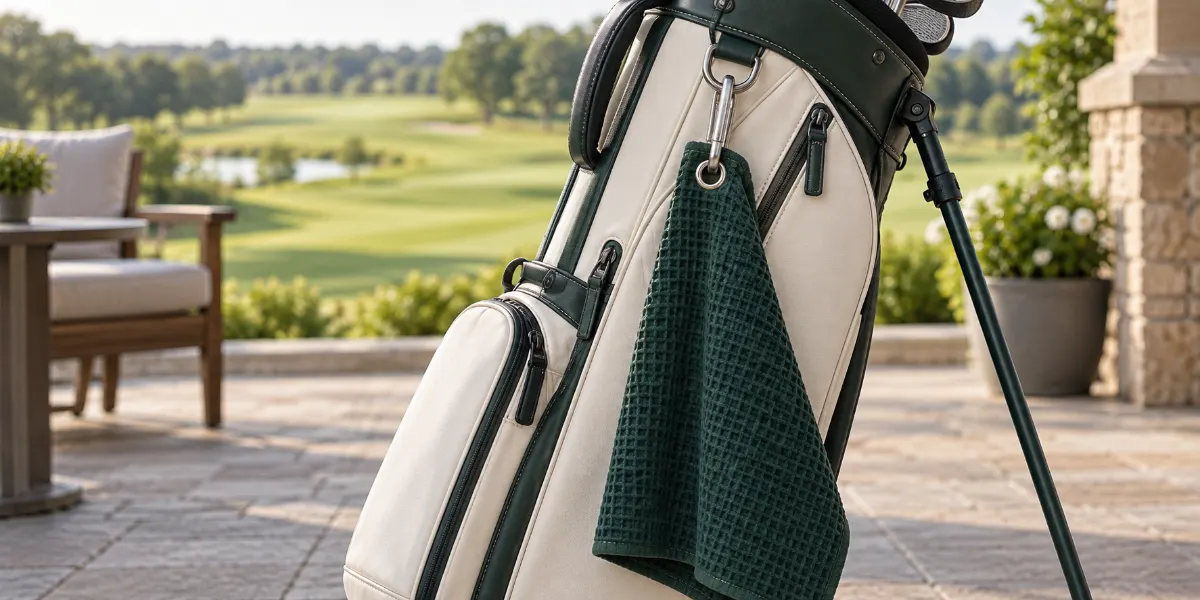
Custom golf towel grommets and carabiners work as one connection: reinforced towel fabric, a correctly fitted clip and a suitable bag attachment point. This guide starts with how to attach a golf towel to a bag, then explains what to specify when ordering the hardware.
How to attach a golf towel to a bag
Locate the bag’s intended towel ring, accessory loop or other attachment point described by its maker. Check that it is accessible with the bag in its playing position. Open the towel’s clip, connect it through the towel grommet or designed loop and the bag attachment point, and let the gate close completely. For a different attachment design, follow that design’s instructions rather than forcing it onto the same ring.
A detachable carabiner is one established format: for example, TaylorMade describes one on its Retro Towel product page. That example illustrates the format; it does not establish the dimensions or compatibility of a PASSEN model.
Check the whole connection in three places
1. Bag attachment
Use the intended ring or loop. A convenient zipper pull is not automatically designed as a towel anchor.

2. Closed clip
Make sure the gate closes and neither the ring nor folded fabric holds it open. Check for sharp edges.
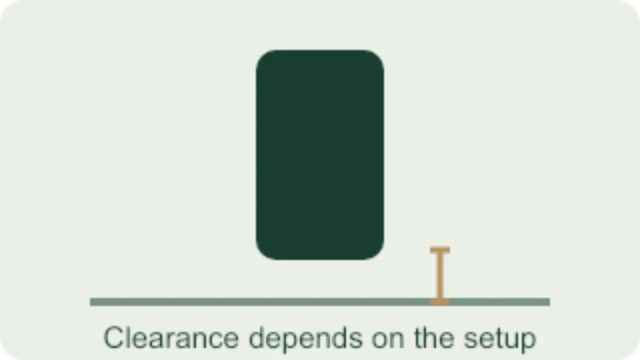
3. Free hanging space
Stand or mount the bag normally. Keep the towel clear of the ground, moving legs, wheels and frequently used pockets.
Choose the attachment style for the towel you use
| Attachment | What to verify |
|---|---|
| Corner grommet and clip | Reinforcement, hole size, gate opening and hanging length |
| Fabric loop | Stitching, loop size and the intended clip or threading method |
| Center-slit or draped towel | The intended placement and whether it stays clear when clubs are removed |
| Magnetic attachment | Compatible mounting surface and the maker’s handling instructions |
Do not punch an unreinforced hole into a finished towel just to make a clip fit. A metal eyelet does not by itself establish tear resistance. A very large clip can also create more movement and snagging even if it fits through the hole.
Specify the grommet dimensions and installation
Use a dimensioned drawing or a labeled sample to distinguish the inner opening from the outer flange. Record the grommet material and finish, washer design and the installation method. The fabric stack thickness matters when choosing the matched hardware and setting process.
| Specification field | What to record |
|---|---|
| Inner opening | Usable diameter after installation |
| Outer flange | Outside dimension and contact area |
| Fabric stack | Towel, reinforcement and any folded layers |
| Placement | Distance from the finished edges and orientation |
| Installed finish | Smooth setting, alignment and fabric condition on both sides |
| Clip compatibility | Body thickness and clearance through the finished opening |
Use the component maker’s installation instructions and matching tools. Hardware systems differ; a setting method for one grommet is not a universal procedure. Inspect a first-off finished towel for sharp edges, uneven rolling, looseness or damaged fabric before continuing the assembly run.
Reinforce the towel without creating a new weak point
The load enters the towel through a small area around the hole or sewn loop. A suitable reinforcement and stitch layout spread that load into a larger fabric area. The design must work with the selected towel construction, including its thickness and tendency to stretch or fray.
Specify patch material and size, layer count, stitch layout and edge finish. Keep the hole position consistent relative to the finished hem. A larger metal ring alone does not repair a damaged corner; assess and restore the surrounding textile as part of any repair or revised sample.
Hardware supplier Sailrite’s grommet repair guidance likewise emphasizes addressing damaged fabric rather than simply installing a new ring in the same failing area. For a new towel program, establish the reinforcement through a finished-sample review rather than copying a hardware size from an unrelated product.
Select the carabiner and bag connection
Record the accessory clip’s body material, finish, opening, gate type and attachment geometry. Evaluate the gate with the towel installed: can it open far enough, return to the closed position and move without being blocked by the grommet or thick loop?
A silver or black finish is a color description, not a metal specification. Confirm the underlying material and coating if they affect appearance or exposure requirements. Review contact points where the clip can rub the grommet, the bag hardware or the printed towel.
If a waffle towel with a carabiner is the intended format, use the configurable towel product page to specify the fabric, grommet setting, clip opening, logo and quantity for quotation. The actual hardware and finished towel should be checked together on the approved sample.
| Check | Reason |
|---|---|
| Gate opening and return | The connection must be usable with the intended bag loop |
| Body and joint surfaces | Roughness can catch textile fibers or mark neighboring parts |
| Movement after clipping | The assembly should not depend on a forced or awkward angle |
| Repeated attachment | Operation should remain consistent through the agreed handling check |
| Finished appearance | Color and coating should match the approved sample |
Test the complete towel attachment
Define the test before choosing an acceptance result. Record sample condition, grip points, load direction, hold time or cycle count and what constitutes a failure. A loose clip test does not establish the strength of the grommet, patch and towel corner together.
| Review stage | What to observe | Record |
|---|---|---|
| Initial inspection | Alignment, edge condition, gate action and fit | Measurements and photographs |
| Agreed pull check | Fabric distortion, movement of the grommet or attachment damage | Load, direction, duration and result |
| Repeated handling | Changes after clipping, removal and normal movement | Cycle count and observed changes |
| Moisture or wash exposure | Staining, coating change, corrosion, shrinkage or fraying | Exposure or care conditions and before/after results |
| Packing review | Hardware rubbing, snagging or pressure marks | Pack arrangement and unpacked condition |
Select the exposure review to match the intended use and care instructions. A laboratory corrosion result needs its test method and acceptance criteria; it should not be translated directly into a guaranteed number of seasons on the course. Compare the finished assembly before and after the agreed exposure.
Keep branding clear of the hardware area
Position the logo on the towel as it will hang, not only as a flat rectangle. A folded towel or a corner clip can hide part of the decoration. Check the selected logo method with the actual fabric and include the reinforcement patch in the artwork layout.
Record logo dimensions and distances from the finished edges. Keep lettering legible at its intended size and assess whether stitching or printing overlaps a high-stress attachment area. Use the personalized golf towel guide for the broader artwork and product selection process.
Washing, packing and receiving checks
Agree the care instructions for the whole towel and its attachment. If a removable clip is to be taken off before washing, include that in the instructions. The grommet and sewn parts remain part of the towel, so their wash compatibility still needs review with the fabric and decoration.
Pack the clip so it does not snag the towel or press repeatedly against the logo in transit. Confirm whether it ships attached or separately in the same pack, and make sure the receiving team can account for both parts. Check carton count, pack quantity and different hardware or artwork versions before dispatch.
For a retail card or player gift box, test the actual folded towel and hardware inside the pack. Request packed weight and carton dimensions for that arrangement. See the packing guide for protecting the finished product without unnecessary box volume.
MOQ, samples and reorder planning
Standard PASSEN orders start at 200 per SKU. Logo, color or packaging customization starts at 500 per SKU. Sets are counted as sets, and different SKUs do not combine to reach the minimum.
PASSEN offers free samples. Send the towel construction, finished size, hardware requirements, artwork and intended bag attachment so the review addresses the complete assembly. Keep specification review, artwork, sampling, approval, production, inspection and freight as separate schedule stages.
For reorders, retain the approved sample, hardware identification, material and color references, artwork and packing files. Record a revision whenever the grommet, clip, fabric or reinforcement changes, then repeat the checks affected by that change.
Why work with PASSEN?
PASSEN coordinates product specification, branding, sampling, production communication, quality checks and packaging for custom golf accessory programs.
- 20+ years of golf-industry experience within the team and 500+ completed custom projects.
- Programs supported in 35+ countries with one account manager coordinating each project.
- A digital mockup after specifications are confirmed and a pre-production sample for every order.
- Related golf accessories can be coordinated for color, branding, packaging and shipment.
Include the product format, dimensions, fabric, hardware, quantity per SKU, logo, packaging, destination and required arrival date in the request. Review the custom development process and project examples when preparing the brief.
Frequently asked questions
Why does a golf towel grommet need reinforcement?
The attachment concentrates load around a small opening. A suitable patch, fabric stack and stitch layout spread that load and should be reviewed on the finished towel.
What grommet size should I choose?
Specify the finished inner opening, outer flange, fabric stack and clip clearance. Choose matched hardware around the selected towel and installation method, rather than assuming a universal size.
Is a center slit the same as a grommet hole?
No. They are different attachment formats and can have different installation and hanging arrangements. Follow the selected towel design.
Which carabiner material is best?
Choose the material and finish around the intended use, weight, appearance and exposure. Check the gate and complete connection on the actual bag point.
How should pull strength be tested?
Test the complete production towel, reinforcement, grommet and clip using an agreed direction, load and duration. Record the method, result and acceptance criteria.
Can the towel be washed with the clip attached?
Follow the agreed care instructions for the finished assembly. If the removable clip must be taken off, state that clearly; the retained grommet and textile parts still need appropriate care verification.
What are PASSEN’s minimum quantities and sample options?
Standard PASSEN orders start at 200 per SKU. Logo, color or packaging customization starts at 500 per SKU. Sets are counted as sets, and different SKUs do not combine to reach the minimum. PASSEN offers free samples; include the selected towel and hardware requirements in your request.
Discuss your project
Send the product specification, quantity per SKU, artwork, packaging and delivery requirements for a project review.