
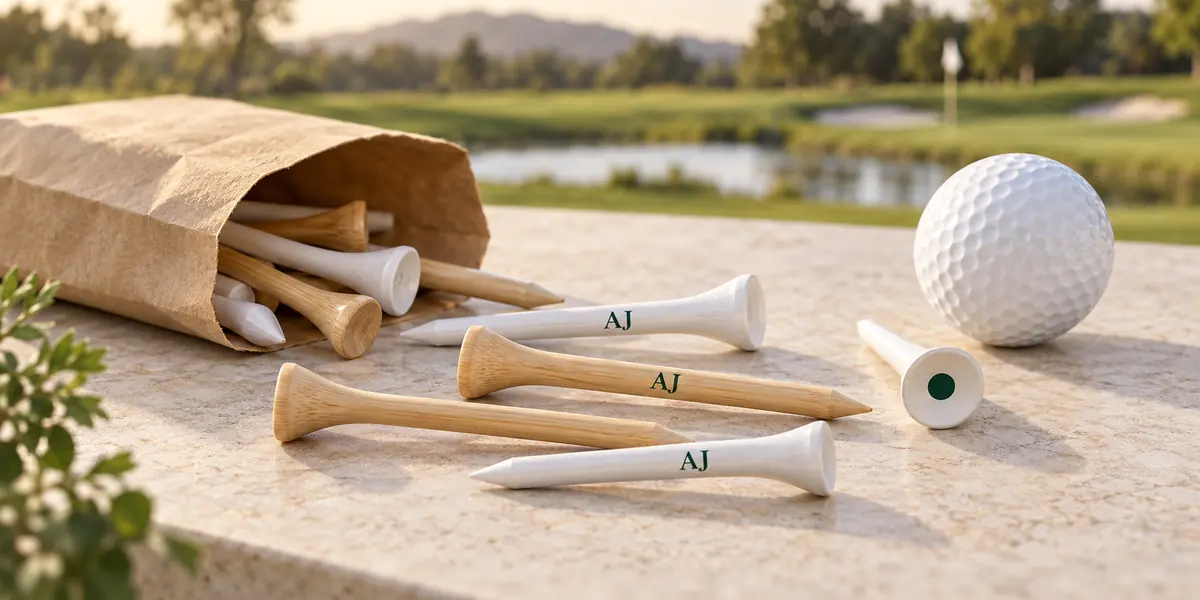
Personalized golf tees work best when the message is short, the print area is confirmed and every pack can be matched to the right design. Choose the tee first, then adapt the name, initials or event text to its actual surface. An enlarged screen proof can hide lettering that becomes unreadable on the finished item.
This guide focuses on names, initials and short messages. For broader material choices, use the bamboo, plastic and wooden tee comparison. Personalization adds artwork and packing decisions; it does not remove the need to confirm length, material and ball support.
Choose what the personalization needs to communicate
| Design direction | Useful starting layout | Check before approval |
|---|---|---|
| Individual initials | A compact mark with clear letter spacing | Exact letter order and punctuation |
| A full name | One readable line where space permits | The longest name and letters with accents |
| Club or event name | A short title, with optional date | Whether the date is legible at finished size |
| Club logo plus player name | A shared mark and a separate name position | Available space and feasibility for each version |
| A longer message | Shorten the tee wording and use a pack card for detail | Consistency between the tee and packaging |
Decide whether everyone receives the same design or whether the content changes between recipients. These are different production briefs. Individual names require a feasibility and quantity review; a total order of 500 pieces does not automatically mean 500 different names can be produced under one approved SKU.

Three checks before choosing the artwork
Choose the tee length
Identify the intended model and length before requesting its usable print area.
Review the final-size design
Check the lettering at actual size and identify the correct reading direction.
Approve the packed result
Match design, count and label so each pack contains the intended version.
Shank print and cup print serve different layouts
The shank is the narrow stem; the cup is the small area that supports the ball. A name or short message may suit a lengthwise shank layout, while simple initials or an emblem may suit a cup position. Both require confirmation on the selected tee: cup shape, surface finish and available decoration area vary.
For an industry example, Personalized Golf Tees separates cup and shank artwork in its order form. That is a useful way to structure your brief, not a statement that every PASSEN tee supports the same positions or printing process.
Ask for a drawing that marks each printable area in millimeters and shows the top, point and reading direction. If both locations are requested, supply separate artwork files and identify the color for each. Do not shrink one detailed logo into both locations without checking the finished result.
Keep names legible on a curved surface
Begin with a simple typeface and enough contrast against the selected tee color. Fine scripts, closely spaced capitals and small interior gaps can become difficult to read. The longest record is a useful layout test, but also include the shortest record and any punctuation, accents or unusual characters.

There is no universal character limit that applies to every tee and font. The limit follows the approved print area, typeface, size and process. If a name is too long, agree whether it will be shortened, moved to another layout or reviewed separately. Do not silently reduce all names until the longest one fits.
Check the real colored surface. A natural grain, painted coating or stripe treatment can affect contrast and positioning. Keep important text away from a color band or another feature unless the combined layout has been approved. A colored stripe is not automatically a calibrated height guide.
Prepare a name list that can be checked
| Field | Purpose | Illustrative entry |
|---|---|---|
| Record ID | Keeps design and pack label connected | A017 |
| Exact text | Preserves spelling, capitals and punctuation | Alex Jordan |
| Tee version | Identifies length and finish | Selected 70 mm version |
| Quantity | States individual tee count for the record | Quantity to be confirmed |
| Pack instruction | Identifies grouping and recipient label | One labeled recipient group |
| Proof revision | Shows which layout was approved | Revision B |
Use one final list instead of mixing names from email, screenshots and separate messages. Provide only the information needed to produce and identify the items. A recipient reference and approved display name are usually more useful here than unrelated personal details.
- Check spelling, initials, dates and duplicate records before sending the list.
- Agree on character handling and the layout rule for long names.
- Review representative artwork at actual size and resolve exceptions.
- Approve the final data list and artwork revision together.
- Keep revisions explicit; identify changed records instead of silently replacing the file.
Current PASSEN tee references and order units
| Reference | Current listing distinction | Order clarification |
|---|---|---|
| 88-9K striped bamboo tees | 70 mm and 83 mm lengths; stripe color references | Counted as individual tees; define additional artwork and pack count separately |
| KIB-5 100-piece tee pack | 70 mm and 83 mm; white, red or natural references | 500 individual tees per SKU equals five 100-piece packs |
For KIB-5, confirm the selected material in writing because the title refers to bamboo while the existing material field uses wood / bamboo. Neither listing establishes unrestricted variable-name production or a particular cup-print process. Request feasibility for the intended personalization before approving quantities.
Inspect the sample and verify the pack count
Review name accuracy, print position, contrast, registration and the finish around the cup and point. Ask for a representative decorated sample on the selected tee rather than approving only flat artwork. Define any rub or handling evaluation and compare the result with the agreed sample; do not assume an unverified scratch-proof finish.
Separate recipient grouping from purchasing units. As an arithmetic example, 20 recipient packs with 25 tees in each contain 500 tees. That calculation alone does not approve 20 different names, waive a minimum per SKU or establish a custom 25-piece packing option. The production and packing arrangement must be quoted explicitly.
For variable designs, reconcile the completed count to the approved list and check the label against actual contents before sealing each pack. Keep loose designs separated during assembly. A reserve allocation should state whether spare tees are blank, event-branded or assigned to specific names.
What to send for a personalized tee quote
Send the model, length, selected material and color, print locations, exact artwork, number of distinct designs, quantity per version, packing plan and destination. Include the required arrival date and ask for sample, artwork and production timing for this configuration. For packaging choices, see the accessory packaging guide.
General PASSEN standard MOQ is 200 per SKU and logo, color or packaging customization starts at 500 per SKU. The KIB-5 100-pack exception starts at 500 individual tees, or five packs, per SKU for standard and custom orders. Different SKUs do not combine to meet a minimum; individual-name arrangements require a separate feasibility and quotation review.
Frequently asked questions
Can every tee have a different name?
Submit the number of names and quantity for each. Variable personalization must be reviewed and quoted; it is not automatically included in the general MOQ.
How many characters fit on a tee?
The limit depends on the model, print area, font and process. Approve the longest and shortest examples at actual size.
Can I print both the cup and shank?
Request feasibility for the selected tee and supply separate layouts. Availability on one design does not establish it for every model.
Are 500 tees the same as 500 packs?
No. For the 100-piece KIB-5 pack, 500 tees equal five packs. Always state both quantities.
What should I check on the physical sample?
Check the exact text, orientation, legibility, print finish, tee dimensions and completed packaging against the approved brief.
Do I need a separate label for each name?
Where packs are allocated to individuals, an agreed recipient reference or label helps match contents to the final list. Confirm the packing process in the quotation.
Discuss your project
Send your selected format, quantity per SKU, artwork, packaging and delivery destination for review.