
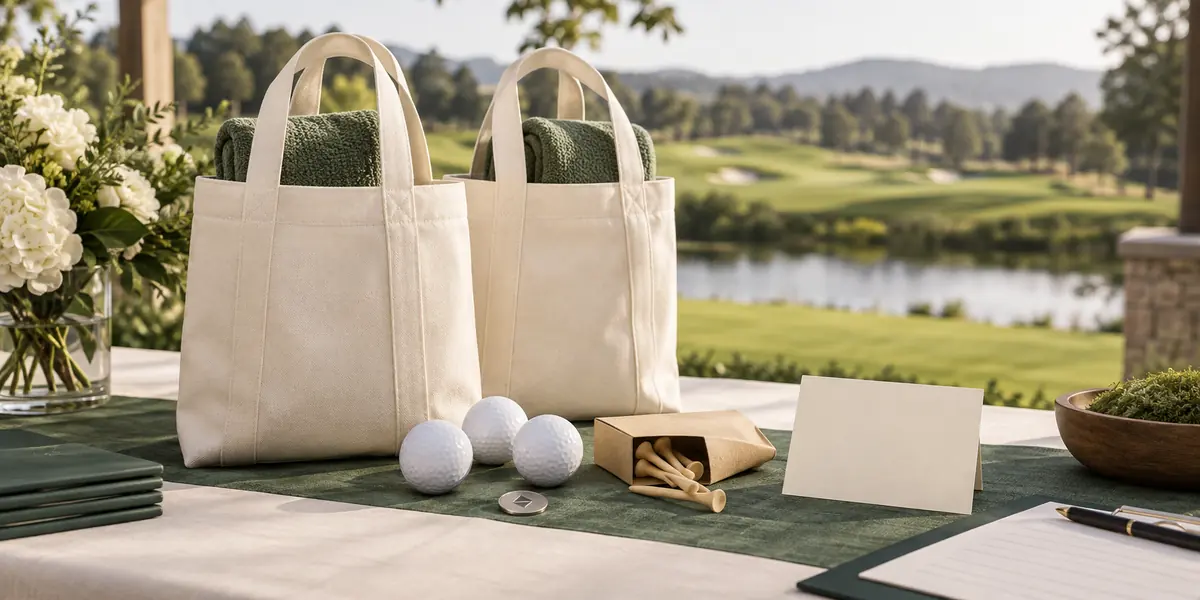
Useful golf tournament gift bags combine items players will use, a clear event identity and a distribution plan that works at registration. Begin with the audience and complete-pack budget, then select a small coordinated mix. More items are not automatically a better gift.
This page covers assembly and event delivery. For a broader selection of individual gifts, use our 25 golf tournament gift ideas. The sample combinations below are planning examples, not fixed PASSEN bundles or quoted prices.
Build the program in three stages
Choose the complete mix
List every item and its quantity in one player pack. Include the container and printed information, not just the golf accessories.
Approve the branding
Assign event and sponsor artwork to specific positions. Confirm each version before any components are decorated.
Plan the handover
Decide where cartons arrive, who receives them and how packs are organized for registration and separate recipient groups.
What should go in a golf tournament gift bag?
| Role in the pack | Items to consider | Selection question |
|---|---|---|
| On-course use | Towel, tees, marker or divot tool | Will this audience understand and use it during a round? |
| Organization | Scorecard holder, small pouch or bag tag | Does it fit the intended scorecard or attachment? |
| Event information | Welcome card, schedule or sponsor insert | Is the content final, readable and relevant? |
| Container | Tote, drawstring bag or presentation box | Can it hold the complete load comfortably? |
| Optional upgrade | A selected premium accessory | Does it add value without complicating sizing or distribution? |
Avoid including several items that perform the same job unless that is deliberate. For a mixed audience, favor useful accessories that do not depend on knowing each player’s clothing or glove size. If sized products are important, collect the required information before approving the order.
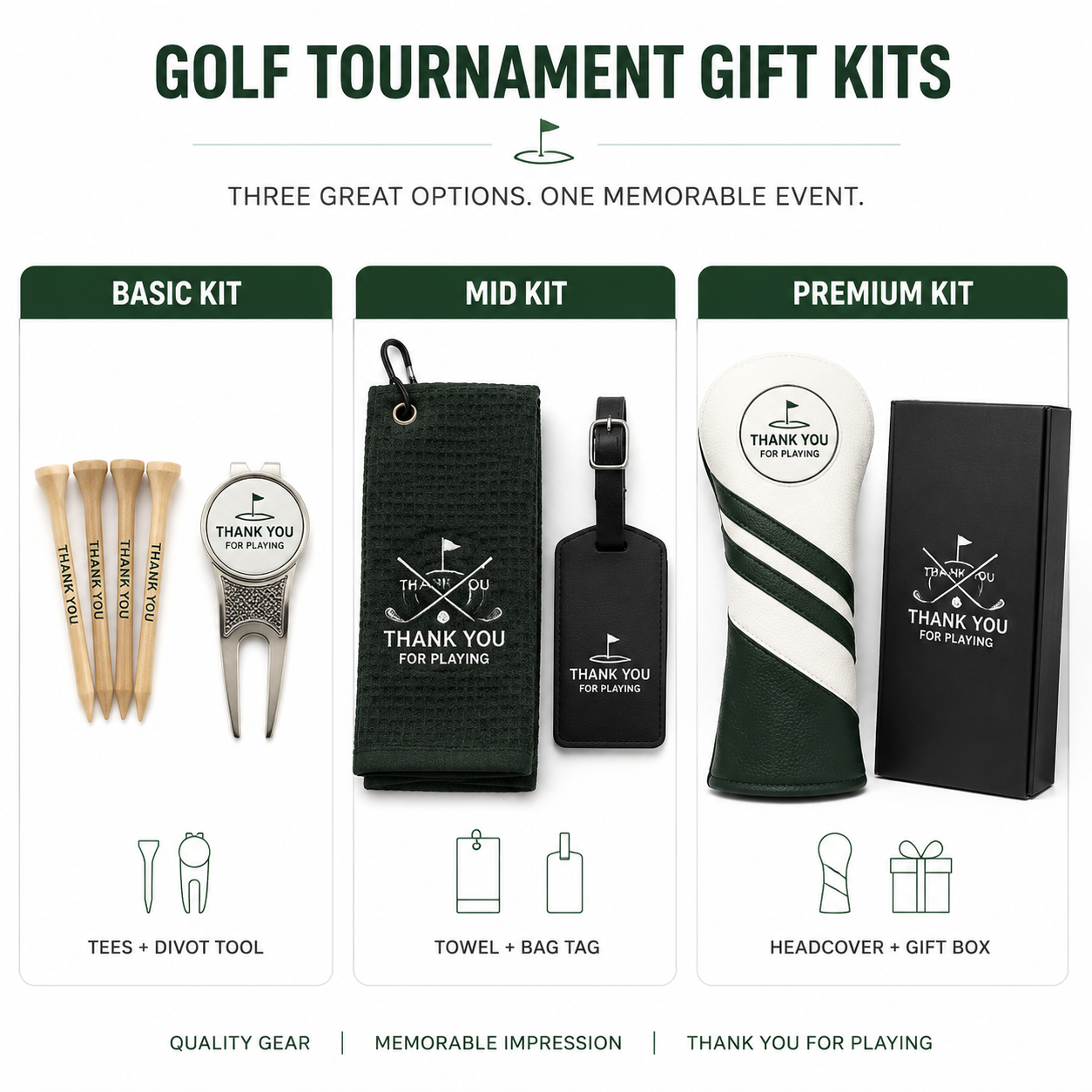
Three example pack combinations
| Planning example | Possible contents | Review before choosing |
|---|---|---|
| Compact player welcome | Tee pack, marker and event card in a small pouch | Exact tee count and space for each component |
| Course-use selection | Towel, divot tool, marker and welcome card in a tote | Metal-to-fabric contact, bag capacity and total weight |
| Club presentation set | Scorecard holder, selected accessory and event card in a fitted box | Scorecard fit, insert layout and registration handling |
For current product references, compare the magnetic hat clip and marker and striped bamboo tees. Each remains a separate item unless the quotation explicitly defines an assembled set. Confirm any other component’s availability, material and decoration before including it in the final brief.
If the items will be supplied as one assembled program, start with the custom golf tournament player pack. The gift set configuration worksheet records contents, artwork, quantity by version, packing and event destination before quotation.

Calculate the pack budget before adding upgrades
Include products, container, decoration, setup, assembly, inserts, transport and any destination charges that apply. Keep prizes, staff gifts and player registration bags in separate budget lines so that one category does not quietly consume another’s allowance.
Planning formula: total program cost = component quantities × quoted unit costs, plus setup, packing, assembly and delivery charges. Divide by the actual number of complete packs to compare options. This is a budgeting method, not a published price list.
Before reducing a useful item’s quality to meet a budget, compare removing a redundant component or simplifying packaging. Ask for a revised complete quotation whenever the mix changes; a replacement can affect both assembly and carton volume.
Count players, recipient groups and reserve packs separately
Use the expected player list as the base. Add any separately approved volunteer, sponsor or guest allocations, then decide the reserve quantity from the event’s registration uncertainty. Keep the reason for each addition visible rather than applying an unexplained percentage.
| Illustrative event allocation | Complete packs |
|---|---|
| Registered players | 144 |
| Approved guest or staff allocation | 8 |
| Organizer-selected reserve | 8 |
| Total to assemble | 160 |
In this example, 160 packs each containing one towel, one marker and ten tees require 160 towels, 160 markers and 1,600 individual tees. These are assembly quantities only: they do not override supplier MOQ or define a standard tee-pack size. Inventory left after assembly needs a named owner and storage plan.
PASSEN standard MOQ is 200 per SKU and logo, color or packaging customization starts at 500; sets are counted as complete sets. Different SKUs do not combine to meet a minimum. The 100-pack bamboo tee exception is 500 individual tees, equal to five packs, per SKU. An event needing 160 personalized packs therefore requires an order plan that addresses these minimums; it is not automatically eligible for a 160-set custom order.
Set a clear sponsor-logo hierarchy
Decide which mark identifies the event, which identifies the host and where sponsor acknowledgments belong. A small marker face may suit one strong emblem better than several tiny logos. Use the insert card for additional names where appropriate instead of crowding every product.
Keep one artwork register with the component, logo version, color reference, decoration position and approver. Obtain the right artwork files and reproduction permissions. Do not assume one printing method or one setup charge covers every surface and sponsor variation.
Gift-program supplier BirdieBox describes product sourcing, decoration, assembly and delivery as connected parts of a program. Use that complete-program perspective, while confirming the actual terms of your own order.
Work backward from the venue receiving date
| Milestone | What must be settled |
|---|---|
| Before dispatch | Packed count, labels, delivery address and receiving contact |
| Before assembly | All approved components and final insert files available |
| Before production | Product and decorated samples accepted; quantities frozen |
| Before sample approval | Artwork, materials, recipient versions and packing layout agreed |
| Before ordering | Budget, required arrival date, approvals and contingency plan assigned |
Ask the supplier to propose a schedule for these stages, including transport and time to inspect on arrival. Set the required receiving date before the event so the organizer can resolve shortages. Do not treat an estimated dispatch date as a guaranteed arrival date.
Assemble one pack before approving the full run
- Lay out one complete pack against the component list.
- Place hard or pointed items in appropriate protection before adding fabric pieces.
- Insert the correct event card and check any recipient-specific label.
- Lift and carry the packed bag; check handles, closure and movement.
- Open it as a player would and confirm the count and presentation.
- Record the approved arrangement and repeatable packing order.
For detailed choices of inserts and shipping protection, use the golf accessory packaging guide. Keep unapproved substitutions out of the packing line; even a similar-looking accessory can change fit or the promised contents.
Make registration easy for the event team
Label cartons by pack version and quantity. Put player packs, sponsor gifts and reserves in clearly separated groups. Give the receiving team a packing list and identify who can authorize using reserves or resolving a shortage. If names are used, agree on the sorting method before cartons are closed.
At receipt, check carton count and condition, compare representative complete packs with the approved reference and report discrepancies promptly. Keep a small confirmed sample at the registration desk so volunteers can answer what is included without opening every bag.
Frequently asked questions
How many items should a tournament gift bag include?
There is no fixed number. Choose a useful mix within the complete-pack budget and avoid unnecessary duplication.
Can every sponsor logo go on every item?
That depends on available area and the decoration process. Agree on hierarchy and use an insert for additional acknowledgments where needed.
How many spare bags should I order?
Base reserves on the organizer’s registration uncertainty and separate recipient allocations. Document the chosen quantity rather than treating one percentage as universal.
Can I order below the custom MOQ for a small event?
Do not assume an exception. Review the required quantities against the confirmed minimum for each SKU or complete set before committing.
Should bags be assembled before delivery?
Compare venue labor, product protection, recipient sorting and delivery volume. Specify who assembles and verifies the final contents.
What should I send to start a quote?
Send the event date, required arrival date, recipient counts, budget scope, proposed contents, branding, pack versions and receiving destination.
Discuss your project
Send your selected format, quantity per SKU, artwork, packaging and delivery destination for review.