
Golf Accessories Market Size and Growth Forecast (2026-2034): Data Every Customer and Supplier Should Know
The global golf equipment market was valued at approximately $8.6 billion in 2024 and is projected to reach $13.2 billion by 2032, representing a compound annual growth rate of 5.5%. Within this market, the accessories segment — everything that is not clubs, balls, bags, or apparel — is growing faster than the overall market at 6-8% annually, driven by customization demand, sustainability trends, and the expansion of golf participation globally.
This article provides the market data, growth drivers, and segment-level analysis that customers need to make informed purchasing and inventory decisions. The numbers cited come from published industry reports, trade association data, and cross-referenced market analyses.
Key Takeaways
- The golf accessories market is approximately $4.2 billion globally and growing at 6-8% annually, outpacing the broader golf equipment market. Customization and sustainability are the two primary growth drivers.
- Asia-Pacific is the fastest-growing region with 10-12% annual growth, driven by golf's expansion in China, South Korea, Vietnam, and India. North America remains the largest market by absolute dollar value.
- Training aids and eco-friendly accessories are the two fastest-growing subcategories, both growing at 20-30%+ annually. The conventional accessories market (tees, towels, markers) is growing at 3-5%.
- The average accessory spend per active golfer is approximately $120-180 per year in North America, $80-120 in Europe, and $40-80 in Asia-Pacific. These numbers are rising in all regions as customization becomes more accessible and desirable.
- Online supplier research is replacing trade shows. Over 70% of pro shop customers now research suppliers online before making contact. A supplier's digital presence is now more important than their trade show booth.
Market Size and Segmentation
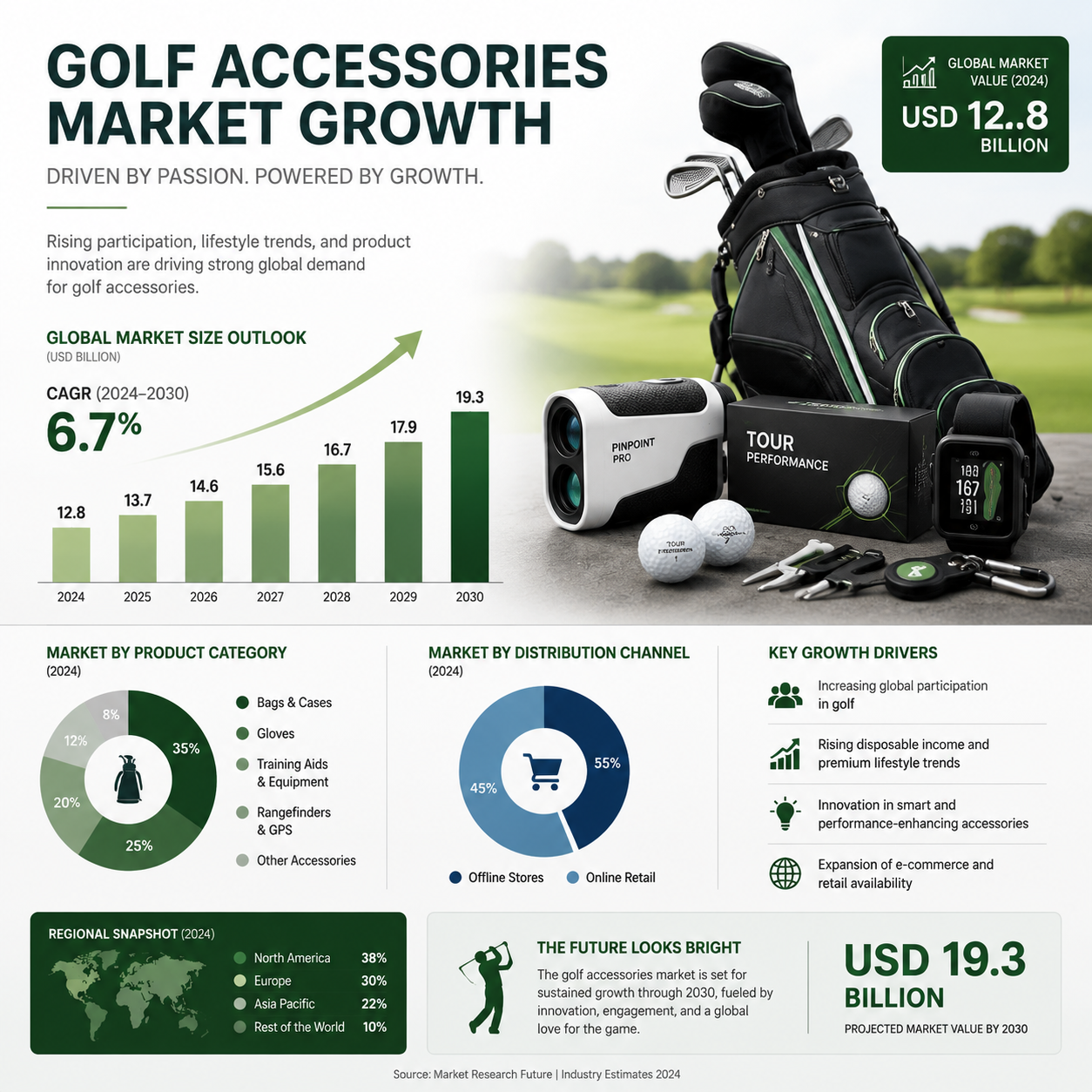
The $4.2 billion golf accessories market breaks down into five primary segments. Understanding the relative size and growth trajectory of each segment is essential for inventory planning and supplier selection.
| Segment | 2024 Market Size | Annual Growth | Key Driver |
|---|---|---|---|
| Headcovers & Protection | $950M | 5-7% | Customization demand, premium materials |
| Towels & Cleaning | $780M | 4-6% | Eco materials, corporate branding |
| Tees & Consumables | $620M | 3-5% | Bamboo adoption, bulk orders |
| Training Aids | $520M | 25-35% | Launch monitors, home simulators |
| Markers, Tools & Others | $1,330M | 4-8% | Souvenir demand, gift market |
Training aids are the outlier. A $520 million segment growing at 30% annually will surpass $1 billion by 2028, making it the second-largest accessories category behind the broad "markers and tools" segment. Any retailer or supplier not carrying training aids by 2027 is leaving a significant revenue stream unaddressed.
Regional Breakdown: Where the Growth Is
| Region | Market Share | Growth Rate | Key Markets |
|---|---|---|---|
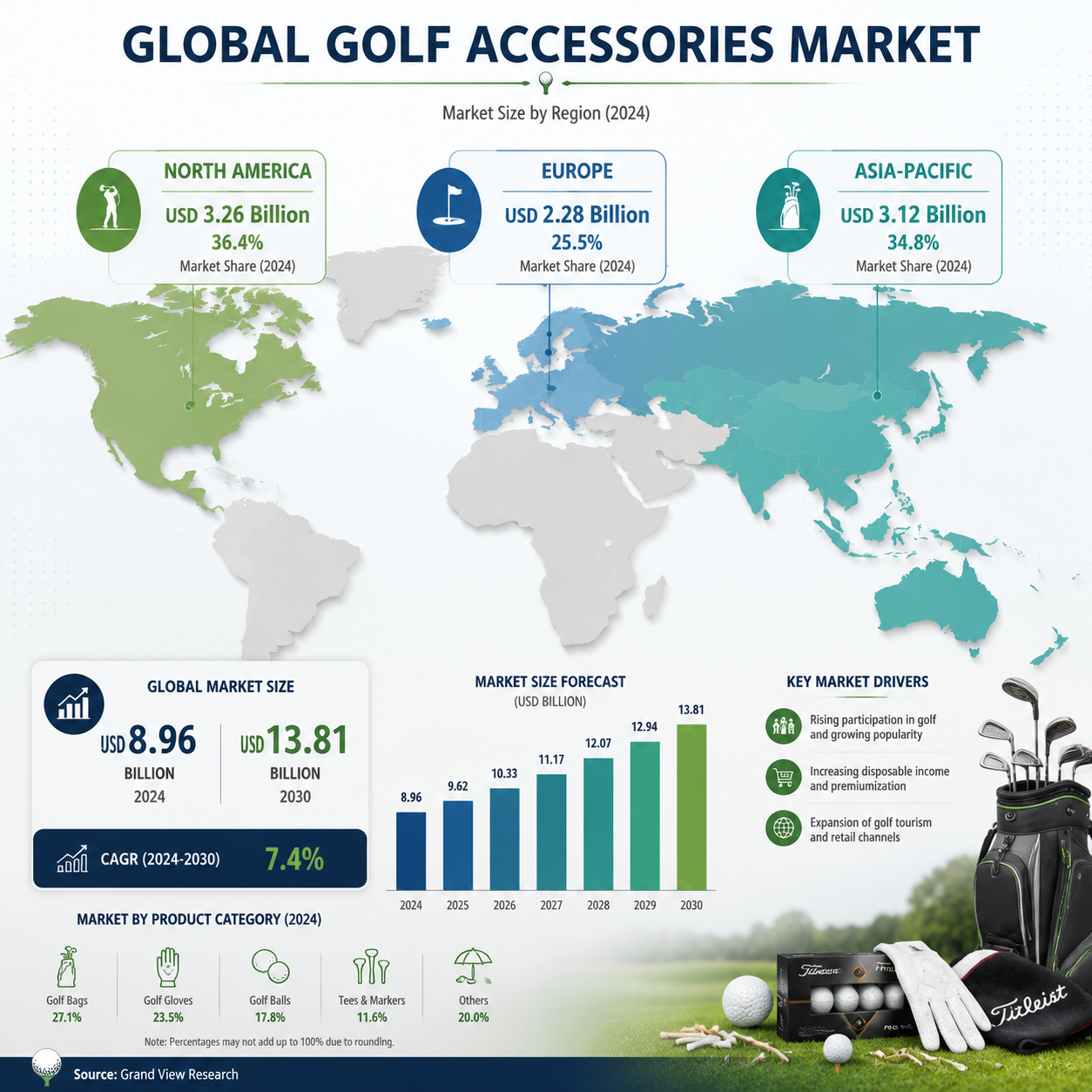
| North America | 48% | 4-6% | US (37M golfers), Canada |
| Europe | 22% | 3-5% | UK, Germany, Sweden, France |
| Asia-Pacific | 22% | 10-12% | South Korea, Japan, China, Vietnam |
| Rest of World | 8% | 5-8% | Australia, UAE, South Africa |
North America remains the dominant market by dollar value, but Asia-Pacific is the growth story. South Korea alone has over 5 million active golfers in a country of 52 million people — nearly 10% participation rate. Vietnam is building golf courses at a pace of 10-15 new courses per year. These markets represent significant opportunities for accessory suppliers who can establish distribution relationships early.
Golf Participation: The Foundation of Growth
The accessories market grows when golf participation grows. The post-COVID golf boom has proven durable. An estimated 41.1 million Americans played golf in 2025 (on-course and off-course combined), up from 34.2 million in 2019. This is not a temporary spike. Junior participation is at an all-time high. Women's participation grew 22% from 2019 to 2025. Off-course golf (simulators, Topgolf, driving ranges) has expanded the definition of a "golfer" to include millions who do not belong to a traditional golf club.
For accessory customers, the most important participation trend is the growth of off-course golfers. A Topgolf visitor who buys a branded towel or ball marker is a different customer than a private club member, but they spend real money on accessories. The off-course segment is driving demand for affordable, fun, and customizable accessories that the traditional golf retail channel has largely ignored.
E-Commerce and DTC Trends in Golf Accessories
Online sales of golf accessories grew an estimated 18% in 2025, well above the overall accessories market growth rate. Amazon's golf accessories category expanded by over 200 new branded sellers in 2025 alone. Direct-to-consumer brands like Swag Golf, Seamus Golf, and Asbri Golf have proven that premium accessories can be sold online without traditional retail distribution.
For pro shops, this means competition from online channels is increasing. The response should not be to compete on price. The response should be to compete on exclusivity and experience. An accessory with the club's logo cannot be purchased on Amazon. A training aid that the member can try before buying cannot be demoed on a website. These are the pro shop's structural advantages. Lean into them rather than fighting a price war that cannot be won.
What This Data Means for Inventory Planning
The market data translates into practical inventory decisions. Here is what the numbers suggest for three common customer profiles.
For Pro Shops: Allocate 25-30% of accessory inventory budget to training aids, up from the typical 10-15%. This category is growing 4-5x faster than the rest of the market and the margins are healthy. Shift 10% of the headcover budget to training aids for the next two quarters and measure the results. The data suggests this trade will be net positive.
For Corporate Gift Customers: Eco-friendly accessories are not a trend. They are the new baseline. Over 50% of corporate gift recipients surveyed in 2025 said they prefer sustainable products. Budget for rPET towels and bamboo tees, not because they cost slightly more, but because they perform better as corporate gifts. The sustainability story adds value that the recipient's organization can share with its customers and stakeholders.
For Accessory Suppliers: The Asia-Pacific market is growing at 2-3x the rate of the North American and European markets. If your business is 100% focused on the US and Europe, you are missing the region that will generate the majority of global growth over the next decade. Establishing distribution in South Korea, Japan, or Vietnam is a 2-3 year investment that pays dividends for decades.
FAQ
How reliable are these market size figures?
The figures cited are drawn from published reports by Allied Market Research, Grand View Research, the National Golf Foundation, and cross-referenced industry analyses. Golf accessories is a fragmented category with no single authoritative data source. The segment-level breakdowns are estimates based on triangulating multiple sources. Treat the absolute dollar figures as directional. The growth rates and relative segment sizes are more reliable than the absolute market size figures.
Will the golf boom continue, or is it a pandemic-era bubble that will deflate?
The evidence strongly suggests durability. Junior participation is at record levels. Off-course golf has created an entirely new entry point that did not exist at scale before 2019. Golf course closures, which averaged 130 per year from 2010-2019, have slowed dramatically (under 40 per year in 2023-2025). New course construction has resumed in multiple markets. The underlying demographics and participation trends support continued growth through at least 2030.
What should a small pro shop do with this market data?
One action: add one training aid SKU on your next order. The market data suggests this is the single highest-return inventory decision available to a small pro shop today. A $25 putting mirror requires no shelf space beyond a 10-foot mat (which you may already have), wholesales at $12-15, and sells largely on the strength of the demo experience. This is the lowest-risk way to participate in the fastest-growing segment of the accessories market.
Which golf accessory categories have strong B2B potential?
Towels, tees, ball markers, divot tools, headcovers, grips, bags, counters, and gift sets are strong because they can be customized and reordered.
How can PASSEN support buyers in a growing market?
PASSEN can help buyers build custom golf accessory programs with product selection, branding, packaging, sampling, and bulk OEM supply.