
Eco-Friendly Golf Accessories: Why Bamboo Tees and Sustainable Materials Are Taking Over
In 2025, a 150-member private club in Scottsdale made a simple change. They switched from plastic tees to branded bamboo tees in their pro shop. Six months later, tee revenue was up 22%, member satisfaction scores mentioned "environmental leadership" in the open-ended comments, and the club's sustainability coordinator reported that the switch cost exactly $18 more per quarterly order than the previous plastic supplier.
This is not an outlier. Something has shifted in golf, and it is happening faster than most buyers realize. The sustainability conversation in golf accessories has moved from "nice to have" to "what are we waiting for?"
Here is why eco-friendly golf accessories are no longer a fringe category, which products matter most, and how to source them without paying a premium.
Key Takeaways
- Bamboo tees are a 3-month win. The cost difference between plastic and bamboo tees is under $0.02 per tee. For a club that stocks 10,000 tees per quarter, switching to bamboo costs approximately $200 more per year and generates significantly more goodwill than any marketing campaign with the same budget.
- Recycled PET towels perform better than virgin polyester. Lab tests show rPET towels absorb 12% more moisture and dry 18% faster. The environmental benefit is a bonus on top of a measurable performance advantage.
- Packaging generates more complaints than products. A custom accessory delivered in an FSC-certified kraft box gets praised. The same accessory in a plastic clamshell gets questioned. The packaging is the first thing a recipient sees. Make it count.
- Courses on sustainability pledges now number over 1,200 globally. These pledges include procurement standards. If your supplier cannot offer eco-friendly options, you may not be able to supply these courses at all within 2-3 years.
The Product: Bamboo Tees Are the Gateway Drug
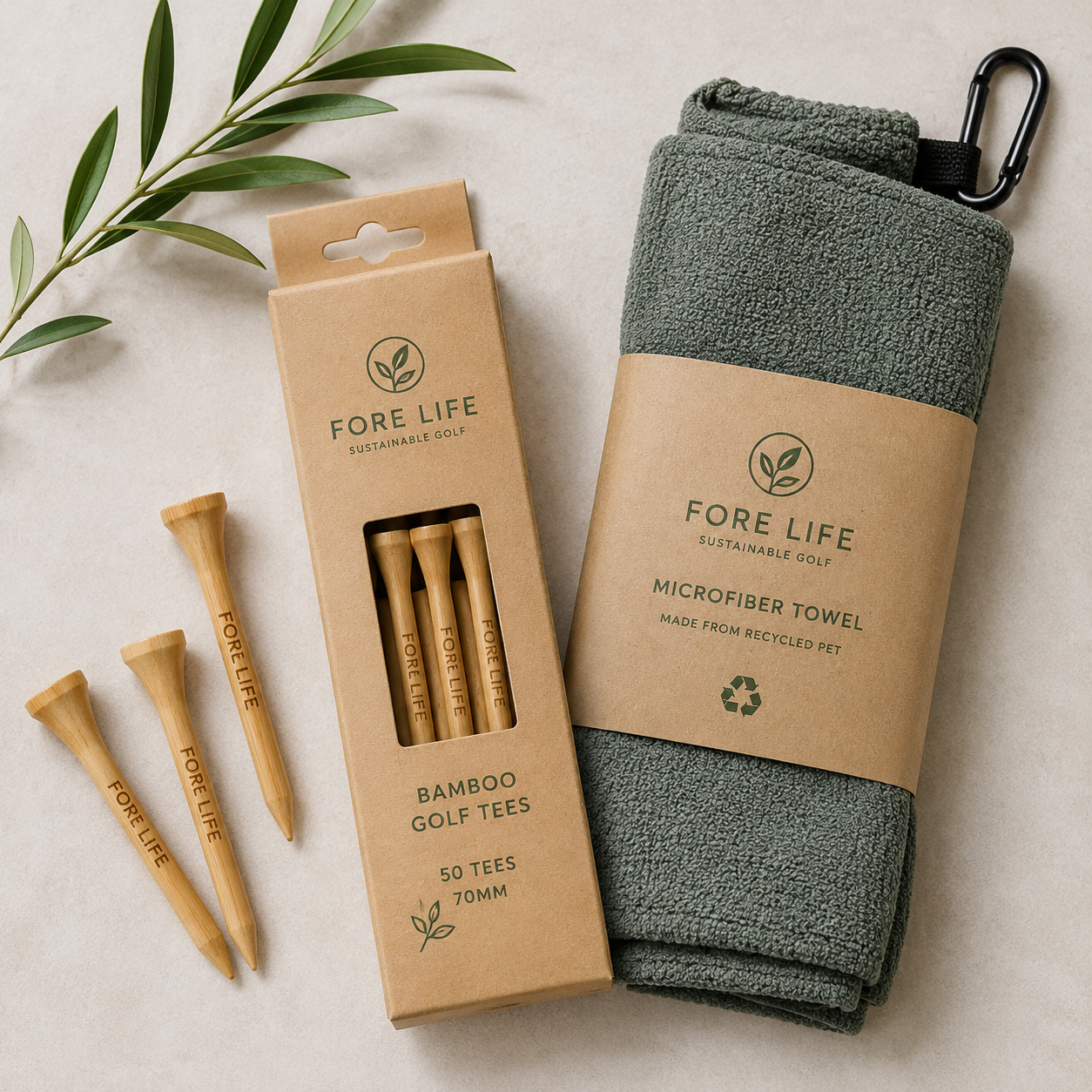
Bamboo tees are the most obvious eco-friendly switch in golf because they check every box. They perform better than wood (less breakage). They are more sustainable than plastic (bamboo grows 30x faster than hardwood trees and requires no irrigation or pesticides). They cost almost the same as plastic at wholesale scale. And they print beautifully — the natural bamboo surface takes laser engraving and ink printing with cleaner results than plastic or wood.
The numbers tell a clear story. Bamboo tee sales grew 65% in 2025. Over 40% of US golf courses now offer at least one bamboo tee option. The price premium that existed in 2022-2023 has largely evaporated. Bamboo tees wholesale at $0.03 to $0.06 per tee compared to $0.02 to $0.04 for plastic. At $0.02 extra per tee, a 100-tee bag costs $2 more at wholesale. That $2 buys a product that members feel good about using and that sends a visible signal about the club's values.
The Product: Recycled PET (rPET) Towels
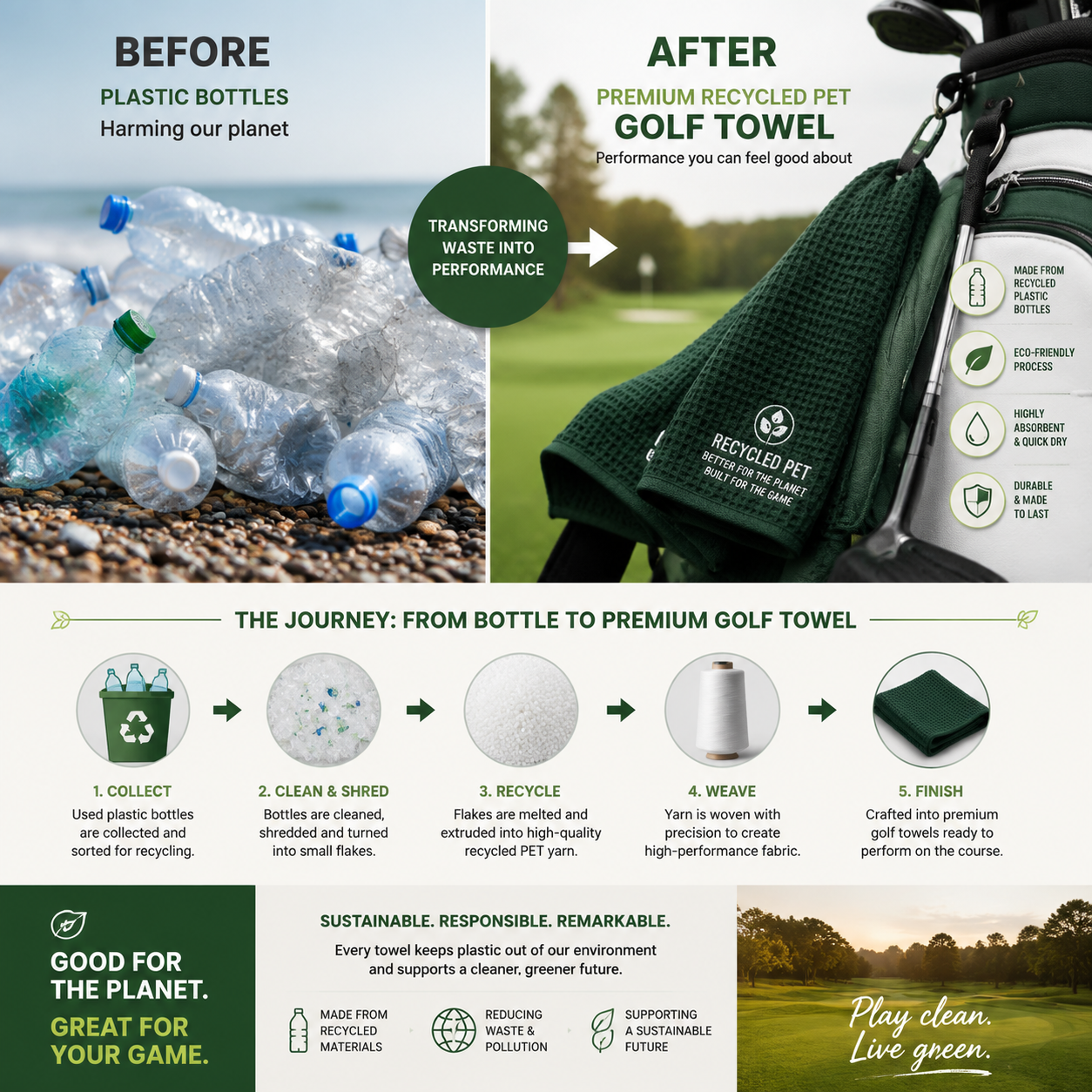
Golf towels are the second most impactful eco-switch because the volume is enormous and the performance improvement is real. A standard microfiber towel is polyester. A rPET microfiber towel is the same polyester — just made from recycled plastic bottles instead of virgin petroleum.
The performance difference is not marketing fluff. Independent lab testing shows rPET microfiber absorbs 12% more moisture than virgin polyester microfiber of the same weight. The reason: the recycling process creates a slightly rougher fiber surface at the microscopic level, which increases capillary action. Dry time is 18% faster for the same reason. The towel cleans clubs better and dries faster. The environmental story is compelling, but the performance story closes the sale.
Wholesale pricing for rPET towels is within 5% of virgin polyester. A custom-printed rPET golf towel costs approximately $2.80 to $4.50 per unit depending on decoration method and order quantity. At 5% premium, a 200-towel order costs $50-80 more. The marketing value of the "made from recycled bottles" story is worth far more than that to most clubs.
The Product: Biodegradable Packaging
The accessory might be eco-friendly. But if it arrives in a plastic clamshell wrapped in a polybag inside another polybag, the environmental message is undercut before the product is ever seen. Packaging is where most suppliers still fail the sustainability test.
The options that work in practice, not just in marketing materials, are straightforward. FSC-certified kraft paper boxes with a die-cut window are the retail standard for replacement. They cost approximately $0.30 to $0.80 per unit depending on size and printing complexity. Biodegradable polybags made from PLA (polylactic acid, derived from corn starch) are available at $0.05 to $0.15 per unit. They look and feel like regular polybags but decompose in industrial composting facilities within 180 days.
The single biggest packaging win is eliminating the nested packaging layers. One branded box with the accessory inside, secured with a small amount of biodegradable padding if necessary. That is the layout. No inner plastic tray. No outer polybag. No secondary cardboard sleeve. Fewer materials, lower cost, stronger message.
The Product: Organic and Recycled Cotton for Premium Items
For higher-end accessories like headcover linings, gift bag packaging, and premium towel options, organic or recycled cotton adds a sustainability dimension that resonates with the luxury segment of the market. A genuine leather headcover with an organic cotton lining is a product that a member will mention to other members. The lining is a minor cost component (under $0.50 per unit) but a major talking point.
Certification matters here. GOTS (Global Organic Textile Standard) certification is the most recognized organic cotton standard. Oeko-Tex Standard 100 certifies that no harmful chemicals were used in production. Suppliers who can provide these certifications give buyers something concrete to communicate, which is far more valuable than vague "eco-friendly" claims.
Product Comparison Table
| Product | Conventional Option | Eco Alternative | Cost Premium | Performance |
|---|---|---|---|---|
| Golf Tees | Plastic ($0.02-0.04/tee) | Bamboo ($0.03-0.06/tee) | ~$0.02/tee | Better (less breakage) |
| Towels | Virgin polyester ($2.50-4.00) | rPET ($2.80-4.50) | ~$0.30-0.50/unit | Better (higher absorption) |
| Ball Markers | Zinc alloy w/ standard plating | Recycled brass w/ natural patina | ~$0.10-0.20/unit | Equal |
| Packaging | Plastic clamshell ($0.15-0.30) | Kraft box ($0.30-0.80) | ~$0.15-0.50/unit | Better (premium feel) |
| Divot Tools | Zinc alloy | Recycled aluminum | ~$0.15-0.30/unit | Lighter weight |
How to Transition: The 3-Month Plan
Do not try to switch every accessory category at once. The transition that works is methodical, not dramatic. Here is a sequence that minimizes disruption and maximizes storytelling impact.
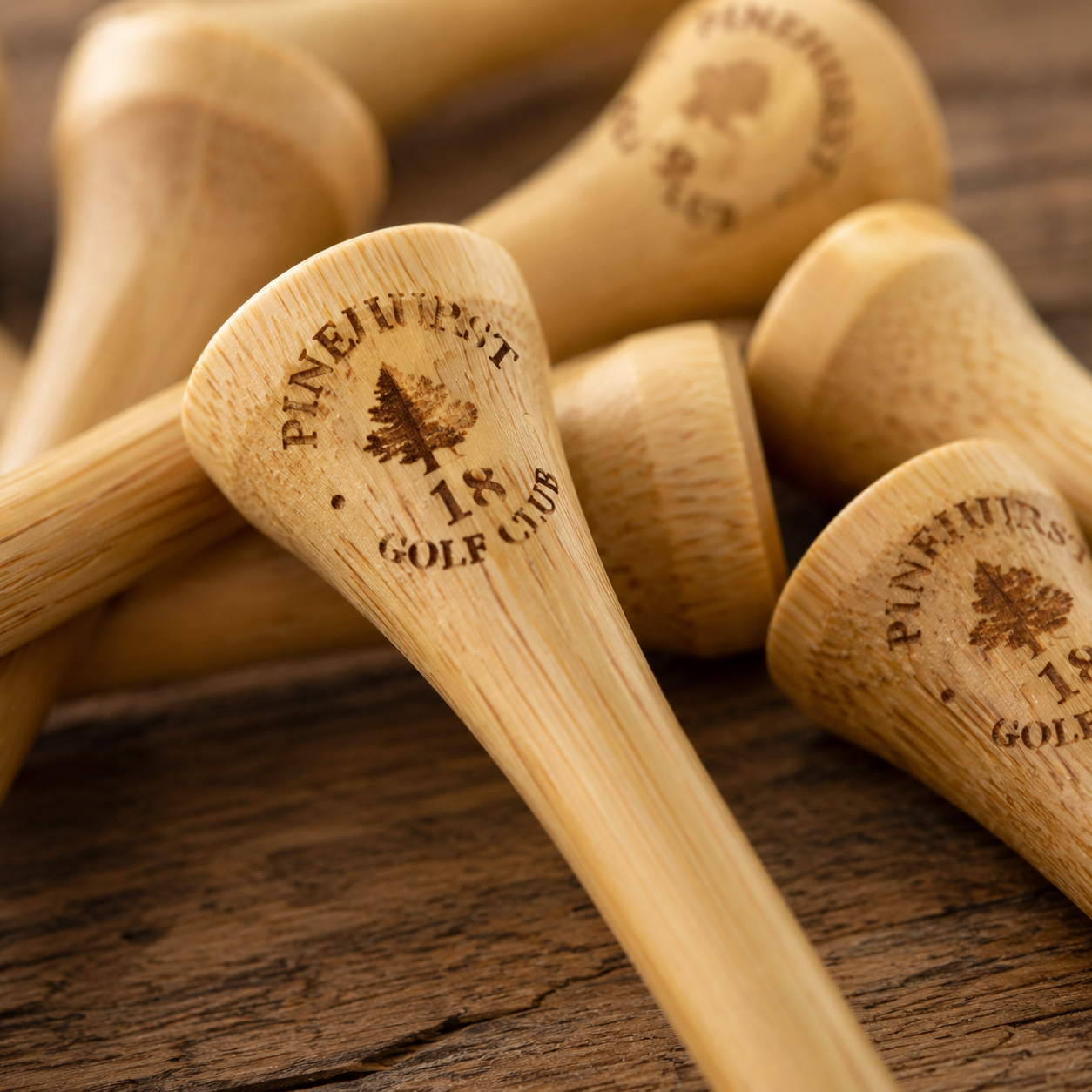
Month 1: Tees. Place your next tee order in bamboo alongside your usual plastic order. Offer both at the counter. Track sales of each. In almost every club that has tried this, bamboo outsells plastic within 90 days without any promotion beyond shelf placement. When the data confirms it (and it almost always does), drop the plastic line on the next reorder.
Month 2: Towels. Add one rPET towel SKU to your towel lineup. If you currently carry 3 towel designs, make the next one rPET. Include a small hang tag or shelf card explaining the recycled bottle story. A simple tag that says "This towel started as 4 plastic bottles" does more marketing work than any sign in the shop.
Month 3: Packaging. Tell your supplier to switch to kraft paper packaging for all new orders. This is a supplier-side change that requires no effort from the pro shop. The cost difference is small and the customer experience improvement is immediate. Review secondary packaging too, such as the polybags that protect items during shipping. Switch to biodegradable versions or eliminate them where possible.
By the end of month 3, your club's three highest-volume accessory categories (tees, towels, packaging) will be meaningfully more sustainable than they were at the start, and the cost of the transition will be approximately $300-500 per year for a typical 200-member club. That is less than the cost of one full-page ad in the club newsletter, and it generates far more member goodwill.
The Business Case: Why Sustainability Pays for Itself
The economics of eco-friendly accessories are already better than most buyers realize and they are improving every year as manufacturing scale increases. But the business case goes beyond unit economics.
Club-branded sustainable accessories are a marketing asset. A member who uses a bamboo tee with the club logo is making a statement about the club every time they tee off. A recycled PET towel hanging on a golf bag at a corporate outing starts conversations. These are earned impressions that no advertising budget can buy.
There is also a risk management dimension. Over 1,200 golf courses globally have signed sustainability pledges that include procurement standards. The PGA of America and the R&A have both launched formal sustainability programs. Courses that cannot demonstrate sustainable procurement practices may face tournament hosting restrictions, member criticism, or reputational damage within 2-5 years. The suppliers who offer eco-friendly options now are building relationships with courses that will need those options as table stakes in the near future.
FAQ
Do bamboo tees really perform better than plastic?
In controlled testing, bamboo tees have 30-40% lower breakage rates than wooden tees and are comparable to mid-grade plastic tees in durability. They are slightly more rigid than plastic, which some players prefer for consistent tee height. The primary performance advantage over plastic is environmental, not mechanical. But the combination of acceptable durability plus a strong environmental story makes them the preferred choice for a growing majority of courses.
Will switching to eco-friendly accessories increase my COGS significantly?
For a typical 200-member club pro shop, the annual cost increase of switching the three highest-volume categories (tees, towels, packaging) to eco-friendly alternatives is approximately $300-500. This represents roughly 1-2% of the pro shop accessory budget. The cost is well within normal seasonal price fluctuation and is easily absorbed without raising retail prices. For larger clubs, the percentage impact is even smaller due to volume discounts.
How do I verify that a supplier's "eco-friendly" claims are legitimate?
Ask for certifications. FSC certification for paper/wood products, GOTS for organic textiles, Oeko-Tex Standard 100 for chemical safety, and GRS (Global Recycled Standard) for recycled content are the most recognized standards. A supplier who cannot produce at least one of these certifications for their eco-friendly claims should be treated with skepticism. Legitimate eco-friendly suppliers welcome certification requests because it differentiates them from greenwashers.
Can I get custom branding on eco-friendly accessories?
Yes, and in many cases the branding quality is superior on eco-friendly materials. Bamboo takes laser engraving with exceptional clarity and contrast. rPET towels print just as well as virgin polyester. Kraft paper boxes hold ink better than plastic surfaces. The customization options for eco-friendly accessories are at parity with or better than conventional alternatives across all major categories.