
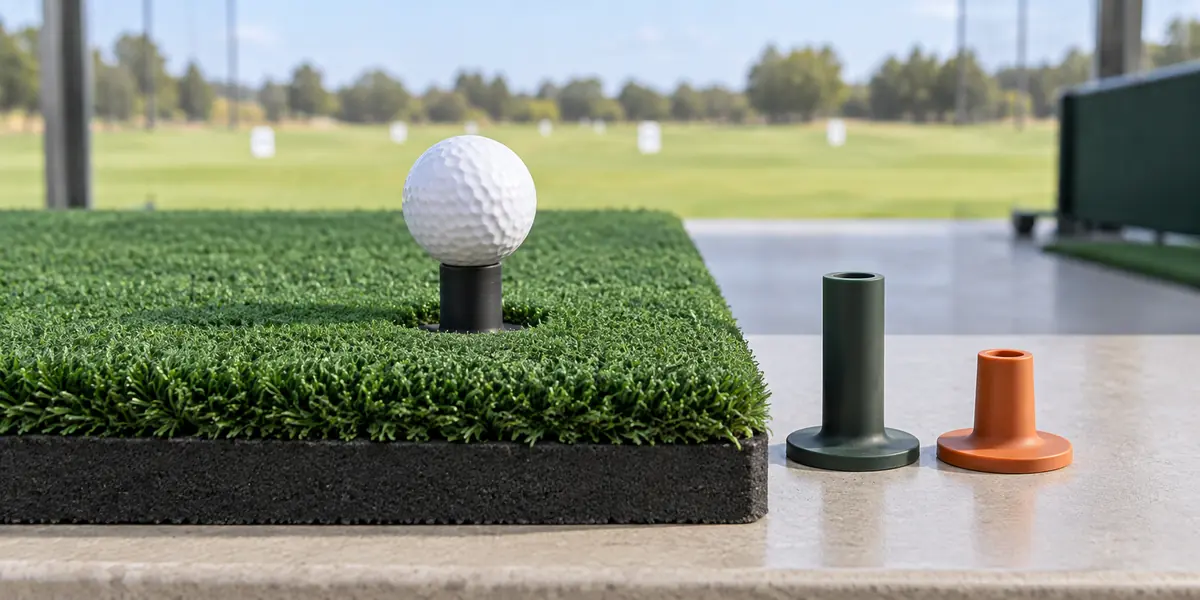
Select custom rubber golf tees by their usable height above the playing surface and their fit with the intended practice setup. The tee’s overall length, packed dimensions and usable ball-support height are different measurements. Establish the mat or ground arrangement first, then compare fixed and adjustable designs.
Rubber tees are often associated with driving ranges and simulators, but mounting systems vary. Some pass through a mat, some support a separate tee and some use other arrangements. A product should be matched to the specific surface rather than described as fitting every hitting mat.
Compare the tee formats before choosing a height
| Format | What it changes | What to verify |
|---|---|---|
| Fixed-height rubber tee | A defined body geometry for repeated placement | Height above the installed mat and base fit |
| Adjustable tee | Allows a range of selected positions | Actual usable range and how the setting is retained |
| Holder for a separate tee | Uses a holder and a replaceable tee as a combination | Accepted tee dimensions and retention |
| Surface-standing practice tee | Rests on a surface instead of passing through a hole | Stability, movement and the intended application |
These categories describe selection directions. They do not mean the current PASSEN model offers every mounting method. Request an operating demonstration for the chosen version before assigning it to a mat or simulator installation.

Three checks for a working setup
Working height
Measure from the playing surface to the ball-support point in the installed position.
Fit and stability
Inspect the base, stem and adjustment together on the intended practice surface.
Identify the version
Record the selected model and color so samples, labels and repeat orders describe the same item.
Measure installed height, not package length
For an under-mat design, part of the tee sits below the hitting surface. A tee that looks tall on a table can expose much less height once installed through thick turf and backing. Ask which points define the supplier’s measurement, then measure the actual installed setup.
A simple example shows the distinction: if a support point sits 60 mm above a common mounting datum and the playing surface sits 30 mm above that same datum, the exposed support height is 30 mm. This is an illustrative measurement example, not a PASSEN specification. The relationship only applies when both measurements share the same reference point; base position and turf compression still need review.
For adjustable constructions, obtain the minimum and maximum usable support heights, how those heights are measured and whether the setting remains stable during intended use. Do not use a package dimension as the adjustment range. Record the installed setting after a working sample has been approved.
Match the base and stem to the mat
- Identify the mat manufacturer and model, including the hitting strip or insert if it is separate.
- Provide the existing mounting arrangement, hole diameter where applicable and access beneath the mat.
- Measure the relevant turf and backing thickness at the tee location.
- Describe the desired ball-support height and clubs used for practice.
- Install the sample according to the tee and mat instructions, then check ball support and stability before normal use.
Follow the mat manufacturer’s guidance before changing an opening or mounting point. Net Return Europe identifies its rubber tee set with the Pro Turf mat and a required hole, while Fiberbuilt describes a Performance Turf construction that accepts real tees. These examples show why the mat system must be identified; their compatibility statements do not establish fit for a PASSEN tee.
Choose the practice height with the player and club
There is no single tee height to assign to every golfer and every club. Start with the player’s intended practice setup and compare the ball position relative to the clubface. A coach or fitter can help evaluate the strike pattern and desired height rather than selecting a setting purely from a product photograph.
When several bays or players share equipment, label the approved tee version or setting clearly. Check that a replacement on a different mat reproduces the intended exposed height. Two identical tees installed through different mat thicknesses may create different ball positions.
Current PASSEN adjustable tee: model OKD
| Listing field | Current reference | Clarification needed |
|---|---|---|
| Product | Adjustable rubber golf tee, model OKD | Operating and mounting method |
| Material | Described as high-toughness rubber | Actual compound or hardness where required |
| Color references | Orange, lime green, royal blue and red | Selected sample color and decoration |
| Packed size | 10 × 5 × 2 cm | This is not a confirmed working height or adjustment range |
| Reference weight | Approximately 20 g | Packed shipment weight and quantity per carton |
The OKD product page does not establish a minimum or maximum working height, a universal mat fit or a tested service life. Request those details for the selected version and review a sample. The generic under-mat concepts in this article’s banner illustrate the topic; they are not a technical drawing of OKD.
Sample checks that reveal practical problems
| Observation | Check | Next decision |
|---|---|---|
| Ball falls from the support | Cup condition, angle, installation and ball placement | Confirm stable support in the intended setup |
| Setting changes during use | Adjustment engagement and retention | Review the mechanism using its instructions |
| Stem or base moves unexpectedly | Mounting fit and the supporting surface | Correct the combination before further evaluation |
| Cracks, tears or lasting deformation | Body, base and adjustment after representative use | Replace the damaged sample and review the specification |
| Decoration wears at a contact point | Logo location and finishing method | Move or revise decoration on the approved design |
Define a representative repeated-use evaluation with the supplier: the setup, clubs, use conditions and acceptance criteria should be recorded. Inspect the tee before and after that evaluation. A rubber description alone does not justify a claim of thousands of impacts, a fixed replacement interval or a particular hardness.
Do not cut, drill or otherwise modify a tee unless the manufacturer provides instructions for that construction. An apparently simple height change can alter the support edge or retention. If the requested setting falls outside the usable range, review another suitable configuration.
Branding and bulk packing
Keep the working cup, flexing areas and adjustment mechanism clear when planning decoration. Request the actual usable logo area and method. Body color, printed contrast and finish should be reviewed on the physical sample; a digital color mockup cannot establish adhesion or wear performance.

For range replenishment, identify each approved height or version on the pack label and record quantities separately. For retail or an event kit, include operating instructions appropriate to the actual model and make clear which parts are supplied. Avoid packing that holds flexible parts bent under pressure or allows components to be confused between versions.
Maintain a reorder reference with the model, mounting setup, working dimensions, selected color, artwork revision and packed contents. If the mat or tee design changes, repeat the fit review. For wooden, bamboo and plastic alternatives used in other settings, see the golf tee material comparison.
Send a quote brief that establishes compatibility
Provide the surface or mat model, mounting details, desired working height, quantity per SKU, color, artwork, packaging and delivery destination. Standard PASSEN MOQ is 200 pieces per SKU; logo, color or packaging customization starts at 500 per SKU. Different SKUs do not combine to meet the minimum. Confirm sample terms, price and delivery timing for the exact version.
Frequently asked questions
Do rubber tees fit every hitting mat?
No. Match the mounting arrangement, stem, base and working height to the actual mat or surface.
What is the OKD height adjustment range?
The current listing does not confirm it. Ask for minimum and maximum usable heights measured in the intended setup.
Is 10 × 5 × 2 cm the working size?
It is the current packed-size reference, not a confirmed working height or adjustment range.
How do I select the right height?
Measure support height above the installed playing surface and review the ball position with the intended club and player.
How long will a rubber tee last?
No fixed service life is established for the listed model. Agree on representative use checks and inspect for damage or loss of function.
Can I order branded rubber tees?
Supply the selected model, logo, quantity, color and packaging brief for feasibility review. Customization starts at 500 per SKU.
Discuss your project
Send your selected format, quantity per SKU, artwork, packaging and delivery destination for review.