

Golf bag tubes create individual channels for club shafts and grips inside a bag. They can be removable plastic inserts, fabric-lined sleeves or part of a built-in full-length divider system. The right choice depends on grip diameter, bag angle, top layout, weight target and how easily clubs must enter and leave the bag.
This guide compares tube constructions, explains common fit problems and provides a sample checklist for custom golf bag programs. For the top layout itself, begin with the 4-way, 6-way and 14-way golf bag divider guide.
Golf bag tubes, top dividers and full-length dividers
| Construction | How it separates clubs | Advantages | Checks |
|---|---|---|---|
| Removable individual tube | One rigid or semi-rigid insert surrounds each shaft and grip | Can be added or replaced separately | Opening diameter, collar, length, retention and rattle |
| Top-only divider | Padded openings separate clubs at the cuff | Lower weight and simple construction | Grip crossing and tangling below the top |
| Fabric full-length divider | Soft partitions continue from top toward the base | Integrated separation with less rigid contact | Continuity, sagging, seam placement and usable width |
| Molded channel system | Structured channels organize clubs through the bag body | Controlled position and premium presentation | Tooling, bag weight, drainage and oversized-grip fit |
Do not assume “14-way” means fourteen independent full-length channels. The top may have fourteen openings while the lower bag uses fewer shared sections. State both the top count and the internal separation scope in the specification.
When removable golf bag tubes are useful
Retrofit organization
Individual inserts can improve separation in an existing open compartment without rebuilding the complete bag.
Club identification
A defined channel can make a club position easier to repeat, especially when the top layout has broad shared openings.
Replaceable component
A worn or damaged tube can be changed separately when the design allows access and the replacement size is controlled.
Removable tubes also introduce trade-offs. A club grip may catch on the internal surface, the tube can lift with the club, or several tubes can reduce usable space inside a small bag. Test the complete set rather than approving one tube on an empty bench.
Construction details behind the tube system
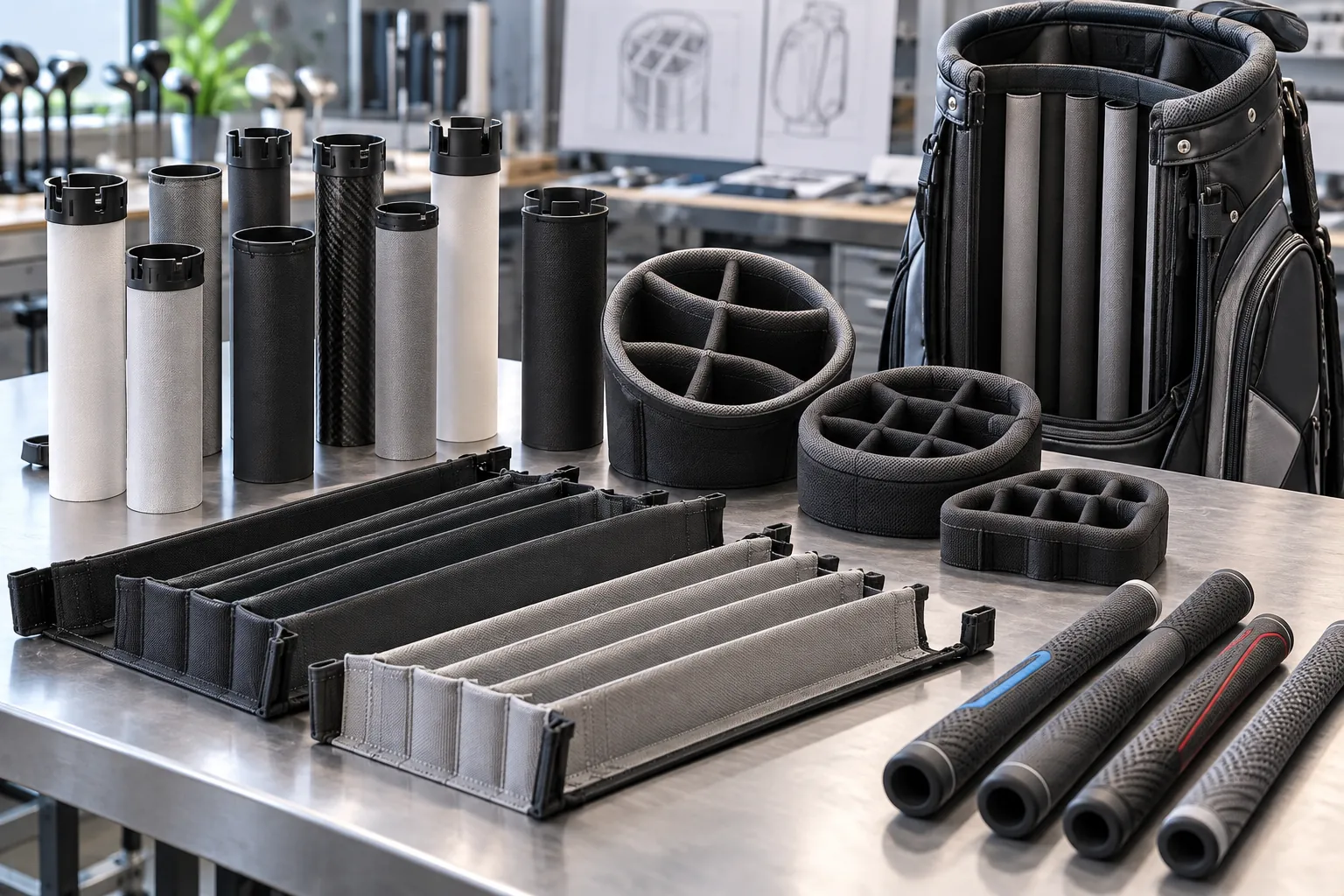
The visible opening is only one part of the system. The tube wall controls stiffness, the top collar protects the grip and cuff, the lower end controls base contact, and the retention method keeps the insert from moving during club removal.
Internal diameter
Check standard, midsize and putter grips separately. The narrowest point may be the collar rather than the tube body.
Finished length
The tube should support the intended separation without pressing into the bag base or sitting too low below the top opening.
Top collar
A rolled, molded or padded edge can reduce sharp contact. Confirm its outside size fits the divider opening.
Wall stiffness
Rigid walls hold shape but may add noise and weight. Flexible walls can deform or bunch if the bag compresses.
Retention
Flanges, clips or anchors can limit pull-out. Check removal force without making service or replacement impractical.
Lower-end finish
Review closed, open and protected ends for drainage, debris collection and contact with the base structure.
Grip clearance is the critical fit check
Golf shafts are narrow, but grips are wider and vary significantly by type. An insert that accepts a standard iron grip may not suit a midsize, oversize or large putter grip. Build the test set around the actual grip mix intended for the customer.
Insert and remove each club at the angles created by the real bag. A cart bag may stand nearly upright, while a stand bag tilts on its legs. A tube that works vertically on a workbench can catch the grip when the bag is leaning.
If the program includes different grip profiles, compare the golf grip size chart and record the largest finished outside dimension used in the fit test.
Prevent lifting, snagging and unwanted noise
A tube may rise with the club when grip friction is greater than the tube’s retention. Check the top collar, internal finish and anchoring method together. Repeated pull-out tests are more useful than one smooth demonstration.
Hard tube walls can also transmit sound when clubs move during transport. Inspect clearance between neighboring tubes and between the tubes and bag shell. Padding, fabric sleeves or controlled grouping may reduce movement, but every added layer changes diameter and weight.
Integrated full-length dividers as an alternative
Soft full-length dividers can separate grips without using rigid individual inserts. They are sewn or attached to the top and internal structure, so the manufacturer can plan channel width, weight and position with the complete bag.
The term still needs a drawing. Ask how many partitions reach the base, where they attach and whether clubs can cross between sections. The stand bag guide and cart bag guide show how divider choices interact with bag format. If specifying a complete cart bag rather than divider tubes alone, review the custom cart bag and confirm its actual internal separation on a sample.
How to approve a golf bag tube sample
Define the test club set
List driver, woods, irons, wedges and putter with their actual grip types and maximum diameters.
Load every position
Place the complete set into the proposed layout. Check that the tubes remain seated and the top does not crowd clubheads.
Test realistic angles
Remove and replace clubs with the bag upright, tilted on its legs and positioned as it will be on a cart.
Cycle and inspect
Repeat club removal, carry and transport movement. Inspect collars, anchors, tube walls, base contact and divider fabric.
Record any grip drag, tube lift, rattling or blocked opening. A retained loaded-layout photo makes later production checks easier because it shows which club belongs in each channel.
Weight, packing and replacement planning
Fourteen individual tubes can add more material than a grouped divider system. Include the complete installed system in the bag’s empty-weight target. For carry products, evaluate whether the separation benefit justifies the extra weight.
Long inserts can also affect shipping. Confirm whether they remain installed, ship as a separate bundle or require protective packing. If replacements will be offered, keep the tube specification, collar and attachment consistent across reorders.
Prepare a custom golf bag tube brief
State whether the system is removable or integrated, the tube count, internal diameter, length, wall material, collar, lower end and retention method. Add the top layout, full-length divider scope, test club set, bag angle and acceptance criteria.
Include bag type, pockets, straps, colors, logo, quantity per SKU, packaging and destination. Use the custom golf bags page to submit the complete program rather than quoting the tube separately from the bag.
Frequently asked questions
What are golf bag tubes?
They are individual channels placed inside a golf bag to separate club shafts and grips. They may be removable inserts or part of an integrated divider system.
Do golf bag tubes fit oversized grips?
Not always. Check the narrowest internal diameter and collar against the actual midsize, oversize or putter grip used in the club set.
Can golf bag tubes pull out with a club?
They can if grip friction exceeds the retention force. Test the exact tube, collar and anchor through repeated club removal.
Are tubes better than full-length fabric dividers?
They solve different needs. Tubes provide individual rigid channels, while fabric dividers can reduce weight and hard contact. Fit and usability decide the better option.
Do golf bag tubes add weight?
Yes. The amount depends on material, count, wall thickness and retention hardware, so weigh the complete installed system.
What should a golf bag tube inquiry include?
Include count, diameter, length, material, collar, retention, top layout, club and grip test set, bag format, quantity per SKU and destination.
Plan a golf bag tube and divider system
Send the bag format, top layout, tube or divider construction, test club set, grip sizes, artwork, colors, quantity per SKU, packaging and destination. PASSEN can review the fit and sample checks before quotation.