

Golf bag dividers organize clubs at the top of the bag and influence how easily each club can be removed, returned and protected during play. The best layout depends on the bag type, the number of clubs, the intended carrying method and the level of separation the buyer expects.
This guide compares the common divider layouts and explains what golf brands, clubs and retailers should specify when developing a custom bag. For a broader comparison of carry, cart, staff and travel formats, see our types of golf bags guide.
4-way, 6-way and 14-way golf bag dividers
| Layout | Best suited to | Key trade-off |
|---|---|---|
| 4-way | Light carry and stand bags, simpler club grouping | Fewer top components and lower complexity, but several clubs share each opening |
| 5-way or 6-way | Versatile stand and cart programs | More separation than a 4-way layout without assigning every club an individual slot |
| 14-way | Highly organized cart, stand and premium bag programs | Individual positions improve organization but add structure, sewing and weight |
| 15-way or putter-well layout | Programs that need a dedicated oversized putter position | The extra opening must suit the selected putter grip and bag profile |
A 14-way top is not automatically better than a 4-way top. A walking golfer may prefer fewer openings and less structure, while a cart-bag buyer may value individual positions and a dedicated putter well. Start with the use case, then select the layout.
Full-length and sectional dividers are different
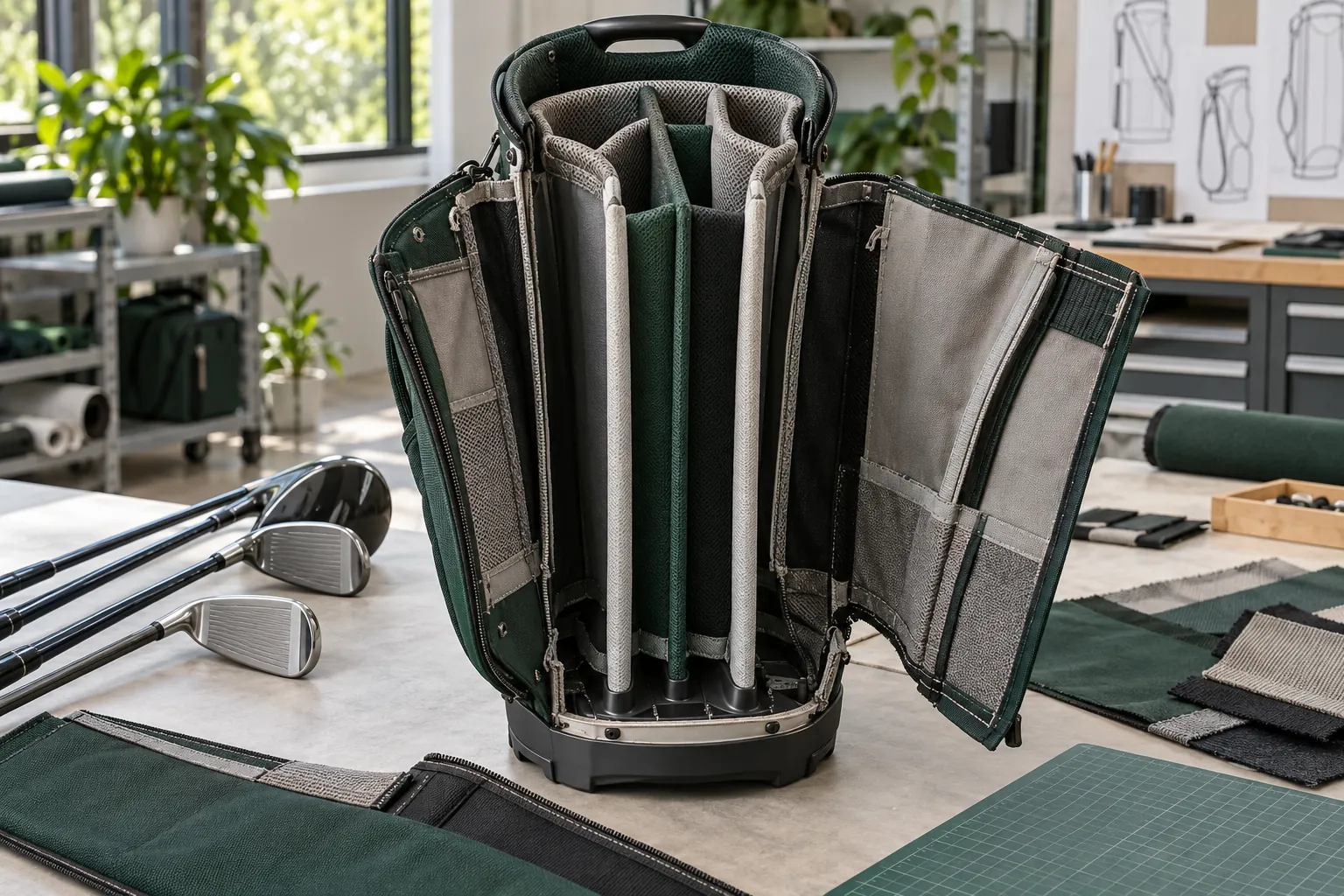
The top cuff is only the visible part of the system. Some bags use fabric sleeves that continue through most or all of the bag body. Other designs divide the top but allow shafts to share space lower in the bag. Buyers should state the intended construction rather than assume “14-way” also means fourteen completely separate full-length channels.
Top-only separation
The top organizes club positions, while shafts may meet below. This can reduce internal components but may allow more shaft contact.
Grouped full-length sleeves
Several top openings can feed into a smaller number of long fabric sections. This balances separation, weight and manufacturing complexity.
Individual full-length channels
Each slot remains separate deeper into the bag. Confirm channel width, seam position and how the sleeves connect near the base.
Inspect the internal sleeves when the sample is empty and again with a complete club set. Loose fabric can bunch around grips. Overly narrow channels can create resistance. Poorly aligned sleeves can make a wide opening feel smaller than it appears.
What divider count changes in daily use
Club organization
More openings make it easier to assign a repeatable location to each club. Fewer openings encourage grouping by woods, irons, wedges and putter. Both approaches can work when the opening layout matches the player’s routine. Our guide to organizing a golf bag shows practical layouts for common top configurations.
Club removal and return
A club should slide without its grip catching on a seam, divider sleeve or another grip. Test the bag upright, on its stand legs and at the angle used on a cart. A system that works when the bag is vertical may feel different when the bag is tilted.
Noise and contact
Dividers can limit some club-to-club movement, but the result also depends on top size, club count, bag angle and how tightly the clubs are packed. Avoid promising silent performance from divider count alone. Evaluate a loaded sample in the intended use position.
Weight and structure
Additional openings, sleeves and reinforcement add material and sewing operations. This matters for a lightweight stand bag. In a cart bag, the extra organization may be more important than a small weight increase. Review the finished sample weight rather than estimating from the top layout.
Details that make a divider system work
Opening geometry
Round, oval and angled openings affect club grouping. Check usable space after padding and binding are installed.
Top-cuff padding
Padding should feel consistent around the perimeter and internal ribs without creating narrow pinch points.
Binding and seams
Exposed edges need clean coverage. Inspect seam position where shafts and grips repeatedly pass through the opening.
Putter clearance
Oversized putter grips may require a larger well. Confirm the actual grip profile used by the target customer.
Handle integration
A molded or fabric handle changes the top structure. Test lifting with the bag loaded and check local reinforcement.
Rain hood fit
The hood must close over the selected club arrangement without pressing heavily on long clubs or the putter.
Match the divider layout to the bag type
A stand golf bag needs a stable relationship between the top, spine, base and leg mechanism. Divider sleeves should not interfere with the internal structure or restrict the bag when the legs deploy. Carry comfort and weight remain central.
A cart golf bag can support more pockets and a more structured top, but the club layout should remain accessible when the bag is strapped to a cart. Confirm which side faces the player and where the putter well sits relative to the cart strap and pockets.
Staff and presentation bags often use a larger top and broader branding panels. Their divider plan should still be verified with the intended club set. A larger exterior does not guarantee that every internal channel is well aligned.
How to approve a divider sample
Define the club set
List the number and types of clubs, including any oversized putter grip, alignment sticks or training aids that must share the top.
Load the complete bag
Insert the intended set and fill the main pockets with representative weight. Check access with the bag upright, carried, on its stand and on a cart where relevant.
Cycle club access
Remove and return each club repeatedly. Look for grip snagging, sleeve twisting, sharp edges, unstable top ribs and inconsistent openings.
Inspect the empty interior
Use light to examine sleeve seams, loose threads, attachment points and the connection near the base. Compare the result with the approved specification.
Document the sample with the same club references planned for final approval. If the divider layout changes, repeat the loaded test; a top change can alter sleeve position, weight and access.
Prepare a custom golf bag divider brief
For a quotation and sample review, specify the bag type, top opening dimensions, divider count, full-length or grouped construction, putter-well requirement, cuff material, padding direction, handle position and intended club set. Add the bag material, pocket plan, strap configuration, logo placement, colors, packaging, quantity per SKU, destination and required arrival date.
Review these inputs as one system. Divider geometry can affect the top handle; sleeve volume can affect the bag interior; and a large putter well can change neighboring openings. PASSEN’s custom golf bags page outlines the broader bag selection and inquiry process.
Frequently asked questions
How many dividers should a golf bag have?
Choose according to the bag type, club set and preferred organization. Four openings suit simple grouping and lightweight carry designs, while fourteen openings suit buyers who want a defined position for each club.
Are full-length golf bag dividers better?
They can improve shaft separation, but they add material and must be aligned correctly. A well-made grouped system may be preferable when weight and easy access are the priority.
Does a 14-way top mean 14 full-length dividers?
No. It describes the visible top openings unless the product specification also confirms individual full-length channels. Ask how many internal sleeves continue through the bag.
Can golf bag dividers damage grips?
Poorly finished edges, narrow channels or bunched sleeves can rub or catch grips. Check binding, seam placement and loaded club access during sample approval.
Should a putter have a separate divider?
A dedicated well can be useful for an oversized grip or frequent access. Confirm its diameter, position and clearance with the actual putter and rain hood.
What information is needed for a custom divider layout?
Provide the bag type, top dimensions, divider count, internal separation, club set, putter requirements, handle position, materials, branding, packaging and quantity per SKU.
Plan a custom golf bag
Send the bag format, divider layout, intended club set, strap system, pocket plan, materials, colors, artwork, packaging, quantity per SKU and destination. PASSEN can review the specification and sample requirements before quotation.