
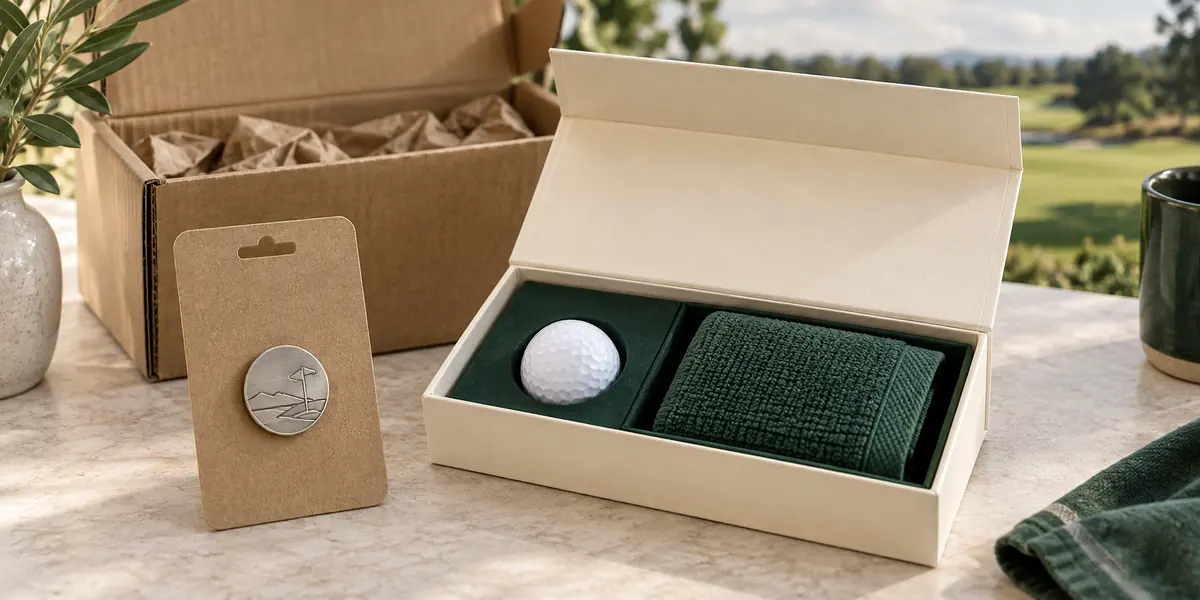
Choose custom golf accessory packaging from the inside out: protect the actual product, make it easy to identify and use, then design its presentation. A retail card, a gift box and a shipping carton have different jobs. The complete system may need more than one of them.
Start with the finished accessory and its sales channel. Record the product dimensions, moving parts, decoration and contents before choosing the outer size. A box that looks right in a rendering may still allow metal pieces to rub or a folded towel to prevent the lid closing.
Separate the three packaging jobs

Retail presentation
Make the item visible or clearly identified. Check how the pack hangs, stands, opens and carries its product information.
Gift presentation
Arrange the complete set so each piece is easy to see and remove. Review the opening experience with all components present.
Shipping protection
Protect the packed units during handling and transport. Choose the outer carton and restraint for the real packed weight and route.
Match the format to the accessory
| Accessory or program | Format to compare | Main check |
|---|---|---|
| Single marker or hat clip | Backing card, small pouch or compact box | Retention, face protection and whether both parts are included |
| Tees or small loose pieces | Counted sleeve, bag or small carton | Piece count, closure and containment of pointed ends |
| Folded towel or soft headcover | Sleeve, protective bag or fitted carton | Folded size, decoration contact and recovery after unpacking |
| Mixed accessory set | Divided tray or fitted insert in a box | Separation of hard parts from fabric and printed surfaces |
| Individual online shipment | Product pack inside an appropriate mailer or carton | Protection through the selected delivery route |
These are formats to evaluate, not standard inclusions. Ask which packaging is included in the selected product quotation. An accessory photographed beside a box is not automatically supplied in that box.
Measure the product in its packed condition
- Prepare the actual configuration. Fold the towel as intended, close the divot tool, fit removable parts and include instructions or accessories.
- Measure the occupied space. Record length, width and height, including clips, closures and raised decoration.
- Identify contact points. Mark surfaces that may scratch, dent, snag or transfer color when touching another component.
- Build a plain structural sample. Confirm fit, closure and removal before committing to printed artwork.
- Check variation. Agree on product and pack tolerances so the design does not depend on one unusually small sample.
State whether a dimension is internal usable space or external finished size. Inserts, folds and board thickness reduce the space available inside a pack. Avoid solving an excessively tight fit by forcing the product or leaving the lid under pressure.
Choose the insert by what it must hold
| Insert approach | Useful purpose | Review point |
|---|---|---|
| Folded paperboard divider | Separate a few defined components | Whether slots and folds retain them after handling |
| Molded pulp tray | Provide formed pockets for compatible shapes | Surface contact, dimensional fit and removal |
| Cut foam insert | Hold a specific outline in a fitted recess | Material suitability, compression and contact with the finish |
| Paper wrap or cushioning | Reduce movement and separate surfaces | Consistent placement and whether small parts remain contained |
Select the insert and outer pack together. A loose small marker can migrate around a larger recess, while a sharp tool can damage a neighboring towel. Check removal with normal fingers and make sure the customer does not have to bend the accessory to take it out.
Approve the dieline before final artwork
Use the packaging supplier’s current dieline for the approved structure. Identify cut lines, folds, glue areas, viewing panels and the direction the pack opens. Keep important wording away from folds and closures; use the supplier’s specified bleed and safe areas rather than guessing dimensions.
Provide the logo, color references, final copy and any barcode or SKU data. Review spelling and version numbers before approving the print file. For retail use, scan the printed barcode on an assembled sample with the intended reader. A screen preview does not verify print contrast or scanning after the pack is folded.
Keep the shipping carton separate from the gift-box decision
A decorative rigid box can still need an outer shipping carton and cushioning. Test the complete packed arrangement for product movement and surface contact, then select an evaluation appropriate to the transport method. A quick hand shake is useful for finding loose parts but is not a substitute for an agreed transit test.
The FedEx packing guide treats box choice, cushioning and sealing as parts of a complete shipping system. Use the requirements for the actual carrier and service; a “fragile” label alone does not provide physical protection. Record the packed carton dimensions and gross weight rather than using the product’s reference weight as shipping weight.
Compare the full packaging cost
| Cost line | What to confirm |
|---|---|
| Structure and unit pack | Material, size, insert, finish and quantity |
| Setup and tooling | Dieline, cutting tool or forming tool charges and reuse terms |
| Printing and decoration | Artwork versions, color requirements and surface finish |
| Assembly | Who inserts, counts, closes and labels the finished units |
| Outer packing and delivery | Carton count, dimensions, weight and destination |
| Samples and revisions | What the sample represents and how changes are charged |
A lower box price can be offset by more assembly or a larger shipping volume. Compare quotations using the same contents and delivery scope. If reducing pack size, keep the necessary clearance and protection rather than simply shrinking the design.
Review material claims and disposal information
Specify the actual materials and ask for support for any recycled-content or certification claim printed on the pack. A kraft appearance does not identify recycled content. Consider whether a window, laminate, magnet or foam insert can be separated, and use disposal guidance appropriate to the destination.
Reduce unnecessary components where the product still remains protected and usable. Avoid universal claims such as fully recyclable everywhere unless they are supported for the complete pack and relevant collection system.
Final sample approval checklist
Approve product fit, component count, removal, closure, artwork, labels, surface protection and outer-carton arrangement together. Keep photos and the accepted artwork revision with the specification. Recheck the pack if the accessory, insert, print finish or supplier material changes.

For PASSEN accessory orders, standard MOQ is 200 per SKU; logo, color or packaging customization starts at 500. Confirm the complete product-and-pack configuration in the quotation. Standalone packaging feasibility and quantity requirements need separate review. Send your requirements through our custom accessory services; for assembling event kits, see the tournament gift bag planning guide.
Frequently asked questions
Is a gift box suitable for direct shipping?
Not automatically. Review the complete outer-carton, restraint and cushioning arrangement for the chosen route.
Should I send product dimensions or packaging dimensions?
Send both when available and label internal and external dimensions clearly. Include the product in its actual folded or assembled condition.
Can one box fit several accessory combinations?
Only after each combination is checked. Different inserts or restraints may be needed to keep all versions secure.
When should packaging artwork be finalized?
Approve the structural sample and current dieline first, then place and check the artwork on that structure.
Does kraft paper mean the pack is recycled?
No. Request the actual material specification and evidence for any recycled-content claim.
What is needed for a packaging quotation?
Provide contents, product dimensions, intended presentation, insert needs, artwork, quantity, outer packing and destination.
Discuss your project
Send your selected format, quantity per SKU, artwork, packaging and delivery destination for review.