
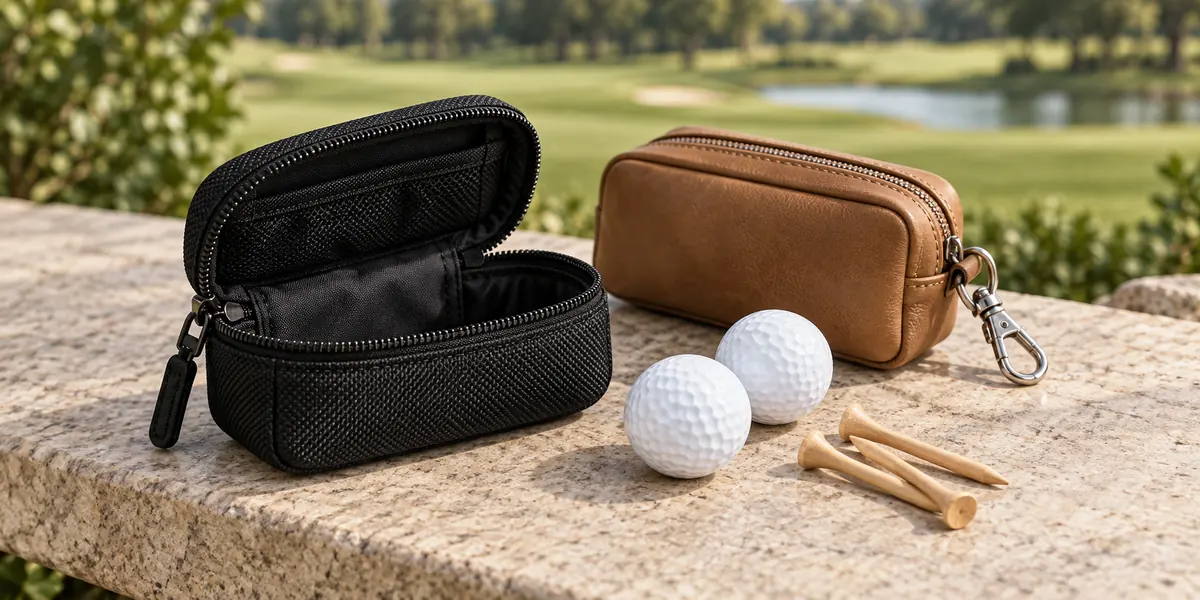
Choose custom golf ball pouches by the contents they must carry, how those contents are accessed and where each loaded pouch will hang. Exterior dimensions help identify a format, but they do not prove usable capacity. Test the complete load before approving the closure, attachment or logo position.
A compact pouch can organize spare balls and small accessories without filling a main golf-bag pocket. The right construction depends on whether the priority is quick ball access, keeping several items together or presenting a branded gift. This guide separates those uses and explains what to check on a real sample.
Choose a pouch format around the way it will be used
| Intended use | Format to compare | Main check |
|---|---|---|
| Spare balls during a round | Compact closed pouch or shaped ball holder | Ball removal and retention while attached |
| Balls plus tees and markers | Accessory pouch with an appropriate opening | Mixed contents fit without blocking access |
| Small personal items | A separately specified valuables pouch | Lining, separation and closure suited to those items |
| Tournament gift presentation | Pouch supplied empty or as an agreed filled kit | Exact contents, decoration and packed condition |
Do not assume a ball pouch also protects a phone, watch or eyewear. Hard balls, tee points and metal tools can contact other contents. If the brief includes personal items, give them a separate compartment or a separate pouch whose construction has been reviewed for that purpose.

Three checks that establish a useful pouch
Load the real contents
Try the intended balls and accessories together, then check how the pouch closes and opens.
Review the fabric
Inspect the outer material, lining and seam construction as a complete assembly.
Measure the usable space
Compare the opening and inside clearance with the contents, not only the outside dimensions.
Capacity: count the balls, then check access
State the required number of balls explicitly. If tees, a marker or a repair tool must share the space, list their quantities and dimensions too. A sample that just closes around the load may still be inconvenient if the first ball cannot be removed without emptying everything else.
- Lay out the full intended contents and photograph the arrangement.
- Insert the items without stretching the body or forcing the opening.
- Close the pouch normally and inspect the seams, zipper or flap for tension.
- Attach the loaded pouch to the intended bag loop or belt and remove a ball as a user would.
- Repeat with the remaining contents to check that they stay retained when the pouch is partly empty.
A stated ball count belongs to a particular design. For example, Make Memento describes its own holder as carrying three balls and four tees. That illustrates why capacity and tee storage should be named separately; it is not a capacity specification for a PASSEN pouch.
Zipper, drawcord, flap or shaped opening?
| Closure direction | What to assess | Possible compromise |
|---|---|---|
| Zipper | Opening length, pull access and clearance from contents | A narrow opening can limit access even when the body has space |
| Drawcord | Gathering, cord retention and the remaining opening | The gathered top can use part of the available capacity |
| Flap or snap | Closure alignment with the pouch loaded | Extra contents may push the flap out of position |
| Elastic or shaped opening | Insertion, removal and retention with actual balls | Flexibility and retention must be checked together |
These are construction options for comparison, not features promised for every available model. Choose the opening around the access routine. If one-handed use matters, demonstrate it on the selected sample rather than describing the pouch as one-handed solely from its shape.
Compare materials without relying on the name alone
For a woven textile pouch, request the fiber composition, weave, backing or coating and lining where relevant. Oxford describes a fabric construction; a denier label does not establish waterproofing, abrasion performance or the strength of the finished seams. Inspect the assembled pouch instead of treating one fabric number as the whole specification.
Leather and leather-look materials need separate descriptions. Confirm the actual surface and backing, flexibility at folds and the recommended care method. Mesh or stretch constructions should be checked for snagging and retention with the intended contents. A softer body may pack easily but change shape noticeably when loaded.
Compare surface appearance and cleaning needs with the intended setting. Balls returned from a wet or sandy course can carry debris into the pouch. Follow the selected material’s care instructions and dry contents before storage; do not describe an ordinary fabric pouch as waterproof without evidence for the complete assembly.
Attachment: inspect the hardware and the sewn connection
Specify the exact point where the pouch will attach. A thick bag ring, a narrow fabric loop and a belt are different interfaces. Check the clip opening, the space needed to operate it and whether the loaded pouch hangs where it can be reached without catching on adjacent equipment.
The connection includes more than the metal clip. Review the connecting strap, stitching and reinforcement as well. With the intended load inside, check that the closure stays accessible and the body does not twist into an awkward position. Agree on any pull or repeated-use evaluation and its conditions; do not invent a load rating from a sample photo.
Current PASSEN references: pouch versus ball carrier
| Reference | Verified listing information | Still needs sample confirmation |
|---|---|---|
| 95NB mini golf ball pouch | Black 1250D Oxford fabric; 12 × 5 × 5 cm reference size; approximately 32 g | Usable ball count, opening, attachment and logo area |
| D5120 five-ball silicone holder | Silicone carrier described for five balls; 25 × 5 × 5 cm packed reference; approximately 80 g | Actual loaded fit, removal, attachment and whether balls are included |
These are different products. The 95NB outside dimensions do not establish a confirmed two- or three-ball capacity. D5120 has a stated five-ball format, but its packed dimensions are not working dimensions for a textile pouch. Identify the model in the quotation before comparing colors or prices.
Plan the logo with the pouch filled
Approve the visible logo position on both an empty and a loaded sample. A curved panel can distort artwork, while a seam, zipper or gathered top can interrupt it. Obtain the decoration area and proposed method for the selected construction rather than assuming embroidery, print or debossing will suit every material.

Review fine lettering at actual size and check the reverse side of any stitched decoration where it may contact contents. For names or separate club designs, maintain a checked artwork list and matching pack labels. A packaging card can carry longer information while the pouch itself keeps a clear, compact mark.
Packing, sample approval and a clear quote
State whether the pouch ships empty or filled. If filled, list every component and confirm who supplies and assembles it. Protect decoration from sharp accessories and confirm the loaded pouch fits the selected presentation box. Use the golf accessory packaging guide to distinguish individual presentation from transport packaging.
Approve capacity, access, closure, attachment, seams, material, artwork and packed condition together. Standard PASSEN MOQ is 200 pieces per SKU; logo, color or packaging customization starts at 500 pieces per SKU. Different SKUs do not combine to meet the minimum. Send the model or proposed format, contents list, quantity, artwork, packaging, destination and required date; sample terms, price and schedule require confirmation.
Frequently asked questions
How many balls fit in the 95NB pouch?
The listing provides outside dimensions but no verified ball count. Confirm capacity with the intended balls and other contents on a sample.
Are balls included with a pouch?
Only if the quotation expressly includes them. A pouch pictured beside balls is not automatically a filled kit.
Is Oxford fabric waterproof?
The weave or denier label alone does not establish waterproofing. Review the fabric treatment, seams, closure and any supporting test evidence.
Can a pouch attach to any golf bag?
Check the actual attachment hardware against the intended ring or loop and assess the pouch while loaded. Universal compatibility should not be assumed.
Can I use the same pouch for valuables and balls?
Review protection and separation for the intended personal items. Loose balls, tees and metal accessories should not be assumed suitable alongside delicate objects.
Is MOQ counted per ball position?
No. The purchasing unit is the pouch or holder. Standard MOQ is 200 per SKU and customization starts at 500 per SKU.
Discuss your project
Send your selected format, quantity per SKU, artwork, packaging and delivery destination for review.