

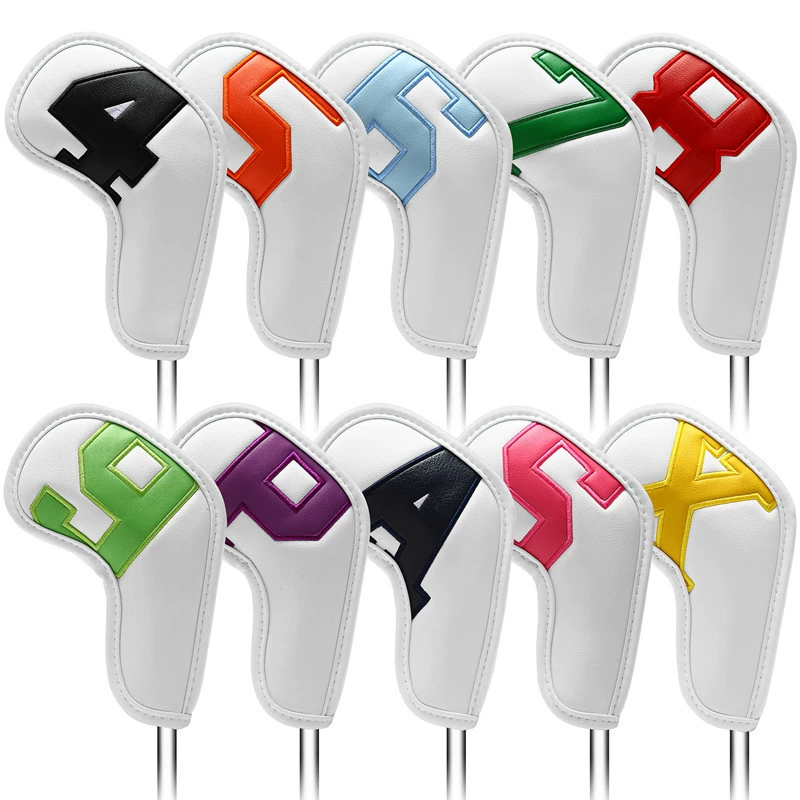
Custom numbered golf iron headcovers must work as a complete set: each cover needs a clear identifier, consistent club fit, secure retention, and correct pack sequence. Buyers should approve the number range, material, lining, closure, logo position, color coding, and a full assembled sample before bulk production.
View our custom numbered golf iron headcovers product page for the current format. When requesting a quote, specify the required club sequence, any extra wedges or putter cover, individual marking method, and whether the set needs a retail pouch, display card, or gift box.
Confirm the Complete Iron-Cover Set
List every required identifier in sequence, such as 4-9, PW, AW, SW, or a custom combination, and state whether markings are printed, embroidered, molded, or applied as separate badges. Confirm fit against the intended iron profiles and the preferred closure.
Approve a complete packed set, not only one sample cover. Check identifier order, color consistency, logo placement, lining, stitching, retention, missing or duplicated numbers, and packaging labels before production release.
Common Program Uses
- Club-shop iron-cover sets.
- Academy and team equipment.
- Member gift collections.
- Golf brand accessory ranges.
Build a Written Product Specification
A useful specification records measurable requirements instead of relying only on a reference photograph. Write down finished dimensions, target weight where relevant, material and color, functional parts, logo size and position, packaging, carton quantity, and acceptable tolerances. When an existing sample is used as a reference, identify which features must be copied and which can change.
| Decision | Details to Confirm |
|---|---|
| Set sequence | required 3-9, P, A, S, L, or custom identifiers and quantity of each |
| Fit | iron-head dimensions, opening, internal clearance, and retention method |
| Identification | number or letter size, orientation, contrast, attachment, and abrasion resistance |
| Set packing | sorting order, completeness check, inner pack, retail pack, and carton count |
Plan Branding Around the Material
Logo method should follow the product surface and the artwork, not the other way around. Printing suits many flat, controlled surfaces; debossing or embossing creates a quieter molded or leather-look result; patches and labels can add contrast; and molded decoration may suit selected flexible parts. Very small text, thin lines, tight color registration, and decoration near an edge require extra review.
Provide vector artwork when possible, identify brand colors, and approve the finished logo dimensions in millimeters. A digital mockup is useful for position and proportion, while a physical sample confirms color, edge quality, legibility, surface interaction, and appearance under normal use.
Approve the Physical Sample as the Production Reference
The sample should represent the agreed material, dimensions, color, logo, functional parts, and packaging. Test it in realistic conditions, record any revisions in writing, and keep the approved sample with the final specification. A brief approval such as “looks good” is less useful than a signed checklist that identifies critical measurements and appearance points.
- Fit across representative iron shapes.
- Identifier legibility in a golf bag.
- Opening retention during movement.
- Lining coverage and seam finish.
- Complete sequence and packing order.
- Logo size, position, color, and edge quality.
- Individual packaging, labels, carton protection, and unpacking appearance.
Control Bulk Production and Packing
Incoming materials, first-off production, in-process assembly, and final packed goods should all be checked against the approved reference. Inspection frequency can be adjusted to order size and product risk, but critical function and branding points should never depend on visual memory. If several colors or versions are included, use a SKU matrix that connects every version to its artwork, quantity, label, and carton mark.
Packaging must protect the product without adding unnecessary volume. Confirm whether units need individual bags, backing cards, inserts, retail boxes, gift boxes, barcode labels, or master-carton dividers. Drop, rub, compression, and transit checks may be appropriate when decoration or shape can be damaged in shipment.
MOQ, Lead Time, and Reorder Planning
MOQ and price depend on construction, material, custom color, tooling, decoration, packaging, and quantity per version. A first order with fewer colorways and one approved pack is usually easier to control. Lead time should separate specification review, artwork, sampling, sample approval, material preparation, production, inspection, and freight so the required delivery date can be assessed honestly.
For repeat orders, retain the approved sample, final artwork, material or color references, packaging files, and inspection record. When any component changes, document the revision rather than silently substituting it. This keeps appearance and performance more consistent across production runs.
Why Work With PASSEN?
PASSEN coordinates product specification, branding, sampling, production communication, quality checks, and packaging for custom golf accessory programs.
- 20+ years of golf-industry experience within the team and 500+ completed custom projects.
- Programs supported in 35+ countries with one account manager coordinating each project.
- A digital mockup after specifications are confirmed and a pre-production sample for every order.
- Related golf accessories can be coordinated for color, branding, packaging, and shipment.
Prepare an RFQ That Can Be Quoted Accurately
Send the product format, dimensions, material, color, quantity, logo file, logo size and position, packaging, destination country, and required date. Include reference samples or compatibility dimensions when they affect function. Review PASSEN’s custom development process and project examples before submitting the brief.
Frequently Asked Questions
Which numbers belong in an iron headcover set?
The sequence depends on the intended club configuration. State every required number and wedge letter, including the quantity of each, before sampling.
Can the identifiers be customized?
Yes. Embroidery, print, patches, molded tabs, and other methods may be used when size, contrast, orientation, and durability are approved.
How is fit approved for several irons?
Test representative long, mid, short, and wedge heads, then document the acceptable opening and internal-clearance range.
How are missing pieces prevented?
Use a fixed packing sequence, piece-count check, visual set reference, and final inspection of each retail pack and carton.
Discuss Your Project
Share the target use, specification, estimated quantity, logo, packaging, delivery market, and required date. PASSEN will review the brief and identify the next practical sampling step.