
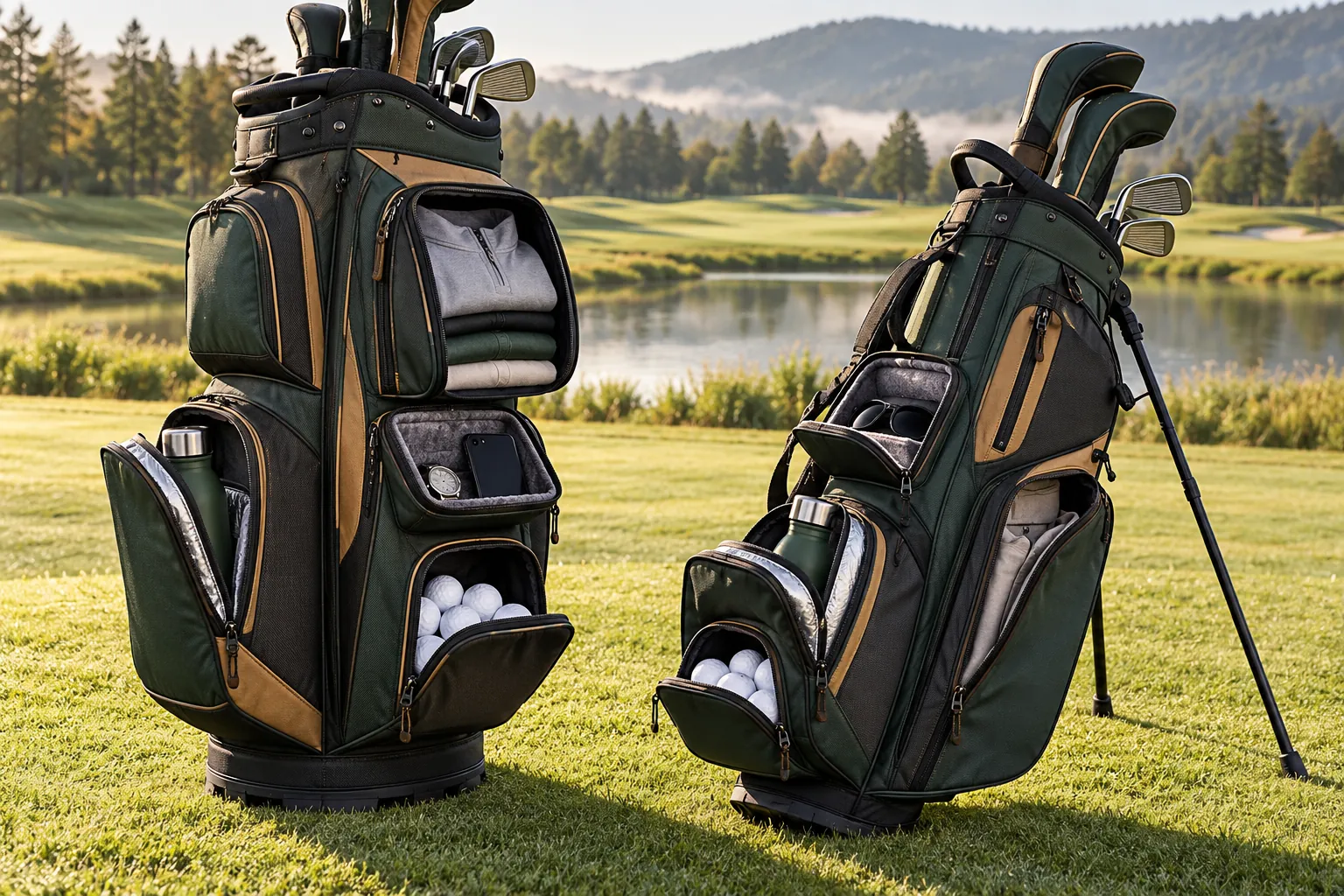
Golf bag pockets should place clothing, balls, valuables, drinks and small accessories where the player can reach them without unbalancing the bag. The right pocket count depends on the bag type and use case. Access, shape and construction matter more than adding the highest possible number of compartments.
This guide explains the common pocket types, how their positions change between bag formats and what buyers should inspect during custom golf bag sampling. If the overall format is undecided, compare stand, cart, staff and travel golf bags first.
Common golf bag pockets and their purpose
| Typical contents | Buyer checks | |
|---|---|---|
| Full-length apparel pocket | Jacket, rain layer, hat or larger soft items | Opening length, gusset depth, internal snag points and access when loaded |
| Ball pocket | Golf balls, tees and frequently used accessories | Capacity, one-hand access, panel shape and decoration area |
| Valuables pocket | Phone, wallet, keys or watch | Lining, closure, internal separation and protection from nearby hardware |
| Bottle or insulated pocket | Drink bottle or canned beverage | Diameter, height, drainage, insulation construction and upright retention |
| Rangefinder pocket | Rangefinder or GPS device | Opening direction, quick access, padding and closure security |
| Accessory pocket | Glove, markers, divot tools, pencils or spare items | Usable volume, internal sleeves and visibility of small contents |
Names vary between suppliers, so list the intended contents instead of relying on labels such as “large” or “accessory.” A pocket that holds a folded jacket has different construction needs from one designed for a phone or rangefinder.
Match pocket layout to the golf bag format
Stand and carry bags
Keep the layout compact and balanced. Deep pockets on one side can pull the loaded bag away from the player or interfere with the legs.
Cart bags
Arrange primary pockets to face the player after the bag is strapped to a cart. Check that the cart strap does not block openings.
Staff bags
Broader panels support large apparel and presentation pockets, but the loaded bag still needs usable handles and stable storage.
On a stand golf bag, the pocket body should not restrict the leg mechanism or collapse into the club compartment. On a cart golf bag, access should be tested in the actual cart-facing orientation.
Construction behind the visible pocket
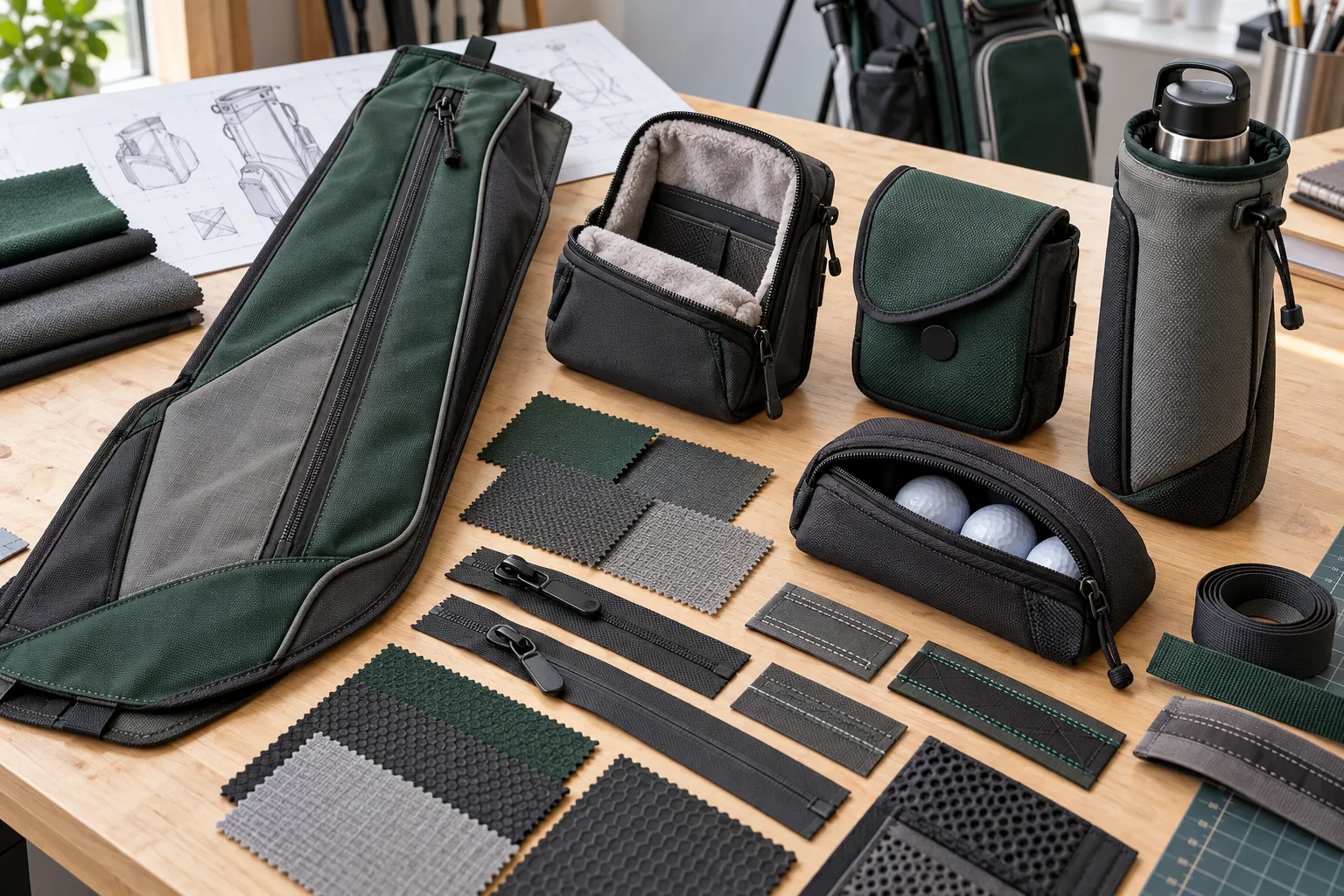
The outer panel is only one part of a pocket. Its gusset controls depth, the lining protects contents, the closure controls access, and reinforcement transfers load into the bag body. Ask for the complete construction rather than approving only the front view.
Gusset and volume
A shaped gusset creates usable depth. Confirm that the pocket still closes when filled with its intended contents.
Lining and separation
Soft lining may suit valuables, while wipe-clean or insulated constructions suit different uses. Specify internal sleeves separately.
Reinforcement
Loaded pockets pull on seams and surrounding panels. Inspect backing at upper corners, zipper ends and attachment points.
Drainage and cleaning
Bottle and ball areas may collect moisture or debris. Decide whether drainage, removable inserts or easy-clean surfaces are needed.
Opening control
Stays, elastic, magnets or structured edges can hold an opening in position. Test them with the bag upright and tilted.
Panel alignment
Adjacent pockets, piping and decoration should remain balanced after the bag is loaded, not only when it is empty.
Zipper, magnetic and open-access pockets
Zippers provide defined closure and broad access when the slider path is planned well. Review tooth size, tape color, puller shape, end stops and whether the opening can be operated with one hand. Curved zipper paths need extra attention because tight corners can make the slider harder to move.
A magnetic pocket can support quick access, but magnet placement, orientation and holding force must be approved on the finished construction. The flap should close consistently without pressing against the intended contents. Do not assume that every valuables item or electronic device belongs next to a magnet; define the pocket’s actual use.
Open bottle sleeves and mesh pockets improve visibility and access. Check elastic recovery, binding, base support and the bottle diameters used by the target customer. A shallow sleeve may release a tall bottle when the bag tilts.
Do not treat “waterproof” as a visual feature
Coated fabric, covered zippers and sealed seams can improve weather resistance, but a single component does not prove that the finished pocket is waterproof. If weather performance is required, define the expected exposure and test the assembled sample. Water can enter through zipper ends, stitch holes, panel joins or an open pocket top.
For a valuables compartment, confirm the lining, zipper path and surrounding seams. For an insulated pocket, separate temperature-retention expectations from leak resistance. Use accurate construction descriptions in product copy unless a defined finished-product test supports a stronger claim.
Balance capacity with bag weight and shape
Extra pockets add fabric, lining, zipper length, reinforcement and contents. On a carry bag, that can affect both empty weight and loaded balance. Position heavy items close to the bag’s central structure where practical and test the completed bag with realistic contents.
Large side pockets can also change the bag’s packed dimensions. Confirm how the empty bag is supported for shipping and whether pocket panels crease during carton packing. A full pocket count is not useful if the openings are blocked, the bag becomes unstable or the internal club space is reduced.
How to approve a golf bag pocket sample
Define the contents
Assign representative items to each pocket, including their approximate dimensions and weight.
Load the complete bag
Fill the club compartment and pockets together. Check balance, leg operation, handle clearance and cart-facing access.
Operate every closure
Open and close zippers, flaps and elastic sleeves repeatedly with the bag upright, carried and tilted.
Inspect the construction
Review lining, gussets, zipper ends, reinforcement, loose threads, piping and any pressure on neighboring panels.
Photograph the approved arrangement and keep a pocket map with the specification. This prevents a later revision from changing the intended function of a pocket without a new loaded-bag review.
Prepare a custom pocket map
For each pocket, record its purpose, opening dimensions, finished volume direction, gusset, lining, closure, internal sleeves, reinforcement and decoration area. Add the bag format, divider layout, strap system, leg mechanism where applicable, materials, colors and hardware.
Include quantity per SKU, packing method, destination and required arrival date in the inquiry. If a detachable valuables solution is preferred, compare the separate golf valuables pouch guide. For the full bag program, use the custom golf bags page.
Frequently asked questions
How many pockets should a golf bag have?
There is no single correct number. Choose the fewest pockets that hold the intended apparel, balls, valuables, drinks and accessories with suitable access and balance.
What is the large side pocket on a golf bag for?
It is commonly used for apparel and rain layers. Confirm the opening and gusset with the actual items rather than relying only on the pocket name.
Where should a valuables pocket be positioned?
It should be protected, easy to reach and separated from rough hardware or wet contents. Its best position depends on the bag orientation and other pockets.
Are magnetic golf bag pockets secure?
They can provide convenient access when the magnet, flap and contents are matched correctly. Test retention on a loaded bag and define what the pocket is intended to hold.
Does an insulated pocket make a golf bag waterproof?
No. Insulation and water resistance are separate properties. The finished pocket construction, seams, closure and test method determine its weather performance.
What should a custom golf bag pocket brief include?
List every pocket’s contents, opening, dimensions, lining, gusset, closure, reinforcement, decoration, bag orientation and quantity per SKU.
Plan a practical golf bag pocket layout
Send the bag format, pocket map, intended contents, divider and strap systems, materials, colors, artwork, packaging, quantity per SKU and destination. PASSEN can review access and sample requirements before quotation.