
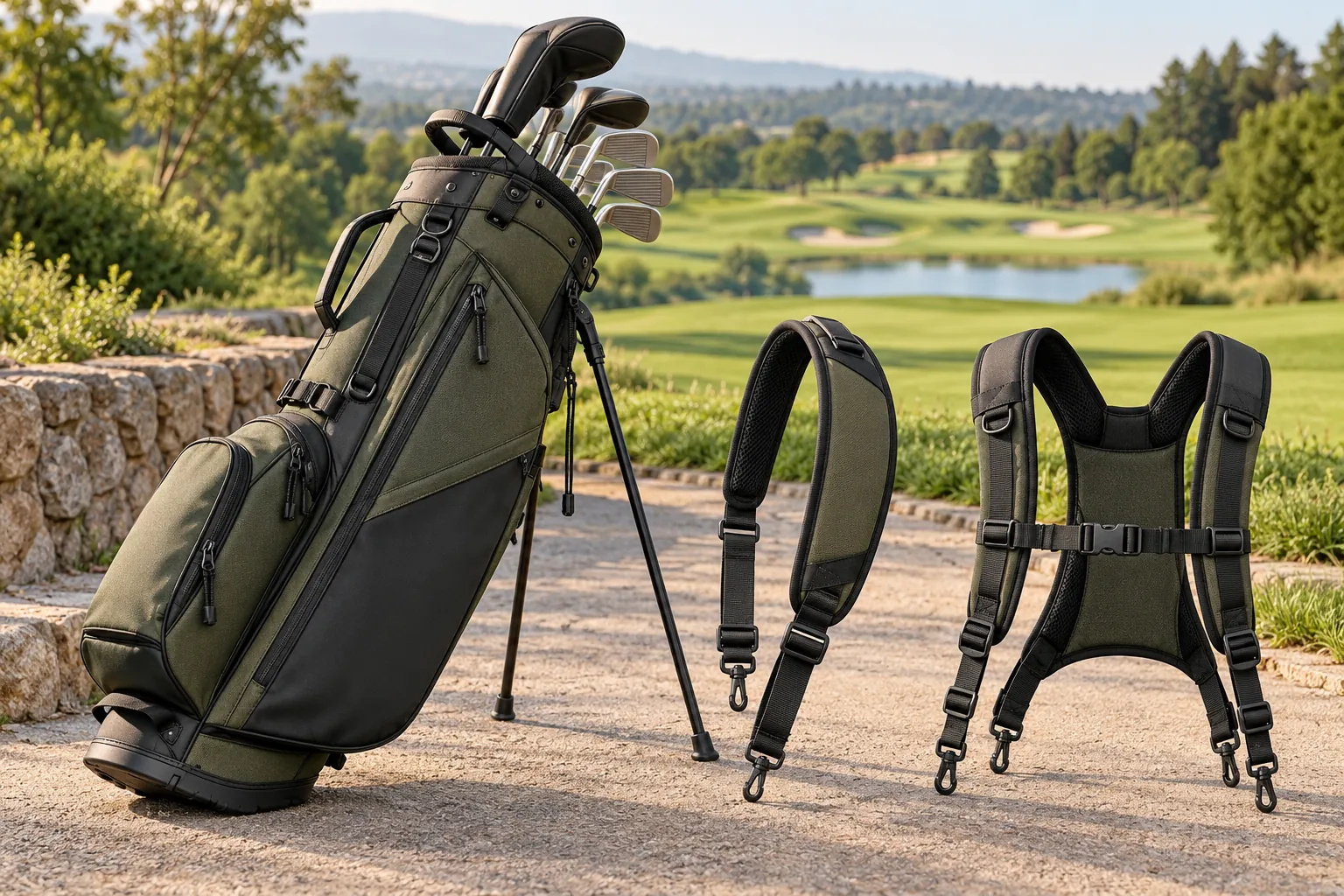
A golf bag strap connects the loaded bag to the player, so its layout affects comfort, balance, stability and ease of adjustment. Single straps keep the carrying routine simple. Dual straps spread the load across both shoulders. The correct choice depends on the bag format and how it will be used.
This guide explains the construction and approval checks behind a reliable strap system. If the overall bag format is still undecided, start with our comparison of golf bag types.
Single strap vs dual strap golf bag systems
| Strap system | Typical use | What to verify |
|---|---|---|
| Single shoulder strap | Staff bags, cart bags and traditional carry programs | Pad length, shoulder grip, bag angle and quick removal |
| Dual backpack-style strap | Walking and stand bags | Load distribution, cross-piece position, four-point geometry and adjustment |
| Convertible strap | Programs that support single or dual carry | Conversion method, unused attachment control and clear assembly |
| Replacement strap | After-sales or accessory programs | Attachment compatibility, hardware size and safe load rating for the intended bag |
The strap cannot be selected in isolation. A single strap on a large staff bag serves a different use from a dual strap on a lightweight stand bag. Match it to the bag body, expected load, top and base structure, handle position and customer routine.
Understand the complete strap assembly
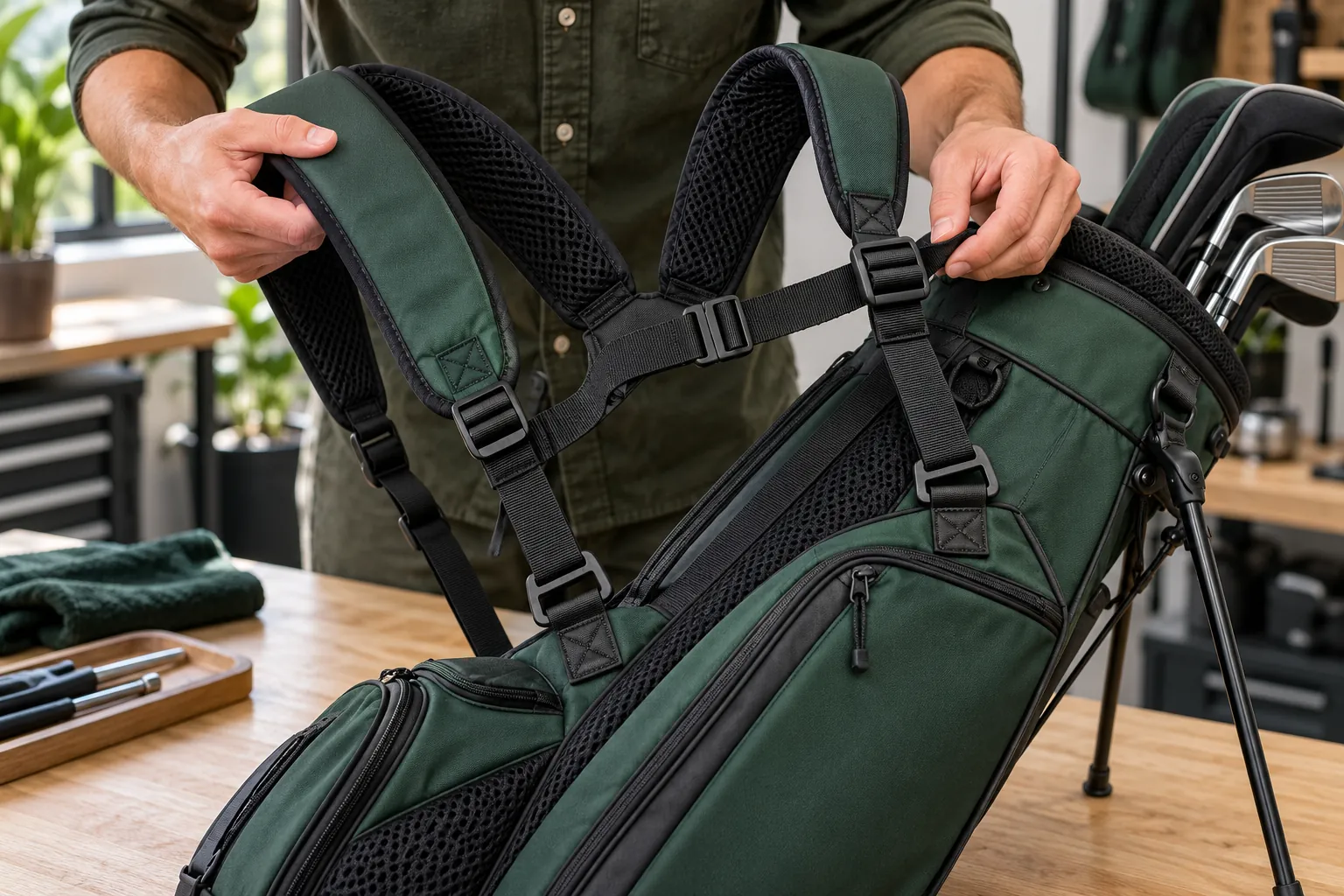
Shoulder pad
Confirm length, width, thickness, edge shape and whether the pad remains centered under load.
Webbing
Review width, hand feel, weave, cut-edge treatment and how smoothly it moves through the adjuster.
Adjusters
Buckles should hold the selected length without creeping while still allowing deliberate adjustment.
Attachment hardware
Hooks, clips, rings and swivels need compatible dimensions and a secure orientation on the bag.
Anchor reinforcement
The bag-side attachment carries repeated load. Inspect stitching pattern, backing and surrounding panels.
Stabilizing connector
Dual systems may use a central piece or sliding junction to maintain spacing and reduce tangling.
Ask for the complete assembly specification rather than only a strap width. Two straps can appear similar while using different foam, backing mesh, webbing, adjusters and anchor construction.
Fit and adjustment range
A strap should accommodate the intended user range and clothing without leaving excessive loose webbing. Test adjustment at both ends of the stated range. Short settings should not pull the bag into an awkward angle, and long settings should still leave enough webbing engaged with the adjuster.
For dual straps, confirm that both sides can be balanced. The bag should sit predictably rather than rotating toward a heavy pocket. The upper cuff, lower anchor position and strap junction determine how the load rests across the back. The golf stand bag guide explains how the strap relates to the legs, base and carry structure.
Padding, lining and ventilation
More foam does not always mean more comfort. A very thick pad can feel bulky or roll at the edge. A thin pad can concentrate pressure when the bag is fully loaded. Approve the pad after carrying a representative bag, not only by squeezing an empty sample.
| Component | Buyer decision | Sample check |
|---|---|---|
| Foam or spacer layer | Thickness, firmness and recovery | Look for flattening, hard edges and uneven sections after loaded use |
| Contact surface | Mesh, textile or smooth lining | Check slip, abrasion and moisture handling against intended clothing |
| Outer face | Match or contrast with the bag body | Review color, panel shape, piping and logo area |
| Edge binding | Softness and durability | Inspect corners and transitions that contact the shoulder or neck |
Material names alone do not confirm performance. Record the approved construction, thickness and feel, then compare production samples with the same loaded test.
Attachment points and hardware
Strap anchors should transfer load into reinforced areas of the bag. Inspect both the visible stitches and the backing behind the panel where possible. A strong clip does not compensate for a weak fabric anchor, and a reinforced anchor does not compensate for an undersized hook.
Check that metal or molded components cannot scrape the club shafts, catch on a pocket or interfere with the stand mechanism. Swivels should rotate as intended without making the strap twist unpredictably. For staff and presentation formats, compare the strap with the bag’s carry handles and display position; our staff golf bag guide covers those priorities.
How to test a golf bag strap sample
Load the intended contents
Use the planned club set and representative pocket weight. Record the total sample weight for repeatable comparisons.
Set the adjustment range
Test short, middle and long settings. Confirm that the hardware holds and the loose ends can be managed.
Walk and cycle the bag
Carry the bag, set it down, deploy the legs where applicable and lift it again. Watch for twisting, slipping and contact with the neck or arm.
Inspect after use
Review anchor stitches, webbing edges, buckles, hooks, foam recovery and any color transfer or abrasion.
For a production program, define a repeatable load and cycle method in the approved specification. The goal is to compare samples under the same conditions, not to rely on a general statement such as “comfortable strap.”
Branding and visual integration
The strap can carry a small woven label, embroidery, print, molded patch or subtle color-block treatment, depending on the construction. Keep decoration away from high-flex areas, critical reinforcement and the main shoulder contact zone unless the sample proves it remains comfortable.
Coordinate strap colors with the bag panels, piping, zipper tape and hardware finish. If several SKUs use the same bag body with different colors or logos, list each variation separately so the correct strap assembly is packed with the correct bag.
Prepare a custom golf bag strap brief
Provide the bag type, intended carrying method, loaded weight target, single or dual layout, attachment-point drawing, pad dimensions, material direction, webbing width, hardware finish, adjustment range, logo treatment and color references. Add quantity per SKU, packaging, destination and required arrival date.
Because the strap affects the complete bag, include the top, base, leg system, pocket plan and handle locations in the sample review. PASSEN’s custom golf bags page shows how to submit the full bag brief.
Frequently asked questions
Is a single or double golf bag strap better?
A single strap suits simple one-shoulder carrying and quick handling. A dual strap usually distributes walking load across both shoulders. The better choice depends on the bag, load and intended routine.
Can a dual strap be fitted to any golf bag?
No. Attachment positions, hardware and bag reinforcement must be compatible. Do not assume a replacement strap is universal without checking the exact bag.
How should a golf bag strap be adjusted?
Adjust it so the bag sits securely without forcing the shoulders or swinging excessively. Dual straps should share the load, and all adjusters should retain their setting during walking.
What padding is best for a golf bag strap?
The approved pad should balance pressure distribution, flexibility and bulk for the target load. Test thickness, firmness, edge shape and contact surface on a loaded sample.
What should be checked at the strap anchors?
Inspect reinforcement, stitch coverage, hardware orientation and the surrounding bag panel before and after loaded carry cycles.
What information is needed for a custom strap sample?
Provide the bag format, strap layout, attachment geometry, target load, adjustment range, pad construction, webbing, hardware, colors, branding, packaging and quantity per SKU.
Develop a golf bag with the right strap system
Send the bag format, intended load, single or dual strap direction, attachment drawing, materials, colors, artwork, packaging, quantity per SKU and destination. PASSEN can review the construction and sample requirements before quotation.