
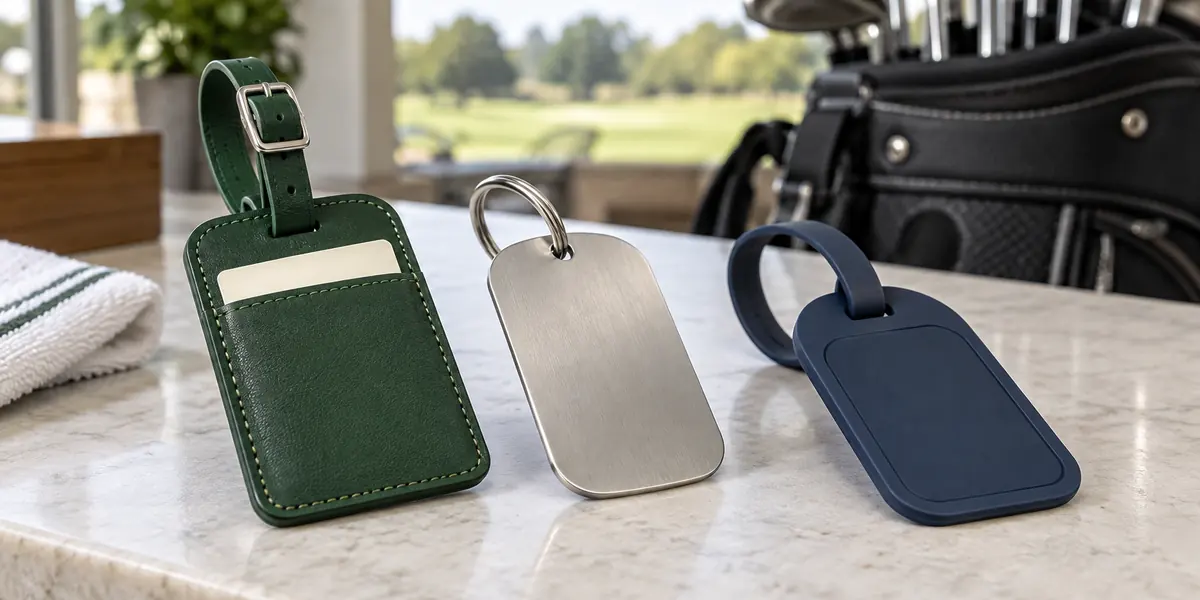
Custom golf bag tags should make the right information easy to find and stay attached to the intended bag. Choose the identification format, material and attachment as one assembly, then approve the artwork and any individual names. This guide covers club membership tags, tournament gifts and retail or travel identification programs.
Start with the purpose of the tag. A visible club crest, a replaceable contact card and an individual member number need different layouts. Coordinate the finish with your golf bag program while keeping the tag’s dimensions and attachment practical for the bag itself.
Choose what the tag needs to do
| Program | Useful format | First decision |
|---|---|---|
| Club membership | Logo face with member name or number | Which details stay the same and which change per member |
| Tournament player gift | Event identity with optional individual names | Artwork and participant-list approval deadline |
| Travel identification | Replaceable card or a covered information area | Card access, information visibility and attachment clearance |
| Pro shop retail | Recognizable design with usable identification space | Shelf presentation, barcode and replacement insert |
| Team or resort program | Coordinated colors and identification | Version quantities and how each pack is distributed |
A tag is not the same product as a score counter or a club-shaft label. If a multifunction design is requested, list every included feature separately. A photograph with several accessories does not define the contents of a quoted set.
Compare tag materials and construction
| Material route | Appearance and construction | Sample check |
|---|---|---|
| Leatherette or coated fabric | Flexible face with stitched edges or a card pocket | Edge finish, stitching, flexing and strap connection |
| Molded plastic | Shaped face with controlled color and relief details | Material specification, thickness and small design features |
| Metal | Rigid face with engraving, printing or other selected finish | Rounded edges, surface marks and hardware contact |
| Clear-window construction | Visible replaceable identification card | Window clarity, card clearance and insertion direction |
A clear window is a construction feature that may be combined with another face material. Specify its film, thickness and pocket opening rather than assuming all window tags behave the same way. If information should be concealed during normal use, define the flap or covered-card arrangement in the brief.
Material names alone do not establish an outdoor lifespan. Review the finished tag after the handling and exposure relevant to your program, including the decoration and attachment. For custom shapes, leave enough material around the strap slot or hole and assess corners that could catch on nearby equipment.
Approve face layout, attachment and complete assembly
Readable face
Review the logo and longest name at the final printed or engraved size.
Attachment fit
Check the strap, ring or hook on the bag point where it will be used.
Complete assembly
Check the face, reverse, card pocket and packing against one reference.

Size the tag around the actual bag
Record face length, width, thickness and corner treatment. Add the strap length, usable loop size or hook opening, and the clearance at the selected bag handle or ring. A larger face creates more artwork area but can interfere with pocket access or swing against the bag.
| Attachment | Useful handling characteristic | Review before approval |
|---|---|---|
| Strap and buckle | Removable loop with an adjustable closure | Usable length, buckle action and stress near holes or stitching |
| Split ring | Compact connection to an appropriate attachment point | Ring opening, installation and rubbing against the face |
| Snap hook | Quick removal where the bag point allows it | Gate clearance, return action and accidental opening |
| Fixed or molded loop | A simple integrated connection | Flexing at the connection and removal procedure |
Fit the completed tag to the bag in its carrying position. Check pocket zippers, club openings and adjacent hardware, then remove and reinstall it. For travel, include the intended travel cover or case in the fit review rather than assuming the same attachment works everywhere.
Prepare artwork and individual-name data
Keep shared artwork and variable information separate. The shared proof defines logo, colors, positions and type style. The variable-data file supplies each required name, member number or other approved field. One controlled list makes counting and checking much easier than names spread across emails.
| Field in the order file | Purpose |
|---|---|
| Record ID | A stable reference for checking and packing |
| Name exactly as required | Approved spelling, capitalization and punctuation |
| Member or team number | Only where the design calls for it |
| Design version | Links the row to its approved artwork |
| Quantity | Shows duplicate or replacement tags deliberately ordered |
Use the longest name and any unusual characters in the proof review. Check the chosen font supports the required text and that automatic line wrapping does not hide information. If a QR code is part of the design, test the final printed sample with the intended destination and allow space around the code.
Freeze one dated list after approval. Mark additions or corrections as a new version and reconcile the revised total before production. For example, two tags for one member should be recorded as an intentional quantity, not removed as an assumed duplicate.
Match decoration to the selected face
Printing, engraving, debossing, foil, enamel, embroidery or woven labels are options to review against the chosen construction. A method suitable for one coated metal or leatherette surface may need a different process on another. Provide vector artwork where available and define the finished logo dimensions, colors and placement.
Approve the smallest lettering and narrowest gaps on a physical sample. View the face at a normal reading distance, then turn it over to inspect the reverse and attachment. Check that a buckle, flap or pocket edge does not conceal the important part of the artwork.
Sample approval and quality checks
- Compare dimensions and the attachment specification with the brief.
- Insert and remove the actual card, where included, and check window clarity and edge access.
- Attach the tag to the intended bag and check clearance, swing and removal.
- Inspect edges, joining points, buckle or gate movement and surface contact.
- Review artwork and variable text against the approved proof and data list.
- Apply the agreed pull, repeated handling and moisture checks to the complete assembly; record the method and result.
Agree test conditions and acceptance criteria before inspection. A pull test needs a direction, load and duration; a surface check needs a defined appearance reference. Keep the approved tag, hardware and artwork together so later orders can be compared with the same specification.

Pack tags for retail, members or event distribution
Use sleeves, backing cards, pouches or gift boxes according to the distribution plan. Protect metal faces and clear windows from hardware rubbing during shipment. Keep straps tidy and separate material, artwork and destination versions with clear pack and carton identification.
For individually named tags, choose a packing order that matches the receiving team’s list. Reconcile the row count, item count and any spares before dispatch. A club that distributes alphabetically and an event that hands out team packs may need different sorting instructions. See the accessory packaging guide and event gift budget guide for the wider pack plan.
MOQ, samples and quotation planning
Standard PASSEN orders start at 200 per SKU. Logo, color or packaging customization starts at 500 per SKU. Sets are counted as sets, and different SKUs do not combine to reach the minimum.
PASSEN offers free samples and can coordinate leatherette, molded plastic, metal, windows, straps, hardware, decoration and retail packing for a bag tag program. Provide the target format and artwork at the start so the sample arrangement covers the features you need to assess.
PASSEN normally provides an initial feasibility response and quote within 24 hours after the format and artwork brief is clear, with a physical sample typically developed in 7-10 days depending on the material and decoration. Separate sampling, approval, production and freight when planning the required arrival date.
Ask the quotation to identify the face and attachment, quantity per SKU, shared artwork, variable-name processing, setup or tooling, packaging, sorting and delivery basis. Individual names or additional versions need their own review within the order; do not assume they change the agreed minimum or are included without a line item.
Frequently asked questions
Which material should I choose for a custom golf bag tag?
Start with the desired flexibility, appearance, decoration and identification format. Review leatherette, coated fabric, molded plastic or metal as a finished assembly with its attachment.
Can every tag have a different player name?
Include the variable-name requirement in the brief, with one approved data list and proof. Confirm the process, quantities, pricing and schedule for those versions before production.
What size should a golf bag tag be?
Choose the face and attachment dimensions around the artwork, information and actual bag clearance. Approve a sample rather than assuming a universal size.
How does the tag attach?
Options include a strap and buckle, split ring, snap hook or fixed loop. Test the complete connection on the intended bag or travel case.
What is the MOQ?
Standard PASSEN orders start at 200 per SKU. Logo, color or packaging customization starts at 500 per SKU. Sets are counted as sets, and different SKUs do not combine to reach the minimum.
Are samples available and how long do they take?
PASSEN offers free samples. A physical bag tag sample is typically developed in 7-10 days depending on material and decoration; provide a clear format and artwork brief for review.
How should named tags be packed?
Specify sorting order, labels and any team or recipient grouping. Reconcile the approved data list with the packed item count and record spares separately.
Discuss your project
Send the product specification, quantity per SKU, artwork, packaging and delivery requirements for a project review.