
When buyers search for golf travel bags, they are usually trying to solve a practical problem: how to move a full set of clubs without making the product heavy, awkward, or difficult to sell. For a golf brand or retailer, that means the buying decision goes beyond fabric color. Protection, movement, storage, hardware, packing, and repeatable production all matter.
This guide is written for brands, pro shops, travel retailers, and corporate programs planning a private-label or wholesale golf travel bag. It explains which construction details to settle before sampling and which checks should remain in the production specification.

Start With the Travel Use
A golf travel bag can be used for airline travel, road trips, tournament transport, storage between seasons, or retail bundles with other golf accessories. Those uses create different priorities. An airline-oriented product may need more structured protection and reinforced contact points. A lighter road-trip model may put more emphasis on foldability, weight, and easy handling.
Define the user before discussing decoration. A resort gift program may need a compact, presentable bag with simple branding. A serious travel retailer may expect wheels, durable handles, replaceable hardware, and a clear fit for long clubs. The same word, travel bag, can describe very different products.
Hard vs soft golf travel bags: choose around the whole journey
Start with a soft travel cover when folding and storage flexibility matter; compare a hard-sided case when a defined rigid enclosure is the priority. A structured or hybrid direction can combine features of both. No label guarantees protection on its own: the golf bag, club arrangement, padding, restraint, handles and transport conditions all need to work together.
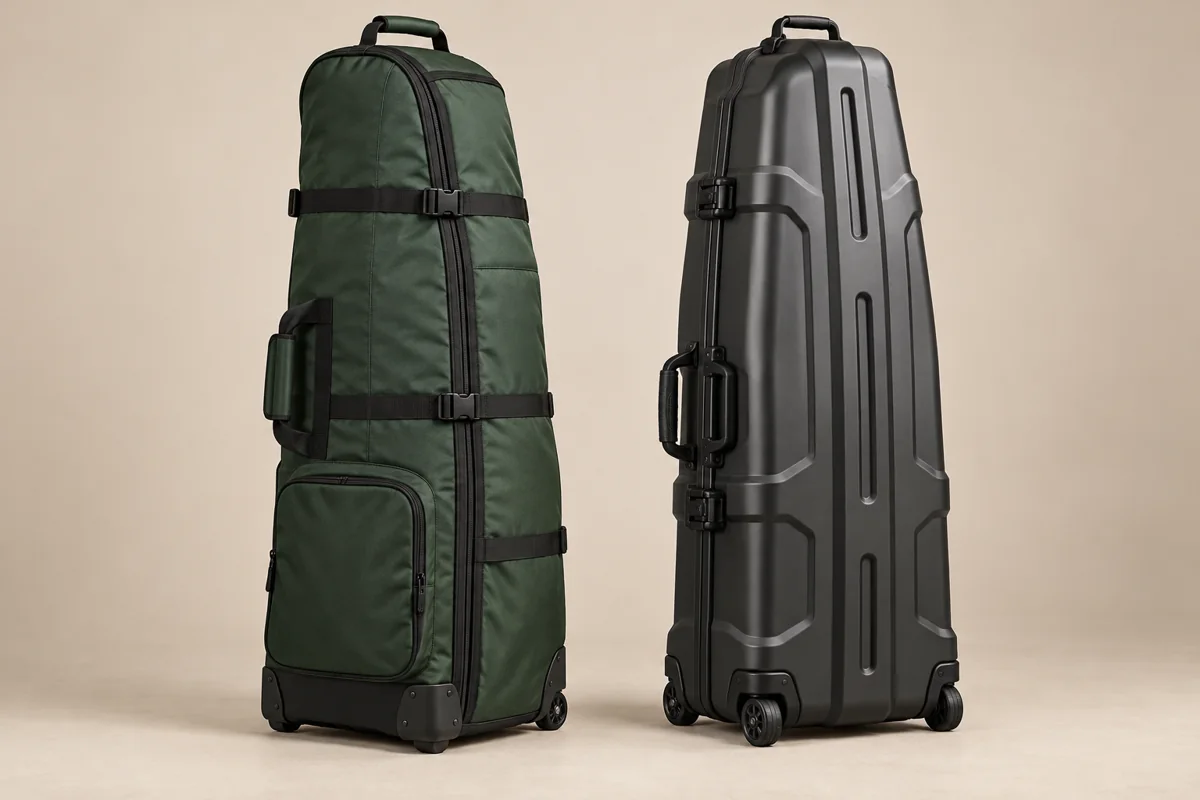
| Buying decision | Soft travel cover | Hard-sided case |
|---|---|---|
| Outer construction | Flexible panels with selected padding and reinforced contact areas. | A defined rigid enclosure with its selected closures and internal support. |
| Storage | Check how the actual empty cover folds and where it will be stored. | Check fixed external size, nesting if available, vehicle space and warehouse volume. |
| Loaded review | Review padding position, internal restraint, zipper clearance and base support. | Review internal fit, head clearance, restraint, closure and handling. |
| Quotation scope | Fabric, padding, reinforcement, wheels, handles, branding and packing. | Shell construction, internal protection, hardware, branding and packing. |
Compare the loaded sample with the intended golf bag and longest club. Review loading and unloading, lifting at each handle, rolling and available vehicle space. A protective shell does not remove the need to prevent equipment moving inside, and a flexible cover should not be judged only from its empty appearance.
Ship Sticks' travel-bag overview distinguishes hard and soft directions. Confirm the selected carrier's current baggage and liability terms directly for a trip; the case style alone does not establish acceptance or compensation.
For a custom program, send internal fit requirements, intended loading, preferred construction, handle and wheel priorities, logo, quantity and packing. Review available configurations through PASSEN's golf bag program. A construction illustration is not a stocked SKU, and a proposal should identify exactly what can be supplied.

The Construction Details That Affect Reliability
- Club protection: confirm padding thickness, top protection, internal dividers, and whether the longest intended club fits without forcing the zipper.
- Base and wheel assembly: check how the load transfers into the base, wheel housing, and stitching. A smooth roll is useful only if the attachment remains secure.
- Handles and straps: inspect the webbing width, reinforcement, grip comfort, and attachment points. Lift the loaded bag by each intended handle.
- Closures: run the main zipper and pocket zippers repeatedly. Slider feel, tape quality, and corner construction matter in daily use.
- Fabric and lining: match denier, coating, abrasion resistance, lining, and color to the target price and travel conditions.
- Storage: check whether the bag folds, nests, or needs a rigid carton, because that changes both freight cost and warehouse handling.
These details are easy to describe in a short product specification. They are harder to recover after bulk production has started, which is why the sample should be tested with a realistic load.
Materials, Color, and Private-Label Branding
Common material decisions include woven polyester or nylon panels, coated fabrics, molded protective sections, foam padding, synthetic leather trims, mesh, webbing, and metal or molded plastic hardware. The best combination depends on the intended price level and the way the bag will be used. A premium look may come from a restrained panel layout and clean hardware rather than adding more decoration.
For branding, confirm the logo location before the pocket layout is fixed. Embroidery, woven labels, printed panels, patches, and molded or debossed details each have different artwork and surface requirements. Keep color references in the written specification and compare the travel bag with the rest of the accessory range before production approval.
Packaging and Freight Should Be Decided Early
Golf travel bags can occupy meaningful carton volume. Ask whether the product can be folded or nested, how the wheels and handles are protected, whether a poly bag or dust cover is needed, and whether the retail package is separate from the export carton. If the destination is Amazon FBA, a distributor warehouse, or an event venue, carton marks and labeling should be part of the brief.
Packaging is also part of the customer experience. The bag should arrive without crushed panels, bent hardware, dirt marks, or loose accessories. A packing trial at the sample stage can reveal problems before the order becomes a full container or a time-sensitive event shipment.

A Practical OEM Sampling and QC Plan
Start by approving the construction and decoration on a physical sample. Load it with the intended club configuration, measure the packed dimensions, inspect the seams and hardware, and confirm the colors and logo placement. For wheeled designs, perform a rolling and lift test. For soft bags, check compression and recovery after packing.
During production, the inspection plan can cover incoming fabric and hardware, panel cutting, sewing, wheel or base assembly, branding, packing, quantity, and final workmanship. Keep the signed-off sample and artwork together. This makes repeat orders easier to compare and gives the factory a clear reference when materials or colors are reordered.
Why PASSEN Is Useful for a Coordinated Golf Bag Program
PASSEN Craft&Tech was founded by manufacturing engineers and brings more than 20 years of golf manufacturing and supply-chain experience. The team has completed 500+ OEM projects for customers in 35+ countries, with a published 97% on-time delivery rate. That background is useful when a travel bag needs to match head covers, towels, grips, or a wider event package.
PASSEN normally provides an initial feasibility response and quote within 24 hours after the requirements are clear. A physical sample is typically developed in 7-10 days, depending on the product. The process includes written specification, sample approval, incoming, in-process, and final quality checkpoints, and packing for a warehouse, Amazon FBA, or event venue. Review the custom golf bags OEM page, the OEM service process, or send the complete brief through the form below.
FAQ
What is the difference between a soft and hard golf travel bag?
A soft travel bag is lighter, flexible, and easier to store, while a hard-sided case provides a more structured shell and a different level of impact protection. The right choice depends on the target customer, airline use, weight target, retail price, and packing method.
What should buyers check when sourcing golf travel bags in bulk?
Check the bag dimensions, material, padding, internal restraint, zipper, handles, wheels, stitching, club-length clearance, weight, packaging, quantity, and inspection standard. Testing a loaded sample is more useful than judging an empty bag alone.
Can golf travel bags be customized for a private-label brand?
Yes. A private-label program can specify fabric, shell or panel construction, colors, logo placement, embroidery or printing, pocket layout, hardware, lining, hangtags, and retail or shipping packaging.
How should a golf travel bag sample be tested?
Load the sample with representative clubs, check clearance and padding, roll it over the expected floor surfaces, open and close the main zipper repeatedly, lift it by each handle, and inspect wheel and seam attachment points before approval.
What information helps PASSEN quote custom golf travel bags?
Send the intended bag type, club length, material direction, target weight and price level, logo artwork, colors, pocket and wheel requirements, packaging, estimated quantity, destination, and required date. A reference bag or product sketch makes the first review more precise.